
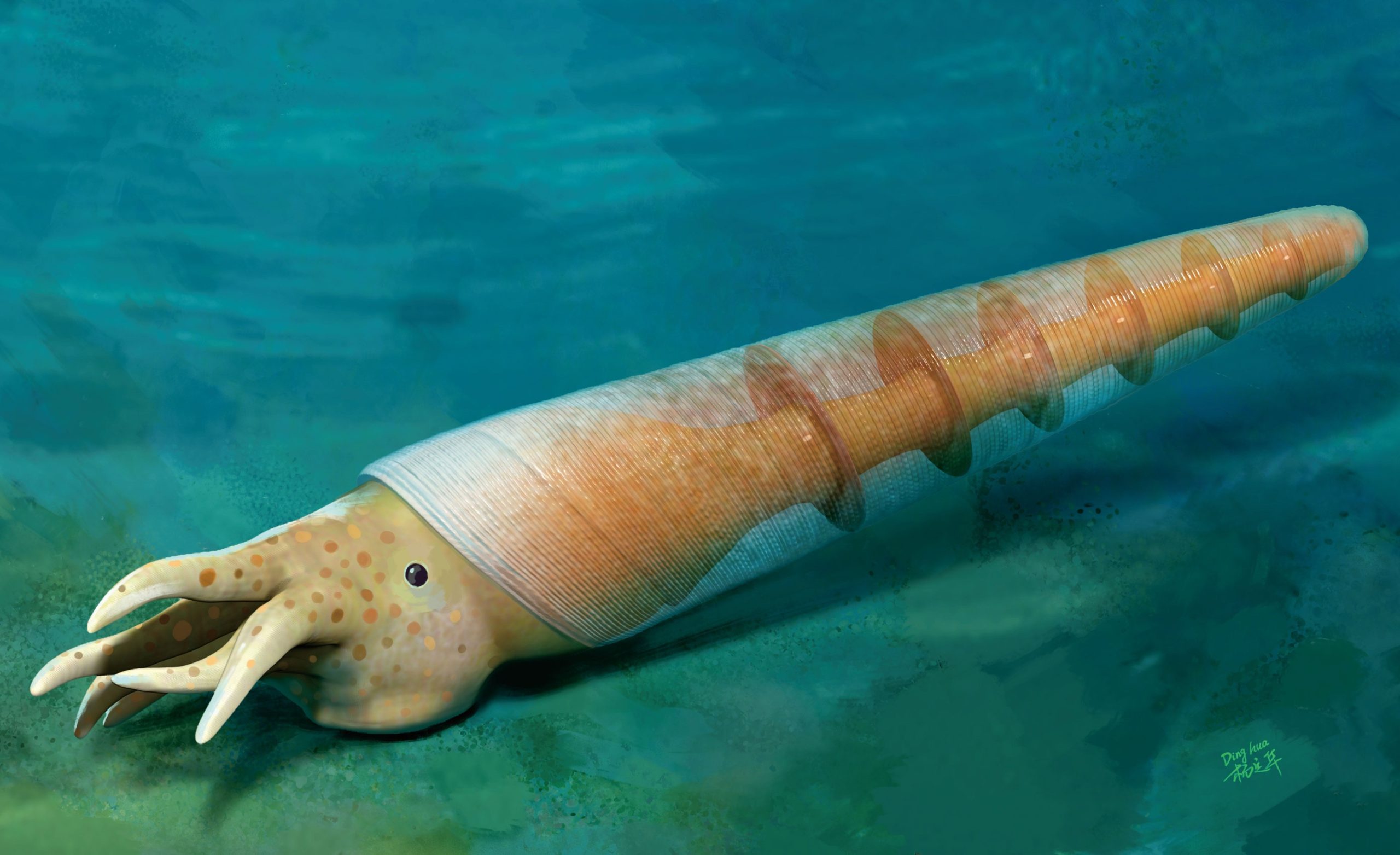
A 520-million-year-old fossil reveals an early stage in the evolution of cephalopod buoyancy.
A tiny tube running through a shell helped early cephalopods control whether they rose or sank in the ocean. Living and extinct members of this group, including octopuses, squids, ammonites, cuttlefish, and nautiluses, have all faced the same challenge of regulating buoyancy, with or without a hard external shell.
Ancient shelled cephalopods relied on structures including chambers, septa, septal necks, and the siphuncle to manage their position in the water. The siphuncle, a tube extending through the shell’s chambers, could regulate the balance of water and gas inside them. This system became one of the defining evolutionary features separating cephalopods from other mollusks, but gaps in the fossil record have obscured how it first developed.
A fossil pushes cephalopod origins earlier
An international group of researchers has now identified the oldest-known cephalopod equipped with a siphuncle. The fossil comes from early Cambrian rocks in South China and provides evidence about when the group emerged and how its distinctive anatomy began to evolve.
Bing Pan of the Nanjing Institute of Geology and Paleontology, Chinese Academy of Sciences, worked with researchers from China, the United Kingdom, and the United States under the leadership of Junfeng Guo of Chang’an University. They described a previously unknown species named Eoceras shaanxiense, recovered from the approximately 520-million-year-old Shuijingtuo Formation in South China.
The findings appeared in Nature on July 29.
Tiny fossils fill a major gap
Before this discovery, the earliest widely accepted cephalopod was Plectronoceras cambria, which lived during the late Cambrian. That fossil is approximately 30 million years younger than molecular clock estimates for the cephalopod lineage’s divergence during the Cambrian Explosion (early Cambrian).
Researchers have therefore searched for older evidence, particularly among the abundant microfossils called “small shelly fossils.” These fossils, which include diverse mollusks and related groups from multiple phyla, occur widely in early Cambrian rocks and offer a promising record of the first cephalopods.
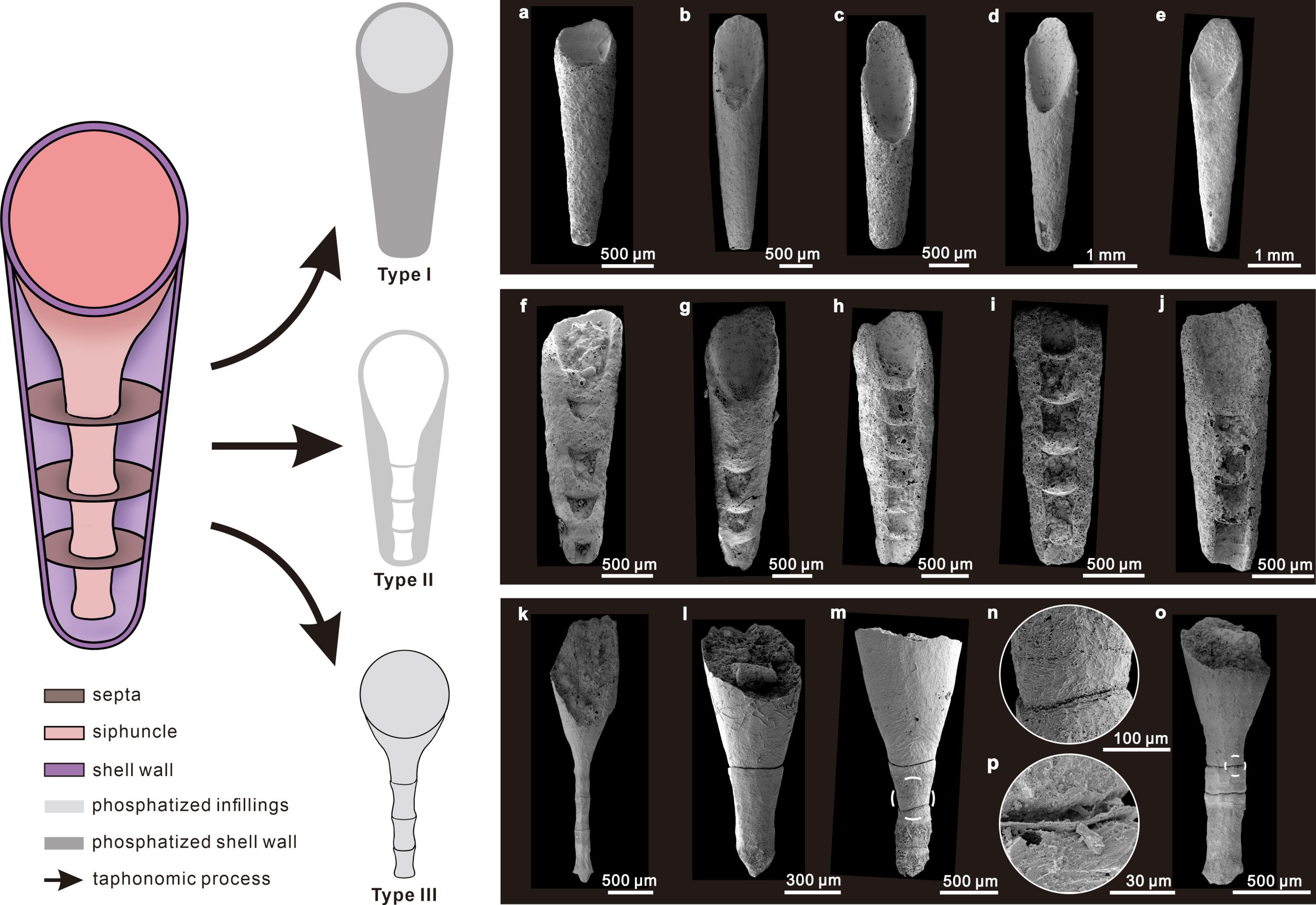
Focusing on small shelly fossils from the Shuijingtuo Formation, the researchers identified 32 specimens of E. shaanxiense. Their analysis indicated that the fossils belonged to an early cephalopod.
The specimens had been preserved through several forms of phosphatization, in which phosphate minerals retained fine anatomical details. Researchers examined them with scanning electron microscopy (SEM) and micro-computed tomography (micro-CT), allowing them to reconstruct the species’ external form and internal structures.
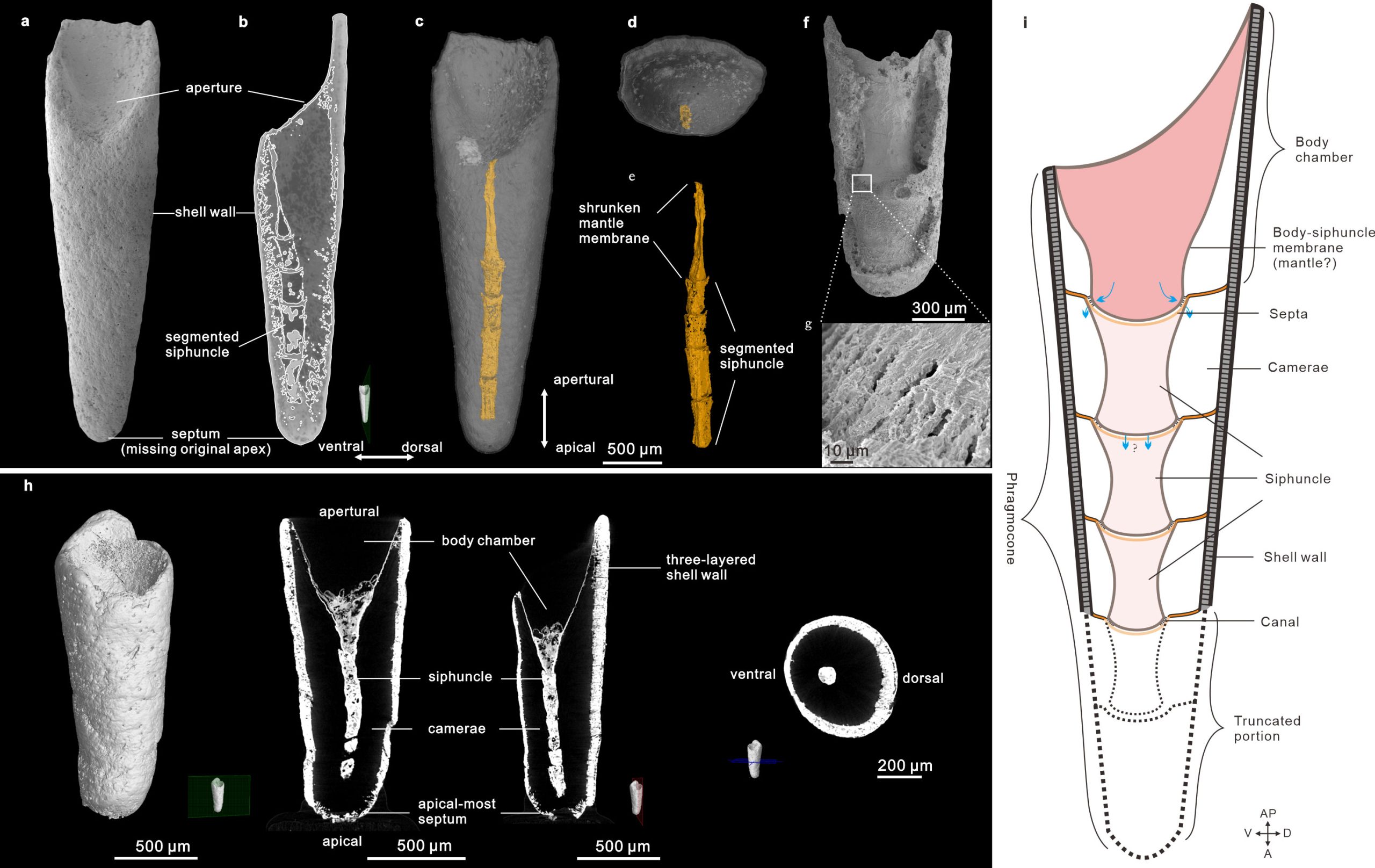
Eoceras measured only a few millimeters and carried an orthoconic, or straight cone-shaped, shell. It also had an angled opening, several internal septa, and a segmented tube positioned along the shell’s underside. Minute canals appeared to connect this tube across the septa.
Comparisons with typical cephalopods that possess siphuncles showed that the segmented tube in Eoceras was itself a siphuncle. This makes the fossils the earliest known cephalopods with that buoyancy structure. The researchers interpret Eoceras as an intermediate form between older animals with chambered shells and later cephalopods with more sophisticated buoyancy systems.
Buoyancy evolved in distinct stages
The anatomy allowed the researchers to propose a broad sequence for early cephalopod evolution. The lineage may have begun with animals that possessed straight shells divided by multiple septa. A sealed, segmented siphuncle then developed inside the shell. Later cephalopods evolved a more complete siphuncle containing septal necks and connecting rings.
Because its buoyancy system was still simple and primitive, Eoceras probably spent most of its life near the seafloor. However, the fossil does not preserve several features found in later cephalopods, and its soft-body anatomy remains unknown. More Cambrian fossils will be needed to clarify the earliest stages of cephalopod evolution and explain how their distinctive shell structures arose.
Reference: “Earliest siphuncle-bearing cephalopod from the early Cambrian” by Zuchen Song (宋祖晨), Bing Pan (潘兵), Junfeng Guo (郭俊锋), Jakob Vinther, Guoxiang Li (李国祥), Jian Han (韩健), Heyo Van Iten, Xiaofang Zhao (赵晓芳), Xianzhi Pei (裴先治), Jiaxin Peng (彭佳欣), Yaqin Qiang (强亚琴), Boyao Zhang (张博耀) and Hanjie Wen (温汉捷), 29 July 2026, Nature.
DOI: 10.1038/s41586-026-10868-y
This study was supported by the National Natural Science Foundation of China, the National Key Research and Development Program of China, and the Opening Foundation of the State Key Laboratory of Continental Evolution and Early Life.
Never miss a breakthrough: Join the SciTechDaily newsletter.
Follow us on Google and Google News.