

A Cambrian fossil once thought to be a mollusk ancestor is now identified as a chancelloriid relative, reshaping ideas about early animal evolution.
A strange and spiny fossil, once thought to be among the earliest mollusks, has just been reclassified. Researchers from Durham University and Yunnan University have now revealed that this ancient creature is actually a distant cousin of the sponge-like organisms known as chancelloriids.
This groundbreaking discovery is set to reshape how scientists understand the early evolution of animals.
Shishania aculeata reclassified as a chancelloriid relative
The fossil, named Shishania aculeata, comes from 500-million-year-old Cambrian deposits in Yunnan Province, southern China—an area renowned for its exceptionally well-preserved fossils.
Initially, Shishania was interpreted as a primitive mollusk, possibly an early ancestor of modern snails, slugs, and clams. It was thought to show mollusk-like features, including a muscular foot and mineralized defensive spines.
However, a new international study led by Durham University and published in Science tells a very different story.
New evidence reveals fossil misinterpretation
The researchers now report that Shishania does not align with mollusks at all. Instead, it bears a strong resemblance to a group of ancient, bag-like sea creatures called chancelloriids, which were anchored to the Cambrian sea floor and covered in defensive spines.
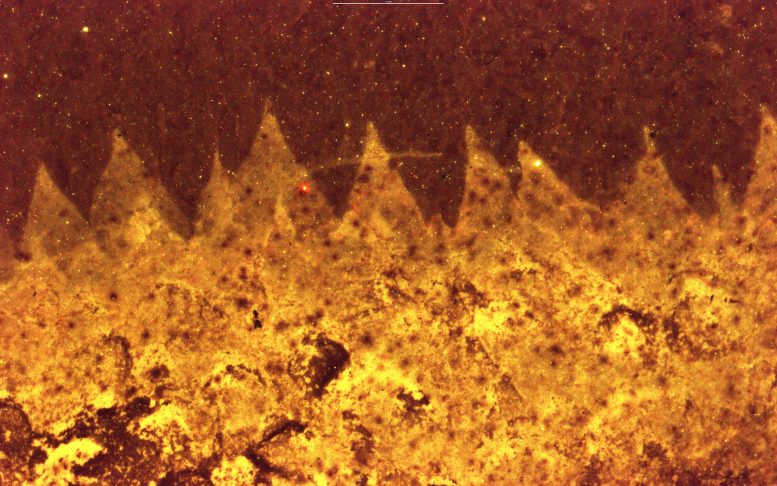
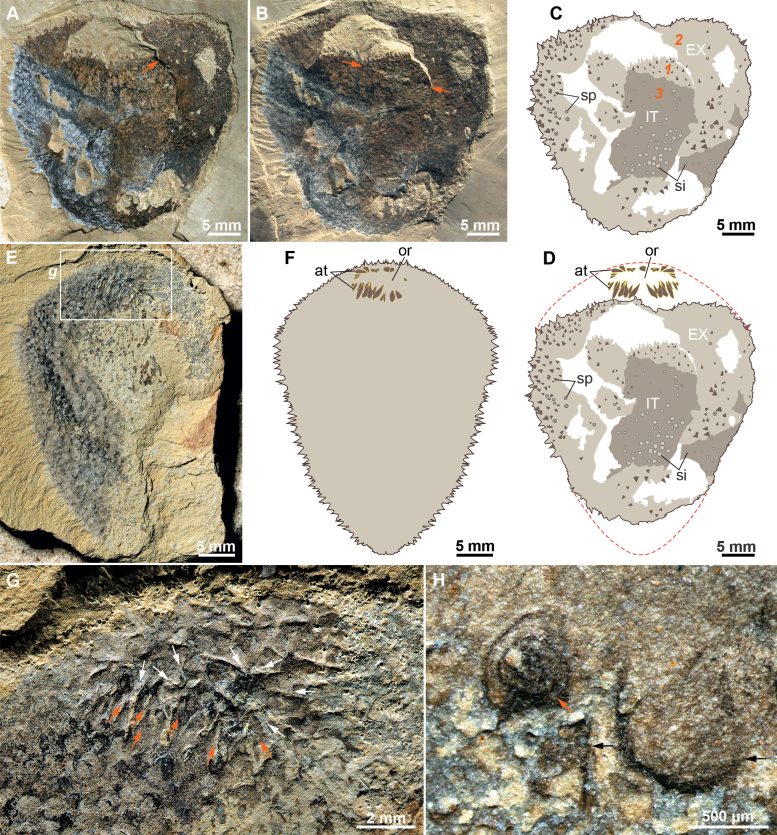
The researchers, using better-preserved specimens and advanced imaging techniques, discovered that many of the features previously thought to indicate molluskan affinity were in fact misleading artefacts of fossilization.
For example, structures taken to be a ‘foot’ were revealed to be the result of distortion during the fossil’s preservation, a process described as a ‘taphonomic illusion’.
Unexpected twist reshapes evolutionary assumptions
Study co-author, Dr Martin Smith of Durham University, said: “These ancient fossils turned out to be masters of disguise. Shishania seemed to show all the hallmarks we might expect of an early mollusk ancestor.
“But as it dawned on us that the mollusk-like outlines of the fossil material represented a work of fossil origami, we were led to re-examine each other part of the interpretation in turn.
“The mystery started to unfurl once we found chancelloriids preserved in a very similar way in the same rock unit.”
Chancelloriids reveal independent body plan evolution
The reclassification is particularly significant because chancelloriids are an enigmatic group known only from Cambrian rocks, disappearing around 490 million years ago.
Though superficially resembling sponges, their bodies are adorned with star-shaped spicules whose intricate microstructure hints at possible connections to more complex animals.
With its extremely simple spines, Shishania suggests that chancelloriids developed their ornate spicules from scratch, rather than adapting them from pre-existing skeletal structures.
That tells something profound about how complex body plans evolved during the Cambrian explosion – the evolutionary burst that gave rise to all modern animal groups.
New findings challenge long-standing mollusk theories
Dr Smith admitted the fossils initially seemed to confirm his own long-standing theories about early mollusk ancestors: “When Shishania was first described last year, I was thrilled – it seemed to match the early ‘slug-like’ animals I’d always imagined. But our Chinese colleagues’ new material forced me to re-evaluate everything.”
Further analysis revealed patterns once thought to reflect molluskan biology such as a ‘paintbrush-like’ arrangement in the spines were actually preservation artefacts, as the same patterning occurred randomly across the fossil.
Compression and deformation during fossilisation had also made the simple cylindrical animals appear more anatomically complex than they truly were.
This reinterpretation has implications not only for understanding chancelloriids, but also for identifying other ambiguous Cambrian fossils.
It reopens questions about early mollusk evolution and cautions against over-interpreting ambiguous fossil features.
At the same time, it helps solidify our picture of chancelloriid origins and gives us fresh insight into how evolutionary novelty emerged.
The study underscores the crucial role of China’s fossil-rich strata and exemplifies how international collaboration continues to transform our understanding of life’s earliest chapters.
Reference: “Shishania is a chancelloriid and not a Cambrian mollusk” by Jie Yang, Wei Li, Ai-lin Chen, Kun-sheng Du, Xiao Peng, Yu Wang, Xi-guang Zhang and Martin R. Smith, 8 May 2025, Science.
DOI: 10.1126/science.adv4635
Never miss a breakthrough: Join the SciTechDaily newsletter.
Follow us on Google and Google News.
2 Comments
Yet another discovery that ‘rewrites’ evolution blah blah – have the cliche-ridden SciTech headline-writers no shame? If science was all about cliche, it would not be science.
It was a small rewrite – a footnote – but it was a rewrite.