
Close Menu
    Facebook X (Twitter) Instagram
    SciTechDaily
    • Biology
    • Chemistry
    • Earth
    • Health
    • Physics
    • Science
    • Space
    • Technology
    Facebook X (Twitter) Pinterest YouTube RSS
    SciTechDaily
    Home»Technology»Duke University Creates “Perfect” Microwave Cloak
    Technology

    Duke University Creates “Perfect” Microwave Cloak

    By SciTechDailyNovember 14, 2012No Comments2 Mins Read
    Facebook Twitter Pinterest Telegram LinkedIn WhatsApp Email Reddit
    Share
    Facebook Twitter LinkedIn Pinterest Telegram Email Reddit
    duke-unversity-microwave-cloak
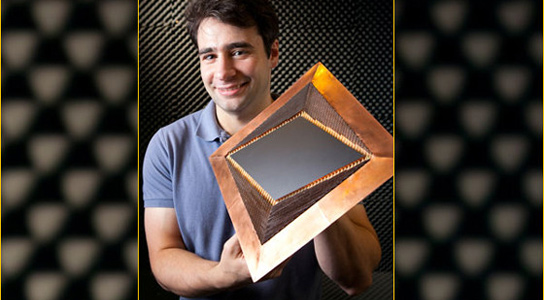
    Perfect invisibility cloak built by Duke University graduate engineering students. Credit: Duke University

    Scientists have been able to successfully cloak an object, rendering a centimeter-scale cylinder invisible to microwaves. Many different invisibility cloaks have been demonstrated, but all of those reflect some of the incidental light, making the illusion incomplete. This is the first to cloak an object perfectly.

    The scientists published their findings in the journal Nature Materials. This illusion does have drawbacks. It only works from one direction, and would be difficult to achieve with visible light. The initial invisibility cloaking papers from 2006 sparked a flurry of activity to move the work on to different wavelengths.
    microwave-cloak
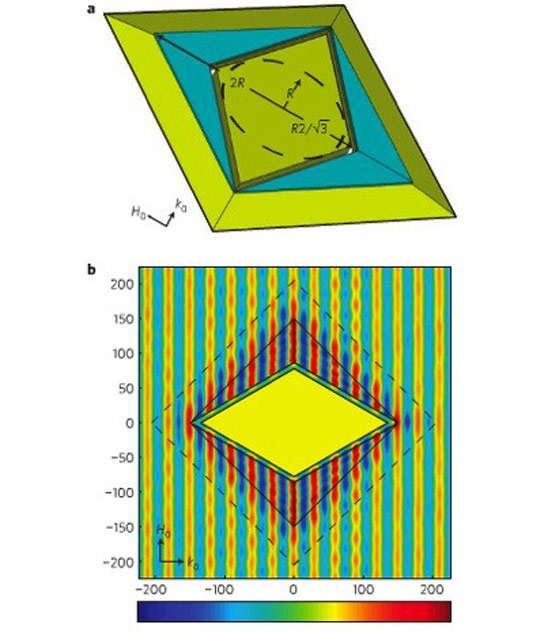
    Simulations of the fabricated cloak design. Credit: Figure by Nathan Landy & David R. Smith

    No effort has been able to achieve a perfect cloak, as was described by the original theory. The structures needed to pull that off are difficult to manufacture, and each attempt has resulted in an approximation to the theoretical idea that results in reflections.

    The scientists at Duke University took a different approach. They tried to rework the edge of a microwave cloak so that they line up, ensuring that the light passes around with no reflections.

    A diamond-shaped cloak, with properties carefully matched at its corners, was used to shuttle light perfectly around a cylinder 7.5 cm in diameter and 1 cm tall.

    While the illusion is perfect, it only works in one direction. It would also be difficult to replicate this at optical wavelengths. However, microwaves have many applications, primarily in telecommunications and radar, and improved versions of cloaking could vastly improve microwave performance.

    Reference: “A full-parameter unidirectional metamaterial cloak for microwaves” by Nathan Landy and David R. Smith, 11 November 2012, Nature Materials.
    DOI: 10.1038/nmat3476

    Never miss a breakthrough: Join the SciTechDaily newsletter.
    Follow us on Google and Google News.

    Duke University Materials Science Metamaterials Popular
    Share. Facebook Twitter Pinterest LinkedIn Email Reddit

    Related Articles

    Supernatural Strength: 3D Printed Titanium Structure Is 50% Stronger Than Aerospace Alloy

    Engineering the Impossible: How Metamaterials and AI Redefine Material Science

    Fourth Dimension Breakthrough: New Metamaterial Controls Energy Waves

    Ultra-High Energy Absorption Breakthrough: Chinese Researchers Unveil Game-Changing Nanolattice Metamaterials

    Surprising New Material Invented That Can Absorb and Release Massive Amounts of Energy

    MIT Engineers Create 3D-Printed Objects That Sense How a User Is Interacting With Them

    Transforming Circles Into Squares: Researchers Reconfigure Material Topology on the Microscale

    3D Kirigami Building Blocks Designed To Make Dynamic Metamaterial Structures

    Controlled Graphene Crumpling Used as Artificial Muscle Actuators

    Leave A Reply Cancel Reply

    • Facebook
    • Twitter
    • Pinterest
    • YouTube

    Don't Miss a Discovery

    Subscribe for the Latest in Science & Tech!

    Trending News

    Wasp Colonies Explode Into Violence After Losing Their Queen

    Scientists Create “Living Plastic” That Self-Destructs in Just Six Days

    Your Blood May Carry a 700-Million-Year-Old Secret

    Scientists Discover Some “Zombie Cells” May Actually Help You Live Longer

    Earth May Be Seeding Venus With Life, According to New Research

    What Scientists Found Inside a 117-Year-Old Woman Reveals New Clues to Long Life

    Scientists Discover Mysterious Creature Living in the Great Salt Lake – and It Exists Nowhere Else on Earth

    It’s Alive? Surprising Discovery Changes What We Know About Fog

    Follow SciTechDaily
    • Facebook
    • Twitter
    • YouTube
    • Pinterest
    • Newsletter
    • RSS
    SciTech News
    • Biology News
    • Chemistry News
    • Earth News
    • Health News
    • Physics News
    • Science News
    • Space News
    • Technology News
    Recent Posts
    • A Psychologist Explains Why 40% of People Are Avoiding the News
    • Scientists Discover Alzheimer’s-Linked Proteion’s Surprising Role in Making Memories Last
    • Vitamin D Drug Shows Surprising Promise Against One of the Deadliest Cancers
    • Scientists Crack Major Ammonia Problem With a Platinum Catalyst Breakthrough
    • MIT Engineers Solve a Major Lidar Problem That Has Stumped Researchers for Years
    Copyright © 1998 - 2026 SciTechDaily. All Rights Reserved.
    • Science News
    • About
    • Contact
    • Editorial Board
    • Privacy Policy
    • Terms of Use

    Type above and press Enter to search. Press Esc to cancel.