
Close Menu
    Facebook X (Twitter) Instagram
    SciTechDaily
    • Biology
    • Chemistry
    • Earth
    • Health
    • Physics
    • Science
    • Space
    • Technology
    Facebook X (Twitter) Pinterest YouTube RSS
    SciTechDaily
    Home»Space»Hubble Views Worm-Like Galaxy IRAS 23436+5257
    Space

    Hubble Views Worm-Like Galaxy IRAS 23436+5257

    By NASAMarch 25, 20131 Comment2 Mins Read
    Facebook Twitter Pinterest Telegram LinkedIn WhatsApp Email Reddit
    Share
    Facebook Twitter LinkedIn Pinterest Telegram Email Reddit
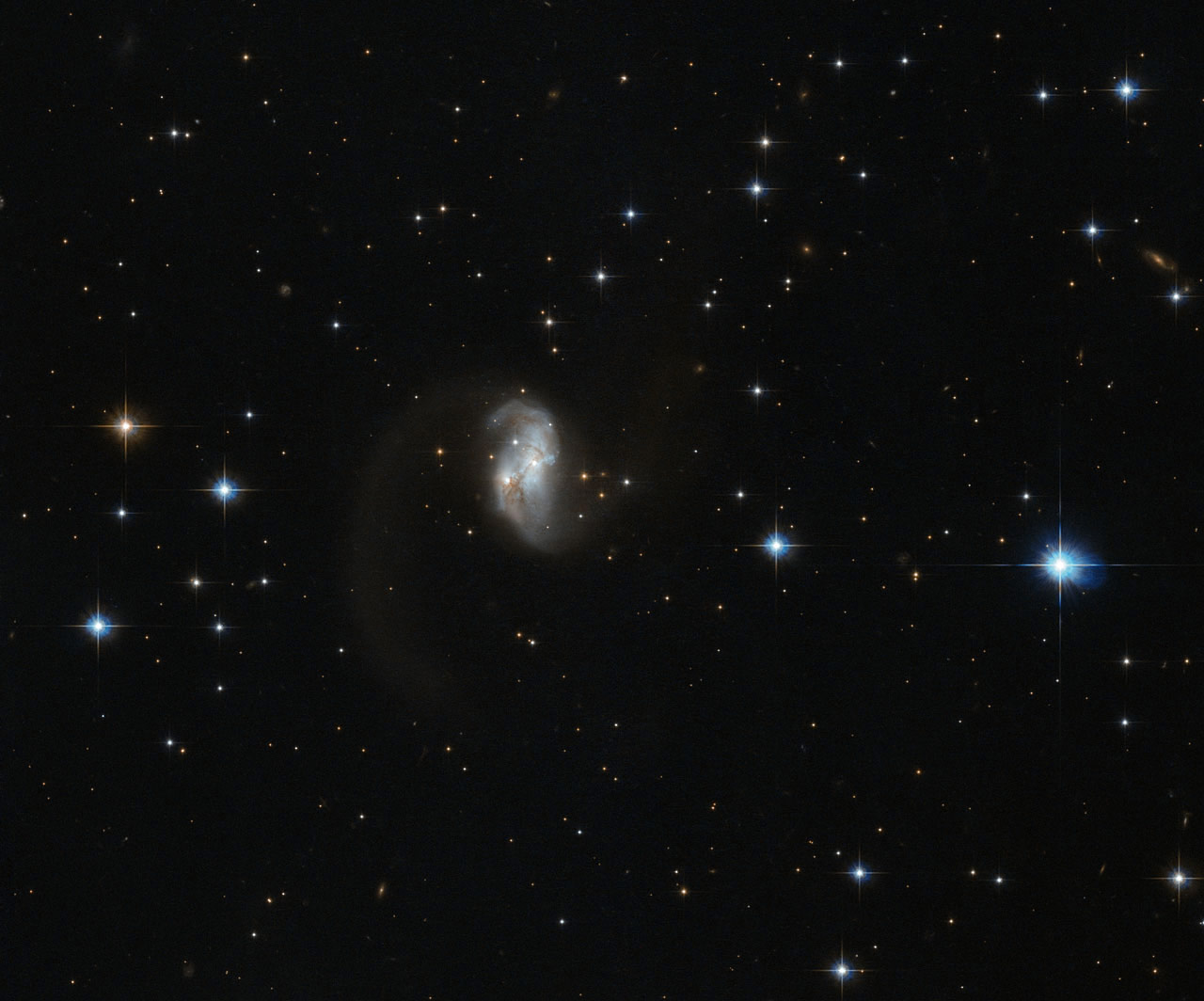
    Hubble Views Wormlike Galaxy
    Hubble Space Telescope view of worm-like galaxy IRAS 23436+5257. Credit: ESA/Hubble and NASA, Acknowledgment: Judy Schmidt

    In this new image captured by the NASA/ESA Hubble Space Telescope, you can see the worm-like galaxy known as IRAS 23436+5257. The shape is most likely the result of a collision and subsequent merger of two galaxies.

    This charming and bright galaxy, known as IRAS 23436+5257, was captured by the NASA/ESA Hubble Space Telescope. It is located in the northern constellation of Cassiopeia, which is named after an arrogant, vain, and yet beautiful mythical queen.

    The twisted, worm-like structure of this galaxy is most likely the result of a collision and subsequent merger of two galaxies. Such interactions are quite common in the universe, and they can range from minor interactions involving a satellite galaxy being caught by a spiral arm, to major galactic crashes. Friction between the gas and dust during a collision can have a major effect on the galaxies involved, morphing the shape of the original galaxies and creating interesting new structures.

    When you look up at the calm and quiet night sky it is not always easy to picture it as a dynamic and vibrant environment with entire galaxies in motion, spinning like children’s toys and crashing into whatever crosses their path. The motions are, of course, extremely slow, and occur over millions or even billions of years.

    The aftermath of these galactic collisions helps scientists to understand how these movements occur and what may be in store for our own Milky Way, which is on a collision course with a neighboring galaxy, Messier 31.

    Never miss a breakthrough: Join the SciTechDaily newsletter.
    Follow us on Google and Google News.

    Astronomy Hubble Space Telescope NASA
    Share. Facebook Twitter Pinterest LinkedIn Email Reddit

    Related Articles

    Hubble Reveals a Star Disk Three Times Hotter Than the Sun’s Surface

    A Star’s Unexpected Heatwave: FU Orionis Challenges Astrophysics Models

    NASA’s Hubble Reveals How the LMC Defied Galactic Destruction

    Legendary Star’s Smooth Disk Mystifies Astronomers, Challenges Planet Formation Theories

    Cosmic Horror Unveiled: NASA Reveals “Blood-Soaked Eyes” Staring From Deep Space [Video]

    Spanning 248 Billion Miles: Stunning Hubble Timelapse Captures a Star’s Violent Eruptions

    Jupiter’s Great Red Spot Enigma: Unexplained Oscillations Baffle Astronomers

    Unlocking Uranus: NASA’s Dual Observations Pave the Way to Discovering New Worlds

    Astronomers Baffled by Black Hole Jets Igniting Star Explosions

    1 Comment

    1. Peter Jackson on March 26, 2013 1:27 pm

      Nice shot. Almost certainly not a collision but the remnants of a quasar with it’s helical jets of re-ionized matter visible each side of the central toroidal AGN. The AGN is the last remains of the old accretion disc. the ‘ring’ is just visible around the central jet axis.

      The flared outflow ‘tails’ are due partly to the precession of the two jets at the (‘SMBH’) centre of mass and partly as the intrinsic rotation of the whole central ‘bar’ (in it’s youth) seems to have commenced.

      Looking very carefully outside the galaxy the gas / plasma halo matter can also be seen describing a very feint arc. this one is a little different to most, but then they all are. Centaurus A is approaching this stage in a while (in cosmic terms). The Hawk galaxy is a bit more advanced.
      (ask for link to a fuller cycle description).

      Reply
    Leave A Reply Cancel Reply

    • Facebook
    • Twitter
    • Pinterest
    • YouTube

    Don't Miss a Discovery

    Subscribe for the Latest in Science & Tech!

    Trending News

    Why Popular Diabetes Drugs Like Ozempic Don’t Work for Everyone: The “Genetic Glitch”

    Scientists Stunned After Finding Plant Thought Extinct for 60 Years

    Scientists Discover Tiny New Spider That Hunts Prey 6x Its Size

    Natural Component From Licorice Shows Promise for Treating Inflammatory Bowel Disease

    Scientists Warn: Popular Sweetener Linked to Dangerous Metabolic Effects

    Monster Storms on Jupiter Unleash Lightning Beyond Anything on Earth

    Scientists Create “Liquid Gears” That Spin Without Touching

    The Simple Habit That Could Help Prevent Cancer

    Follow SciTechDaily
    • Facebook
    • Twitter
    • YouTube
    • Pinterest
    • Newsletter
    • RSS
    SciTech News
    • Biology News
    • Chemistry News
    • Earth News
    • Health News
    • Physics News
    • Science News
    • Space News
    • Technology News
    Recent Posts
    • The Atomic Gap That Could Cost the Semiconductor Industry Billions
    • Earth’s Secret Advantage: Why Most Alien Worlds May Be Too Dry for Life
    • Ancient Bacteria Turned a DNA System Into a Cell Skeleton
    • Researchers Finally Solve 50-Year-Old Blood Group Mystery
    • Scientists Discover “Molecular Switch” That Fuels Alzheimer’s Brain Inflammation
    Copyright © 1998 - 2026 SciTechDaily. All Rights Reserved.
    • Science News
    • About
    • Contact
    • Editorial Board
    • Privacy Policy
    • Terms of Use

    Type above and press Enter to search. Press Esc to cancel.