
Close Menu
    Facebook X (Twitter) Instagram
    SciTechDaily
    • Biology
    • Chemistry
    • Earth
    • Health
    • Physics
    • Science
    • Space
    • Technology
    Facebook X (Twitter) Pinterest YouTube RSS
    SciTechDaily
    Home»Earth»Deforestation Adds More Atmospheric CO2 Than the Sum Total of Cars & Trucks on the World’s Roads
    Earth

    Deforestation Adds More Atmospheric CO2 Than the Sum Total of Cars & Trucks on the World’s Roads

    By SciTechDailyNovember 14, 20122 Comments2 Mins Read
    Facebook Twitter Pinterest Telegram LinkedIn WhatsApp Email Reddit
    Share
    Facebook Twitter LinkedIn Pinterest Telegram Email Reddit
    deforestation-argentina-independent
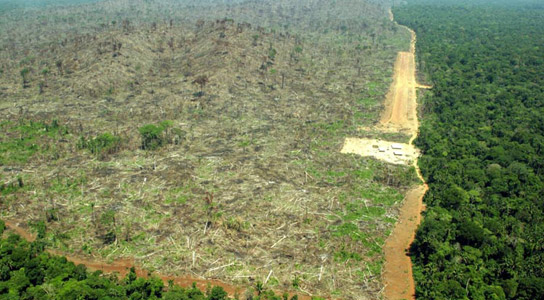
    Illegal land clearance to make way for soy production in Para, Brazil. Credit: Photo by Alberto César courtesy of Greenpeace

    Deforestation in tropical rainforests adds more carbon dioxide to the Earth’s atmosphere than the sum total of cars and trucks on the world’s roads. Cars and trucks account for 14% of global carbon emissions, while most analysts attribute 15% to deforestation.

    One of the reasons why logging is bad for the climate is that when the trees are felled, they release the carbon that they are storing into the atmosphere, where it will mingle with greenhouse gases from other sources. This effect contributes to global warming and preventing deforestation would help decrease emissions as much as increasing fuel efficiency and reducing automobile usage does.

    32 million acres of tropical rainforest were cut down each year between 2000 and 2009, and the pace of deforestation continues to accelerate. Forest clearing will put another 200 billion tons of carbon into the atmosphere in the coming decades, according to the Environmental Defense Fund, a leading green group.

    “Any realistic plan to reduce global warming pollution sufficiently—and in time—to avoid dangerous consequences must rely in part on preserving tropical forests,” states the Environmental Defense Fund. “Conservation costs money, while profits from timber, charcoal, pasture, and cropland drive people to cut down forests,” adds EDF. This also wipes out biodiversity since more than half of the world’s plant and animal species live in tropical rainforests.

    Brazil is among the countries embracing the United Nations’ Reducing Emissions from Deforestation and Forest Degradation (REDD) program and has slowed its deforestation by 40% since 2008 and is on track to achieve an 80% reduction by 2020.

    Never miss a breakthrough: Join the SciTechDaily newsletter.
    Follow us on Google and Google News.

    Conservation Deforestation Ecology Environment Global Warming Rainforest
    Share. Facebook Twitter Pinterest LinkedIn Email Reddit

    Related Articles

    Illegal Gold Mining in Peruvian Amazon Turns Pristine Rainforests Into Heavily Polluted Mercury Sinks

    Timing Is Everything: Stanford Research Reveals Why the Right Sequence of Policies Is Critical To Slow Deforestation

    Big Differences Exposed Among Amazonian Countries in Their Rates of Forest Recovery As Well as Deforestation

    Formal “Protected Area” Designation Reduces the Rate of Deforestation but Does Not Prevent It

    Nature Documentaries Don’t Show Threats to Nature, but Increasingly Talk About Them

    Data Shows 2010 Amazon Megadrought Caused Serious Devastation

    Carbon Absorption by Plants Limited by the Abundance of Soil Nutrients

    Survey of Brazil’s Atlantic Forests Reveals Loss of Key Species

    Reliance on Satellite Data Blamed for Overestimation of India’s Forest Cover

    2 Comments

    1. FJHeller on December 2, 2014 3:53 pm

      By using the iFORE software we can scientifically measure the impact of deforestation on CO2 and other air quality indicators. Developed by the U.S. Forest service; I have used it to measure the impact of clear cutting wind farm sites for turbine pads, access roads, and transmission corridors and was shocked to learn that the negative impact was not deducted from their carbon subsidies.

      In fact, under Maine’s Wind Siting act this environmental impact is omitted and not required for a permit…..AMAZING!

      Reply
      • Bengt Andersson on January 27, 2016 3:33 am

        In Sweden I see that if we stop cutting trees, 100 Mio m2; the CO2 pollution will be reduced by the similar quantity each year.

        At the same time the stock of biomass will increase from 3000 Mio m2 to 4500 Mio m2 in about 50 years.
        This is about what Sweden has to do to reduce for the 1,5 degrC level.

        Most enviromental people claim “cut more”

        Reply
    Leave A Reply Cancel Reply

    • Facebook
    • Twitter
    • Pinterest
    • YouTube

    Don't Miss a Discovery

    Subscribe for the Latest in Science & Tech!

    Trending News

    The Universe Is Expanding Too Fast and Scientists Can’t Explain Why

    “Like Liquid Metal”: Scientists Create Strange Shape-Shifting Material

    Early Warning Signals of Esophageal Cancer May Be Hiding in Plain Sight

    Common Blood Pressure Drug Shows Surprising Power Against Deadly Antibiotic-Resistant Superbug

    Scientists Uncover Dangerous Connection Between Serotonin and Heart Valve Disease

    Scientists Discover a “Protector” Protein That Could Help Reverse Hair Loss

    Bone-Strengthening Discovery Could Reverse Osteoporosis

    Scientists Uncover Hidden Trigger Behind Stem Cell Aging

    Follow SciTechDaily
    • Facebook
    • Twitter
    • YouTube
    • Pinterest
    • Newsletter
    • RSS
    SciTech News
    • Biology News
    • Chemistry News
    • Earth News
    • Health News
    • Physics News
    • Science News
    • Space News
    • Technology News
    Recent Posts
    • The Simple Habit That Could Help Prevent Cancer
    • Forgotten Medicinal Plant Shows Promise in Fighting Dangerous Superbugs
    • Millions Take These IBS Drugs, But a New Study Finds Serious Risks
    • 5 Common Myths About Learning a New Language, Debunked
    • The Neanderthal “Love Story” Isn’t What It Seems
    Copyright © 1998 - 2026 SciTechDaily. All Rights Reserved.
    • Science News
    • About
    • Contact
    • Editorial Board
    • Privacy Policy
    • Terms of Use

    Type above and press Enter to search. Press Esc to cancel.