
Richard Binzel describes how asteroid dirt and dust delivered by OSIRIS-Rex, with help from MIT, may reveal clues to the solar system’s origins.
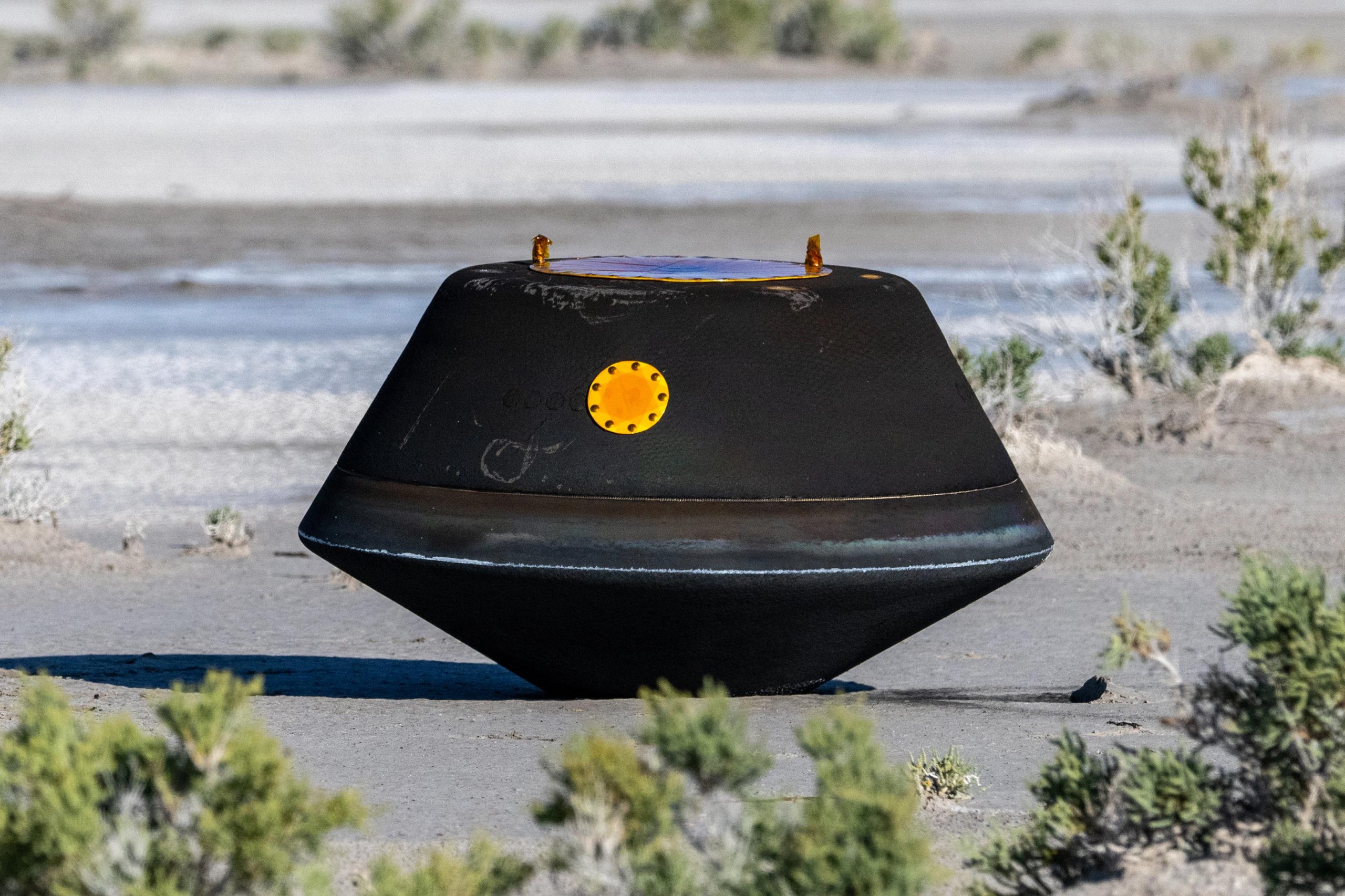
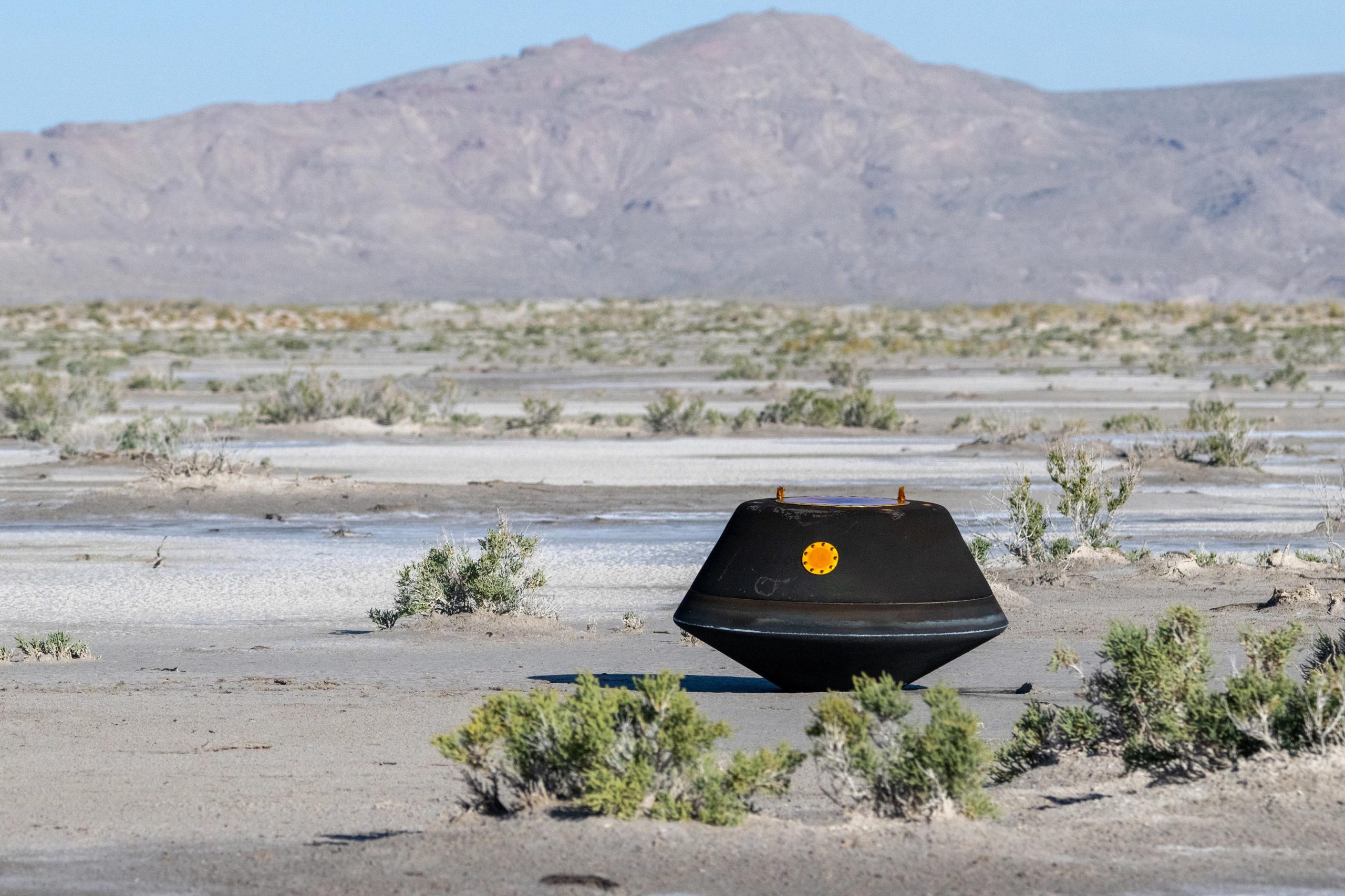
On the morning of September 24, a capsule the size of a mini-fridge dropped from the skies over western Utah, carrying a first-of-its-kind package: about 250 grams of dirt and dust plucked from the surface of an asteroid. As a candy-striped parachute billowed open to slow its freefall, the capsule plummeted down to the sand, slightly ahead of schedule.
The special delivery came courtesy of OSIRIS-REx, the first NASA mission to travel to an asteroid and return a sample of its contents to Earth. Launched in 2016, the mission’s target was Bennu, a “near-Earth” asteroid that is thought to have formed during the solar system’s first 10 million years. The asteroid is made mostly of carbon and minerals, and has not been altered much since it formed. Samples from its surface could therefore offer valuable clues about the kinds of minerals and materials that first came together to shape the early solar system.
OSIRIS-REx journeyed for over two years to reach Bennu, where it then spent another two years circling and measuring its surface, looking for a spot to pick a sample. Among the suite of instruments aboard the spacecraft was an MIT-student-designed experiment, REXIS (the Regolith X-ray Imaging Spectrometer). The shoebox-sized instrument was the work of more than 100 MIT students, who designed the instrument to map the asteroid’s surface material in X-rays, to help determine where the spacecraft should take a sample. REXIS is a joint project between the MIT Department of Earth, Atmospheric and Planetary Sciences (EAPS), MIT Department of Aeronautics and Astronautics (AeroAstro), the Harvard College Observatory, the MIT Kavli Institute for Astrophysics and Space Research, and MIT Lincoln Laboratory.
On September 24, OSIRIS-REx released the capsule to fall through the Earth’s atmosphere, as the spacecraft itself set off on a new course to the asteroid Apophis. The capsule has been transported to Houston’s Johnson Space Center, where Bennu’s dust will be examined and distributed to researchers around the world for further study. The sample’s successful return is a huge milestone for the mission’s members, including MIT’s Richard Binzel, a leading expert in the study of asteroids, and a professor post-tenure in EAPS and AeroAstro. As an OSIRIS-REx co-investigator, Binzel helped lead the development of REXIS and its integration with the spacecraft. MIT News checked in with Binzel for his first reactions following the capsule’s landing and recovery, and what he hopes we might learn from the asteroid’s dust.
Q: First off: What a landing! As someone who’s studied asteroids in depth, and from afar, what was it like for you to see a sample of this asteroid, returned to Earth?
A: I was holding my breath just like everyone else! The parachute opening was a huge exhale, and the soft landing was a release of joy on behalf of the entire team. You work with these people for so long, you become like family, so you feel everything together. Kind of like watching your kid finishing off their balance beam routine and sticking the landing. While I wasn’t at the landing site, many of us were “together” online watching the timeline and all the procedures. What a journey it has been, more than two decades in the making, starting with our telescopic identification of Bennu as a scientifically rich and easily accessible sampling target, and then with the many evolving designs of the mission. MIT student involvement with the REXIS instrument began in 2010. It took six years to reach the launch pad and now, finally, we are seeing the mission literally come full circle in returning the sample to the Earth.
Q: The instruments aboard OSIRIS-REx made measurements of the asteroid while in orbit. What did those measurements in space reveal about the asteroid? And what more do you hope scientists can uncover, now that a sample is back on Earth?
A: Spacecraft instruments, no matter how technologically advanced, cannot accomplish nearly as much as the power of laboratories on Earth. Our instruments aboard OSIRIS-REx told us that Bennu is carbon-rich, likely containing some of the earliest chemical records of the ingredients that made the Earth and even life itself. But how do we know that the spacecraft instruments making measurements while flying above the surface are fully correct in what they reveal and how we interpret the data? We can only be sure by securing the “ground truth” provided through actual samples being brought into Earth’s laboratories. The laboratory analysis of these samples, confirming our preliminary findings, will verify our ability to interpret data about asteroids from both telescopes and orbiting spacecraft. Then the laboratory analysis will take us to even greater depths about the chemistry, conditions, and processes for how our own planetary system came to be.
Q: Let’s give a shoutout to all the students who helped to put an instrument aboard the mission. Going forward, how might this asteroid sample — and the spacecraft’s continued trajectory — relate to the work at MIT?
A: It’s a reminder that the sky is no limit for what we do at MIT. MIT’s REXIS instrument represents MIT’s motto, “mens et manus” [“mind and hand”], extended hundreds of millions of miles out in space, with actual hardware the students both designed and built, that was flown farther into space than any other MIT student project has gone before. I feel it is simply a privilege to have engaged so many students in learning and experiencing the depth of hard work, teamwork, and dedication that it takes to be successful in space exploration.
Never miss a breakthrough: Join the SciTechDaily newsletter.
Follow us on Google and Google News.