
Close Menu
    Facebook X (Twitter) Instagram
    SciTechDaily
    • Biology
    • Chemistry
    • Earth
    • Health
    • Physics
    • Science
    • Space
    • Technology
    Facebook X (Twitter) Pinterest YouTube RSS
    SciTechDaily
    Home»Technology»NASA’s 3D Printing of Rocket Engine Parts Might Boost Larger Manufacturing Trend
    Technology

    NASA’s 3D Printing of Rocket Engine Parts Might Boost Larger Manufacturing Trend

    By SciTechDailyNovember 14, 2012No Comments3 Mins Read
    Facebook Twitter Pinterest Telegram LinkedIn WhatsApp Email Reddit
    Share
    Facebook Twitter LinkedIn Pinterest Telegram Email Reddit
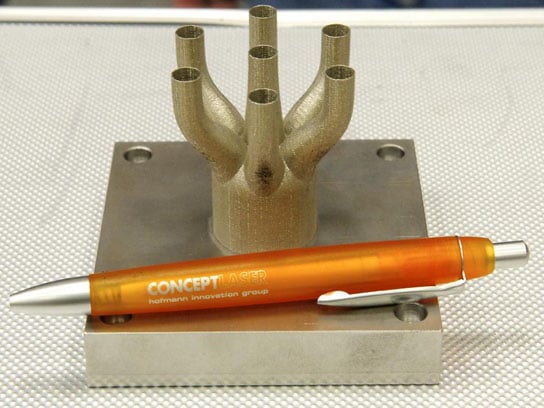
    first test piece produced on the M2 Cusing Machine
    The first test piece produced on the M2 Cusing Machine — a new Selective Laser Machine recently installed in Building 4707 at the Marshall Center to be used to build parts for the Space Launch System. (Pen is included for scale.) Credit: NASA/MSFC/Andy Hardin

    NASA’s Space Launch System (SLS) is its first heavy-lift booster rocket since Saturn 5 took US astronauts to the moon. SLS will play a central role in the future of American spaceflight, but might also provide a critical test for technology expected to revamp the country’s ailing manufacturing industry.

    Selective Laser Melting (SLM) is being used at NASA’s Marshall Space Flight Center in Huntsville, Alabama, to create parts for the J-2X and RS-25 rocket engines that will power the SLS, whose maiden voyage is slated for 2017. NASA expects SLM to simplify the process of making certain parts and in some cases, it will halve the cost of production, provided that the components can withstand the rigors of lifting the largest launch vehicle ever built into space.

    The first version of the SLS is a 70-ton rocket that will lift around 70,000 kg (154,000 lb) while providing 10% more thrust than the Saturn 5. The SLS will power the 2017 Exploration Mission 1, which will launch an unmanned Orion spacecraft on a circumlunar voyage as a precursor to Exploration Mission 2, which is scheduled for 2021. This mission will use a 130-ton SLS to launch Orion and a crew of up to 4 astronauts. This rocket will provide 20% more thrust than Saturn 5 and will lift 130,000 kg (287,000 lb).


    A state-of-the-art machine was recently delivered to NASA’s Marshall Space Flight Center in Huntsville, Alabama, to create intricate metal parts for America’s next heavy-lift rocket. Credit: NASA/MSFC

    It’s hoped that SLM will reduce the cost of the program. SLM is a type of additive manufacturing technology, it uses a finely powdered alloy is deposited in a layer as thin as 20 microns and then fused together by a focused laser beam inside a chamber containing inert gas. Once the laser has turned a layer into solid metal, another layer of powder is deposited and the process is repeated.

    NASA is currently testing the viability of making engine parts from nickel-based alloys using SLM. The same alloys are used to make 90% of the parts in the RS-25 and the J-2X engines. But a key difference is that the engines’ elements are forged and milled into their final shapes and often several pieces have to be welded together to create a part.

    In 2010, Marshall engineers began alternative approaches to building parts for the next-generation J-2X engine. SLM was used to great a duct for a gas generator in the engine. The part itself isn’t complex, but because of the thickness and the radius of the bend, it’s a very difficult part to make.

    Although the SLM part wasn’t as strong as the forged and milled duct, it fell within the minimum acceptable range. However, this part required no welding, meaning that it could have more structural strength.

    More testing is needed whether these components will function in the most intense conditions and if they can be properly made using SLM. Parts with complex geometries that are difficult to make and require multiple welds are good candidates.

    Never miss a breakthrough: Join the SciTechDaily newsletter.
    Follow us on Google and Google News.

    3d 3D Printing Lasers NASA
    Share. Facebook Twitter Pinterest LinkedIn Email Reddit

    Related Articles

    Relativity Space 3D Printed Rocket Launched Using Innovative NASA Alloy

    NASA’s Super Alloy: A Breakthrough in 3D Printing Technology

    Bessel Beams: Laser Beam Shaping To Improve Metal 3D Printing

    NASA Laser Communications: Empowering More Data Than Ever Before

    Future NASA Rocket Engines May Include Large-Scale 3D Printing

    Human Bone Structure Key to Stronger 3D-Printed Lightweight Materials [Video]

    High Resolution 3D Printer Prints 5 Meters per Second

    Drexel University Researchers to 3D-Print Dinosaur Bones

    3-D Printer Makes Custom Human Bones

    Leave A Reply Cancel Reply

    • Facebook
    • Twitter
    • Pinterest
    • YouTube

    Don't Miss a Discovery

    Subscribe for the Latest in Science & Tech!

    Trending News

    New Pill Lowers Stubborn Blood Pressure and Protects the Kidneys

    Humans May Have Hidden Regenerative Powers, New Study Suggests

    Scientists Just Solved the Mystery of Why Crabs Walk Sideways

    Doctors Are Surprised by What This Vaccine Is Doing to the Heart

    This Popular Supplement May Boost Your Brain, Not Just Your Muscles

    Scientists Say This Simple Supplement May Actually Reverse Heart Disease

    Warming Oceans Could Trigger a Dangerous Methane Surge

    This Simple Movement Could Be Secretly Cleaning Your Brain

    Follow SciTechDaily
    • Facebook
    • Twitter
    • YouTube
    • Pinterest
    • Newsletter
    • RSS
    SciTech News
    • Biology News
    • Chemistry News
    • Earth News
    • Health News
    • Physics News
    • Science News
    • Space News
    • Technology News
    Recent Posts
    • Hidden Heart Risk Found in 1 in 5 People, Study Warns
    • Scientists Say This Daily Walking Habit May Be the Secret to Keeping Weight Off After Dieting
    • New Therapy Rewires the Brain To Restore Joy in Depression Patients
    • Researchers Discover Efficient New Way To Split Hydrogen From Water for Energy
    • This Korean Skincare Ingredient Could Help Fight Deadly Superbugs
    Copyright © 1998 - 2026 SciTechDaily. All Rights Reserved.
    • Science News
    • About
    • Contact
    • Editorial Board
    • Privacy Policy
    • Terms of Use

    Type above and press Enter to search. Press Esc to cancel.