
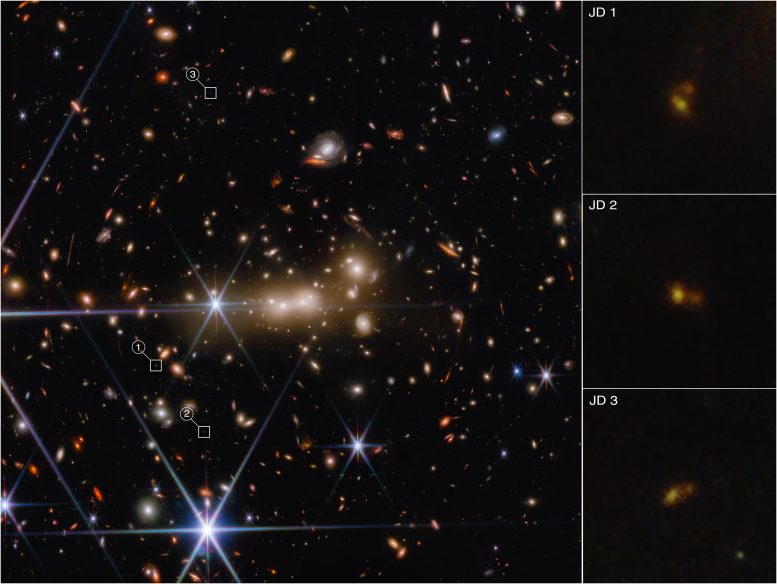
NASA’s James Webb Space Telescope was specially designed to detect the faint infrared light from very distant galaxies and give astronomers a glimpse at the early universe. The nature of galaxies during this early period of our universe is not well known nor understood. However, with the help of gravitational lensing by a cluster of galaxies in the foreground, faint background galaxies can be magnified and also appear multiple times in different parts of an image.
Today, we sit down with three astronomers working on Webb to talk about their latest findings. The team members are Dan Coe of Association of Universities for Research in Astronomy (AURA)/Space Telescope Science Institute (STScI) for the European Space Agency (ESA) and the Johns Hopkins University; Tiger Hsiao of the Johns Hopkins University; and Rebecca Larson of the University of Texas at Austin. These scientists have been observing the distant galaxy MACS0647-JD with Webb, and they’ve found something interesting.
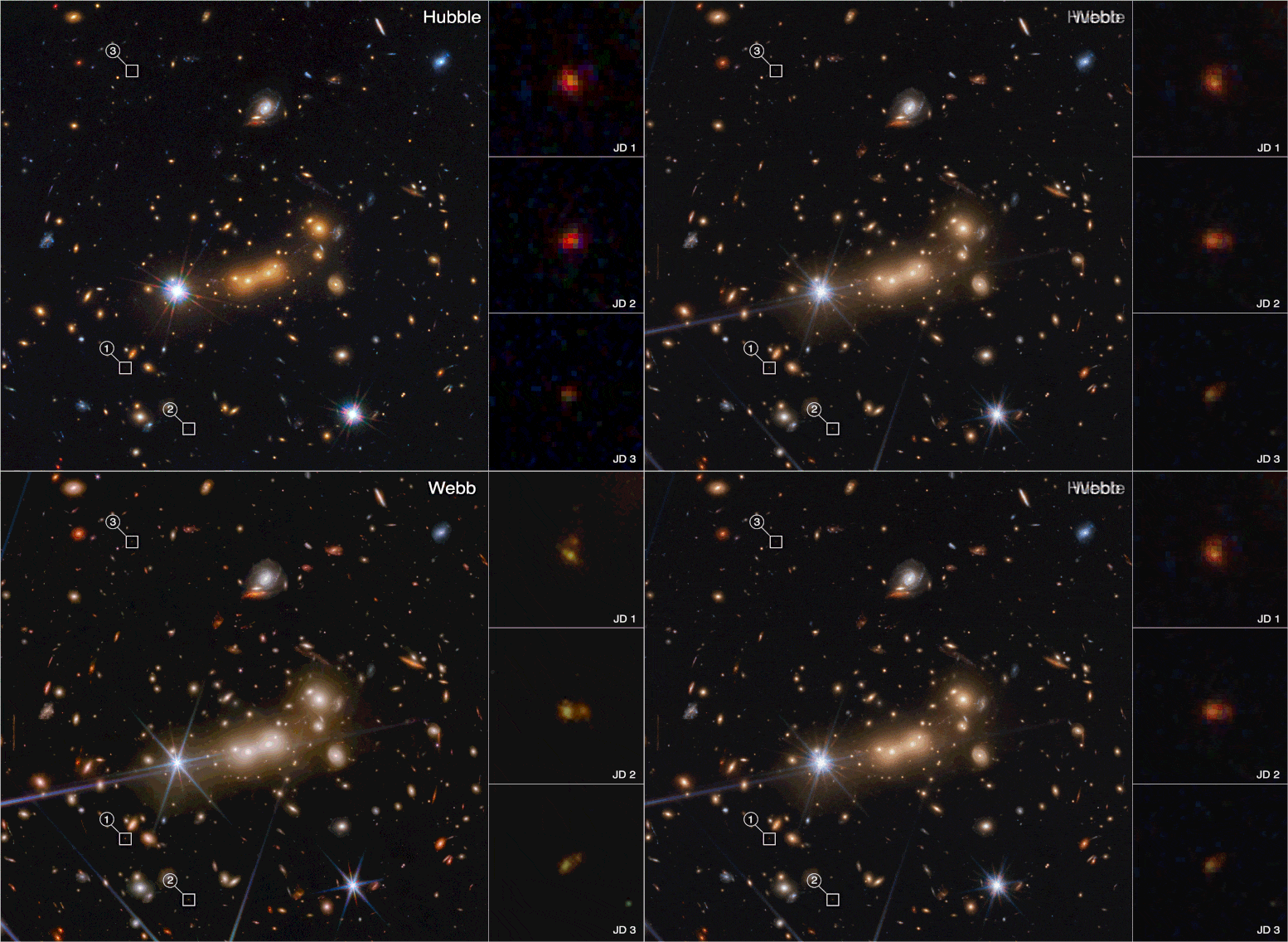
Dan Coe: I discovered this galaxy MACS0647-JD 10 years ago with the Hubble Space Telescope. At the time, I’d never worked on high redshift galaxies, and then I found this one that was potentially the most distant at redshift 11, about 97 percent of the way back to the big bang. With Hubble, it was just this pale, red dot. We could tell it was really small, just a tiny galaxy in the first 400 million years of the universe. Now we look with Webb, and we’re able to resolve TWO objects! We’re actively discussing whether these are two galaxies or two clumps of stars within a galaxy. We don’t know, but these are the questions that Webb is designed to help us answer.
Tiger Yu-Yang Hsiao: You can also see that the colors between the two objects are so different. One’s bluer; the other one is redder. The blue gas and the red gas have different characteristics. The blue one actually has very young star formation and almost no dust, but the small, red object has more dust inside, and is older. And their stellar masses are also probably different.
It’s really interesting that we see two structures in such a small system. We might be witnessing a galaxy merger in the very early universe. If this is the most distant merger, I will be really ecstatic!
Dan Coe: Due to the gravitational lensing of the massive galaxy cluster MACS0647, it’s lensed into three images: JD1, JD2, and JD3. They’re magnified by factors of eight, five, and two, respectively.
Rebecca Larson: Up to this point, we haven’t really been able to study galaxies in the early universe in great detail. We had only tens of them prior to Webb. Studying them can help us understand how they evolved into the ones like the galaxy we live in today. And also, how the universe evolved throughout time.
I think my favorite part is, for so many new Webb image we get, if you look in the background, there are all these little dots—and those are all galaxies! Every single one of them. It’s amazing the amount of information that we’re getting that we just weren’t able to see before. And this is not a deep field. This is not a long exposure. We haven’t even really tried to use this telescope to look at one spot for a long time. This is just the beginning!
About the authors:
Dan Coe is an astronomer of AURA/STScI for the European Space Agency and the Johns Hopkins University. Tiger Hsiao is a Ph.D. graduate student at the Johns Hopkins University. Rebecca Larson is a National Science Foundation fellow and Ph.D. graduate student at the University of Texas at Austin. These NIRCam observations of MAC0647-JD are part of the team’s Cycle 1 program GO 1433 (PI Coe). The team is planning more a detailed study of the physical properties of MACS0647-JD with Webb spectroscopy in January 2023.
Reference: “JWST reveals a possible z∼11 galaxy merger in triply-lensed MACS0647−JD” by Tiger Yu-Yang Hsiao, Dan Coe, Abdurro’uf, Lily Whitler, Intae Jung, Gourav Khullar, Ashish Kumar Meena, Pratika Dayal, Kirk S. S. Barrow, Lillian Santos-Olmsted, Adam Casselman, Eros Vanzella, Mario Nonino, Yolanda Jimenez-Teja, Masamune Oguri, Daniel P. Stark, Lukas J. Furtak, Adi Zitrin, Angela Adamo, Gabriel Brammer, Larry Bradley, Jose M. Diego, Erik Zackrisson, Steven L. Finkelstein, Rogier A. Windhorst, Rachana Bhatawdekar, Taylor A. Hutchison, Tom Broadhurst, Paola Dimauro, Felipe Andrade-Santos, Jan J. Eldridge, Ana Acebron, Roberto J. Avila, Matthew B. Bayliss, Alex Benitez, Christian Binggeli, Patricia Bolan, Marusa Bradac, Adam C. Carnall, Christopher J. Conselice, Megan Donahue, Brenda Frye, Seiji Fujimoto, Alaina Henry, Bethan L. James, Susan Kassin, Lisa Kewley, Rebecca L. Larson, Tod Lauer, David Law, Guillaume Mahler, Ramesh Mainali, Stephan McCandliss, David Nicholls, Norbert Pirzkal, Marc Postman, Jane R. Rigby, Russell Ryan, Peter Senchyna, Keren Sharon, Ikko Shimizu, Victoria Strait, Mengtao Tang, Michele Trenti, Anton Vikaeus and Brian Welch, 25 October 2022, Astrophysics > Astrophysics of Galaxies.
arXiv:2210.14123
Never miss a breakthrough: Join the SciTechDaily newsletter.
Follow us on Google and Google News.
3 Comments
What is science going to do now that it has found all these galaxies that are where they shouldn’t be?
Ignore them.
No observation that contradicts the Big Bang theory survives. Science will waste 10 trillion dollars on fusion because the Big Bang theory tells people this magic energy works. The science community has been completely duped by a Belgian priest named Georges Lamaître. The worst part about the situation is the sheer amount of observations that are ignored for the Big Bang theory to continue unscathed. Essentially, they are all ignored because they all show the Big Bang theory is wrong.
How can science let itself carry on like this? The people in the smartest professions in the world really know nothing about their field because a priest wanted to create the universe for himself. Nobody even realizes that fusion is supposed to inevitably work because of the “expanding universe” misinterpretation. Even Hubble thought the expanding universe was stupid. Many did. Why wouldn’t they?
How is it not possible for astrophysics and physics to understand the horror that it lives in? I guess the point is that all these professionals with their wrong theory don’t really care. They are getting paid a lot of money for believing what they were taught. If they try to fix any problems, they are are going against their educations and could be jeopardizing their careers so everyone continues to praise the Big Bang theory.
I just can’t believe astrophysics and physics can’t realize how stupid it has become because it can’t figure out a priest wanted our universe to follow religion. How do millions of educated people not see this reality? What is a black hole? What is the force of gravity? Why isn’t fusion working? All these questions will never be answered because science believed a priest. It is the biggest con-job in human scientific history.
How could humans let such an idiotic thing happen? How did religion overcome science?
All this reality yet the true reality has no chance to infiltrate the education system that has taught the same thing for decades. It’s better to just be completely lost about everything than to overturn the education machine that makes all the money. No wonder science doesn’t like scientific revolutions. Many great scientists die with great scientific discoveries being ignored because the system was positive it was right. That is the horror and complete destruction of conventionalism. It makes a silly fantasy a compete fact of science. That’s what happens when humans try to create the universe.
The so-called ‘black holr’ non-sense is especially counterintuitive.
I thought the Hubble already saw back to 400 mly after the BB and the Webb can see 200 mly more back.