
Close Menu
    Facebook X (Twitter) Instagram
    SciTechDaily
    • Biology
    • Chemistry
    • Earth
    • Health
    • Physics
    • Science
    • Space
    • Technology
    Facebook X (Twitter) Pinterest YouTube RSS
    SciTechDaily
    Home»Space»Hubble Views What Is Probably the Most Distant Known Galaxy
    Space

    Hubble Views What Is Probably the Most Distant Known Galaxy

    By SciTechDailyNovember 16, 2012No Comments3 Mins Read
    Facebook Twitter Pinterest Telegram LinkedIn WhatsApp Email Reddit
    Share
    Facebook Twitter LinkedIn Pinterest Telegram Email Reddit
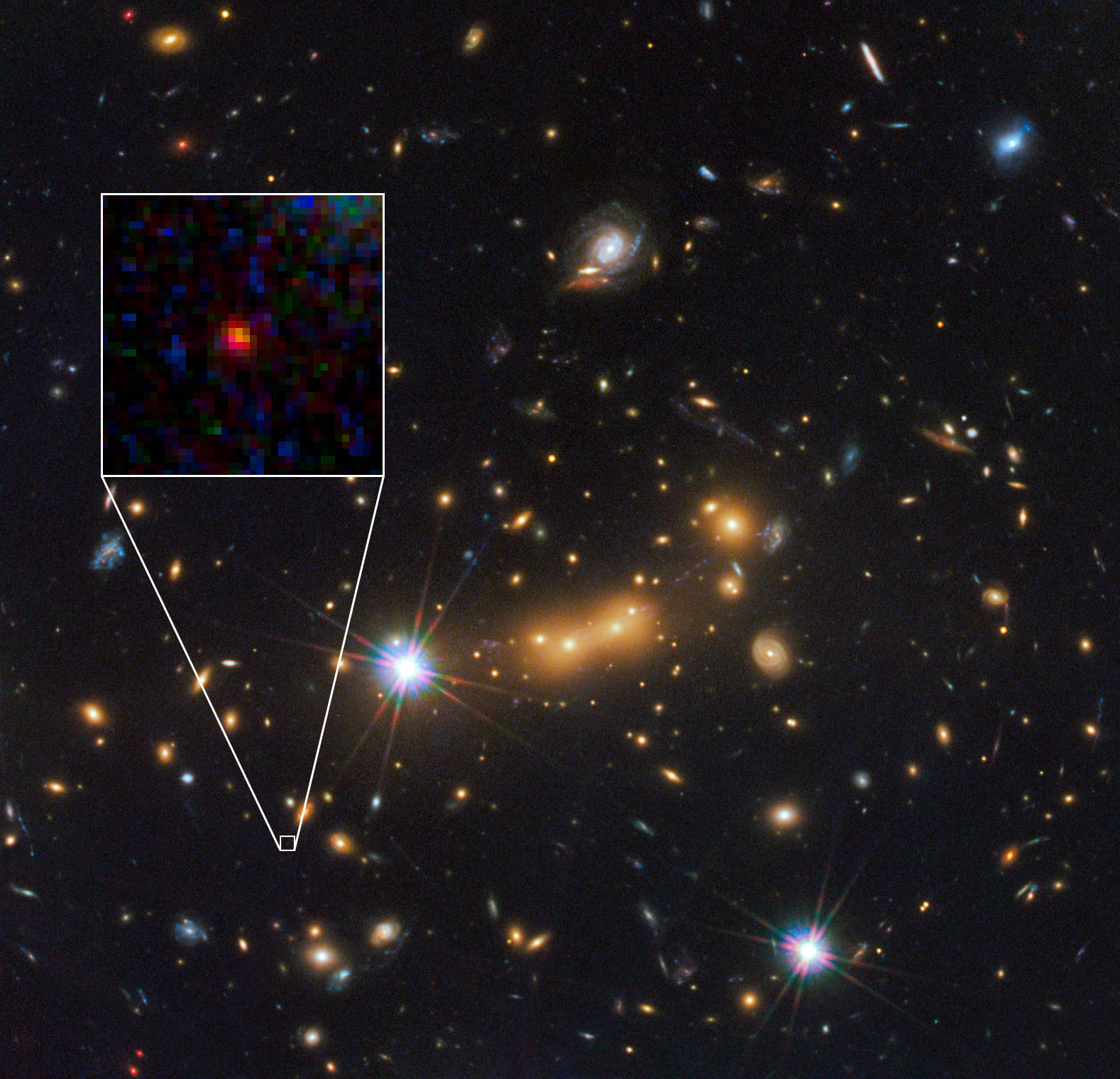
    newly discovered galaxy MACS0647-JD
    In this image, astronomers use the NASA/ESA Hubble Space Telescope and a cosmic zoom lens to uncover the farthest known galaxy in the Universe. The newly discovered galaxy, named MACS0647-JD, is very young and only a tiny fraction of the size of our Milky Way. The object is observed 420 million years after the Big Bang, when the Universe was 3 percent of its present age of 13.7 billion years. The inset at left shows a close-up of the young dwarf galaxy. Credit: NASA, ESA, and M. Postman and D. Coe (Space Telescope Science Institute), and the CLASH team

    The galaxy known as MACS0647-JD is located behind an enormous galactic cluster MACS J0647+7015 that lies between the Big and Little Dipper. Data shows that MACS0647-JD is probably the most distant galaxy ever seen.

    Either MACS0647-JD is a very red object, only shining at red wavelengths, or it is extremely distant and its light has been ‘redshifted’ to these wavelengths, or some combination of the two, states D. Coe, lead author of the study. “Over the next 13 billion years, it may have dozens, hundreds, or even thousands of merging events with other galaxies and galaxy fragments.” The paper will appear in the December 20 issue of The Astrophysical Journal.

    MACS0647-JD would have existed 13.3 billion years ago, roughly 420 million years after the Big Bang. This would place it 200 million years earlier than some of the previous candidates for the most distant objects ever spotted.
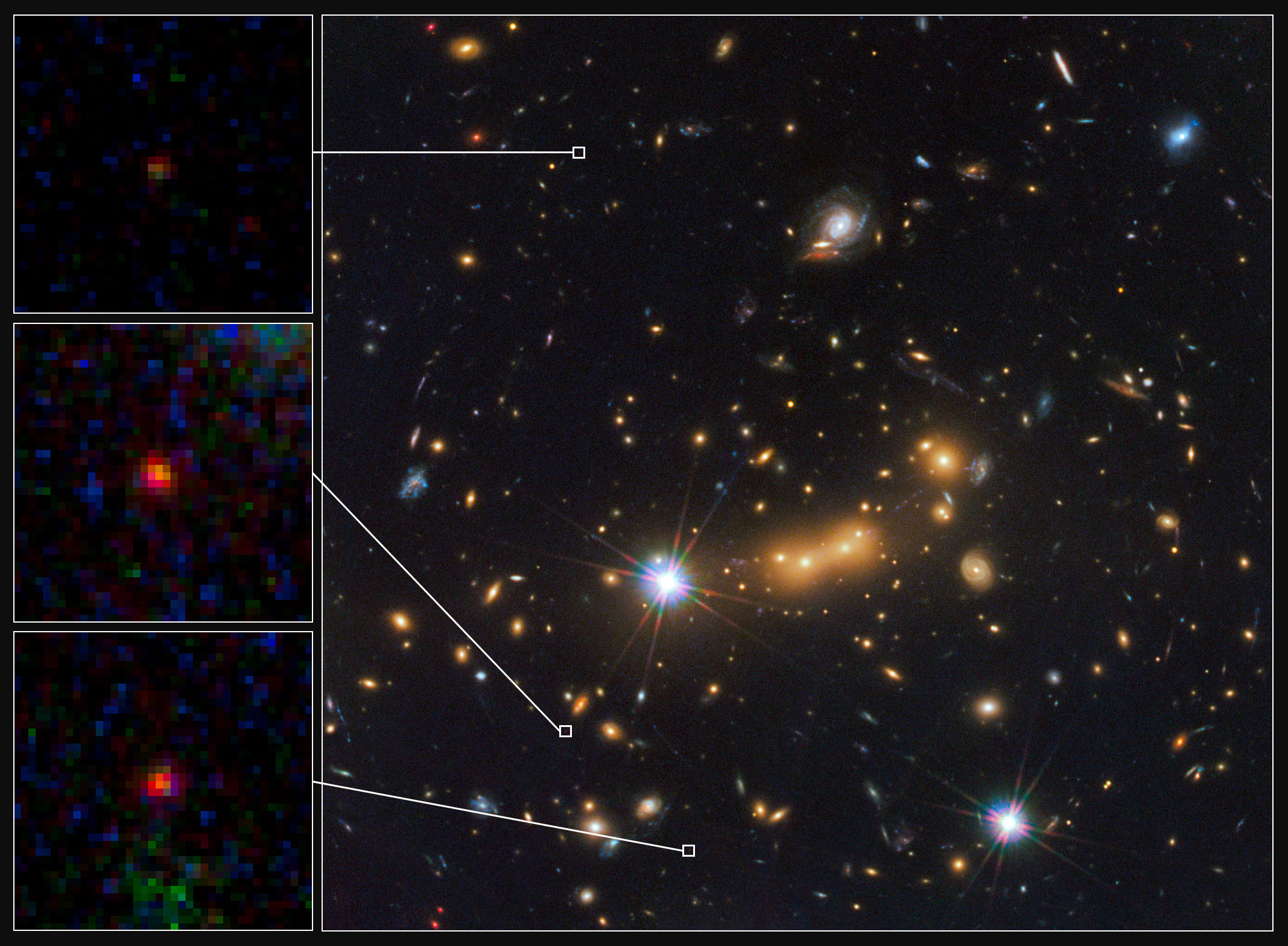
    Hubble spots three magnified views of most distant known galaxy
    Credit: NASA, ESA, and M. Postman and D. Coe (Space Telescope Science Institute), and the CLASH team

    Astronomers combined data from Hubble with NASA’s Spitzer Space Telescope to make this discovery. The galaxy cluster in front of MACS0647-JD helped astronomers find it, since the gravitational pull of the cluster bends light around it. This gravitational lens makes distant objects appear much brighter. If the existence of MACS0647-JD is confirmed, then it could help scientists understand how the Universe came into being when the first stars and galaxies formed.

    MACS0647-JD is a small galaxy, about 600 light-years across and roughly 250 times smaller than the Milky Way which is 150,000 light-years across. Earlier galaxies are thought to have had a turbulent past, crashing into one another and combining together over billions of years to give rise to the enormous cosmic structures we see in the Observable Universe.

    Since this galaxy is stretching Hubble’s and Spitzer’s abilities, it may be much closer than expected. No other telescopes can confirm MACS0647-JD’s existence, but NASA’s future James Webb Space Telescope, set to launch in 2018, could definitively determine how far MACS0647-JD is located from Earth.

    Reference: “CLASH: Three Strongly Lensed Images of a Candidate z ~ 11 Galaxy” by Dan Coe, Adi Zitrin, Mauricio Carrasco, Xinwen Shu, Wei Zheng, Marc Postman, Larry Bradley, Anton Koekemoer, Rychard Bouwens, Tom Broadhurst, Anna Monna, Ole Host, Leonidas A. Moustakas, Holland Ford, John Moustakas, Arjen van der Wel, Megan Donahue, Steven A. Rodney, Narciso Benitez, Stephanie Jouvel, Stella Seitz, Daniel D. Kelson and Piero Rosati, 13 December 2012, The Astrophysical Journal.
    DOI: 10.1088/0004-637X/762/1/32

    Never miss a breakthrough: Join the SciTechDaily newsletter.
    Follow us on Google and Google News.

    Astronomy Astrophysics Hubble Space Telescope NASA Popular
    Share. Facebook Twitter Pinterest LinkedIn Email Reddit

    Related Articles

    3.7 Billion Miles Away: Hubble Uncovers a Hidden Trio That Could Rewrite Kuiper Belt History

    Hubble Captures a Cosmic Bullseye, Revealing a Stunning Nine-Ring Galaxy

    A Star’s Unexpected Heatwave: FU Orionis Challenges Astrophysics Models

    Legendary Star’s Smooth Disk Mystifies Astronomers, Challenges Planet Formation Theories

    Astronomers Baffled by Black Hole Jets Igniting Star Explosions

    The Big Bang’s Dark Legacy Revealed by Hubble: Unexpected Black Holes

    Historic Discovery: Twin Titans Clash As NASA Unveils Closest Supermassive Black Hole Duo

    Galaxies Collide, Stars Awaken: Hubble’s Stunning Revelation

    Cyclones in Space? See How Hubble Uncovered Extreme Weather on a Distant Planet

    Leave A Reply Cancel Reply

    • Facebook
    • Twitter
    • Pinterest
    • YouTube

    Don't Miss a Discovery

    Subscribe for the Latest in Science & Tech!

    Trending News

    Bone-Strengthening Discovery Could Reverse Osteoporosis

    Scientists Uncover Hidden Trigger Behind Stem Cell Aging

    Scientists Find Way to Reverse Fatty Liver Disease Without Changing Diet

    Could Humans Regrow Limbs? New Study Reveals Promising Genetic Pathway

    Scientists Reveal Eating Fruits and Vegetables May Increase Your Risk of Lung Cancer

    Scientists Reverse Brain Aging With Simple Nasal Spray

    Scientists Uncover Potential Brain Risks of Popular Fish Oil Supplements

    Scientists Discover a Surprising Way To Make Bread Healthier and More Nutritious

    Follow SciTechDaily
    • Facebook
    • Twitter
    • YouTube
    • Pinterest
    • Newsletter
    • RSS
    SciTech News
    • Biology News
    • Chemistry News
    • Earth News
    • Health News
    • Physics News
    • Science News
    • Space News
    • Technology News
    Recent Posts
    • Europe’s Most Active Volcano Just Got Stranger – Here’s Why Scientists Are Rethinking It
    • Why Are Giant Ants Letting Tiny Ants Crawl All Over Them?
    • Revolutionary Technique Sends Healthy Mitochondria Exactly Where They’re Needed
    • This Student Recreated the Universe in a Bottle. What She Discovered Could Help Reveal How Life Started on Earth
    • Alzheimer’s Symptoms May Start Outside the Brain, Study Finds
    Copyright © 1998 - 2026 SciTechDaily. All Rights Reserved.
    • Science News
    • About
    • Contact
    • Editorial Board
    • Privacy Policy
    • Terms of Use

    Type above and press Enter to search. Press Esc to cancel.