
Close Menu
    Facebook X (Twitter) Instagram
    SciTechDaily
    • Biology
    • Chemistry
    • Earth
    • Health
    • Physics
    • Science
    • Space
    • Technology
    Facebook X (Twitter) Pinterest YouTube RSS
    SciTechDaily
    Home»Space»The James Webb Space Telescope Is the Largest, Most Powerful Space Telescope Ever Built [Video]
    Space

    The James Webb Space Telescope Is the Largest, Most Powerful Space Telescope Ever Built [Video]

    By NASAJanuary 19, 2020No Comments3 Mins Read
    Facebook Twitter Pinterest Telegram LinkedIn WhatsApp Email Reddit
    Share
    Facebook Twitter LinkedIn Pinterest Telegram Email Reddit
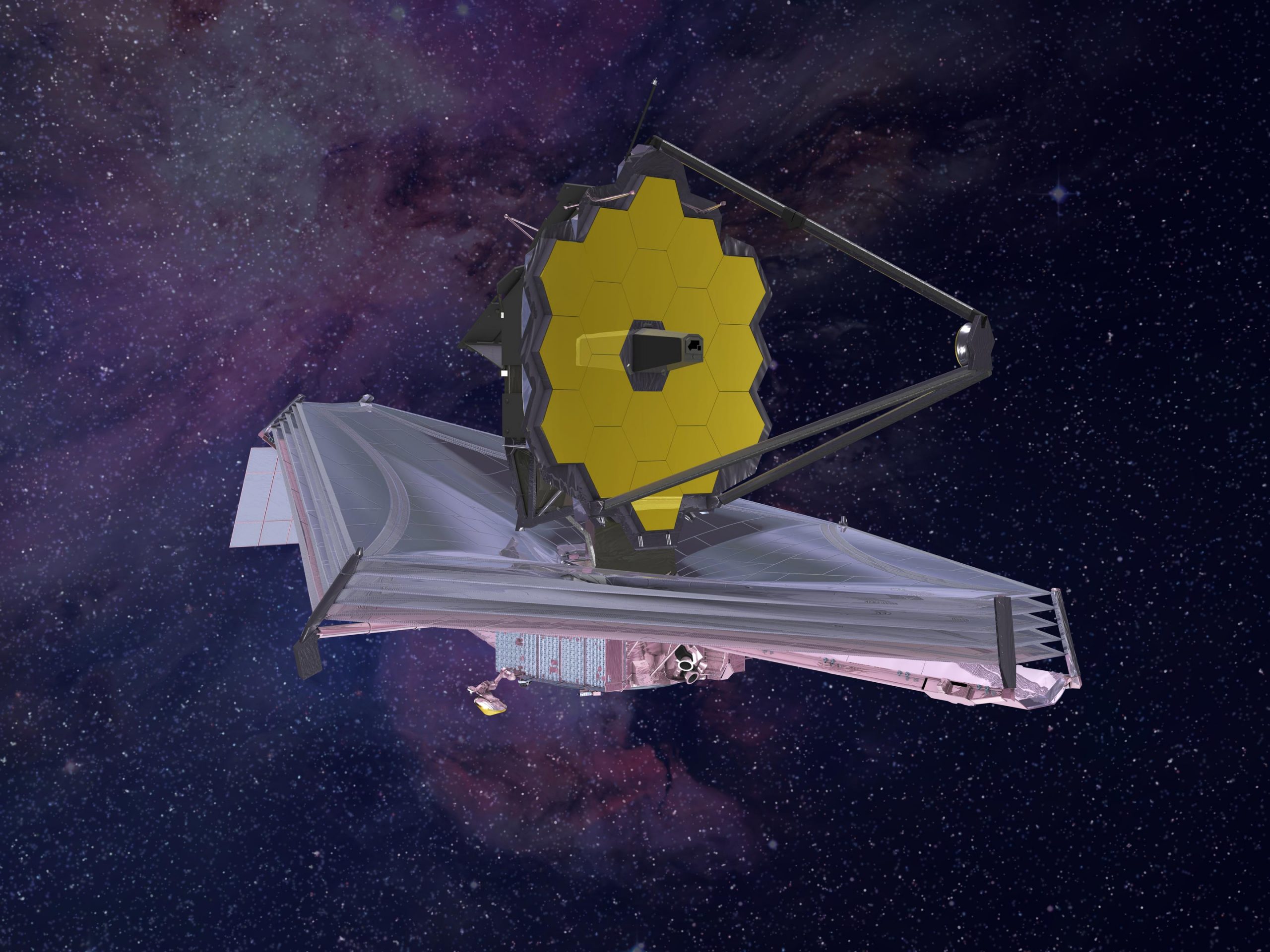
    James Webb Space Telescope Rendering
    Rendering of NASA’s James Webb Space Telescope. The James Webb Space Telescope is the largest, most powerful and most technologically challenging space telescope ever built. Credit: Northrop Grumman

    The James Webb Space Telescope is the largest, most powerful, and most technologically challenging space telescope ever built.

    The Webb Telescope is so large; it must be folded like origami to fit inside its rocket fairing for the ride into space. Once in space, unfolding and readying Webb for science is a complex process that will take about six months.

    Webb is designed to see the most distant galaxies in the Universe and study how galaxies evolved over cosmic time. Webb will study planets orbiting other stars looking for the chemical signatures of the building blocks of life. Webb will also study planets within our own solar system.

    The Webb Telescope Mission is an international space telescope program led by NASA with its partners, the European Space Agency and the Canadian Space Agency.


    The James Webb Telescope Mission overview. An introduction to the Webb telescope and it’s mission.

    The James Webb Space Telescope (sometimes called JWST or Webb) is an orbiting infrared observatory that will complement and extend the discoveries of the Hubble Space Telescope, with longer wavelength coverage and greatly improved sensitivity. The longer wavelengths enable Webb to look much closer to the beginning of time and to hunt for the unobserved formation of the first galaxies, as well as to look inside dust clouds where stars and planetary systems are forming today.
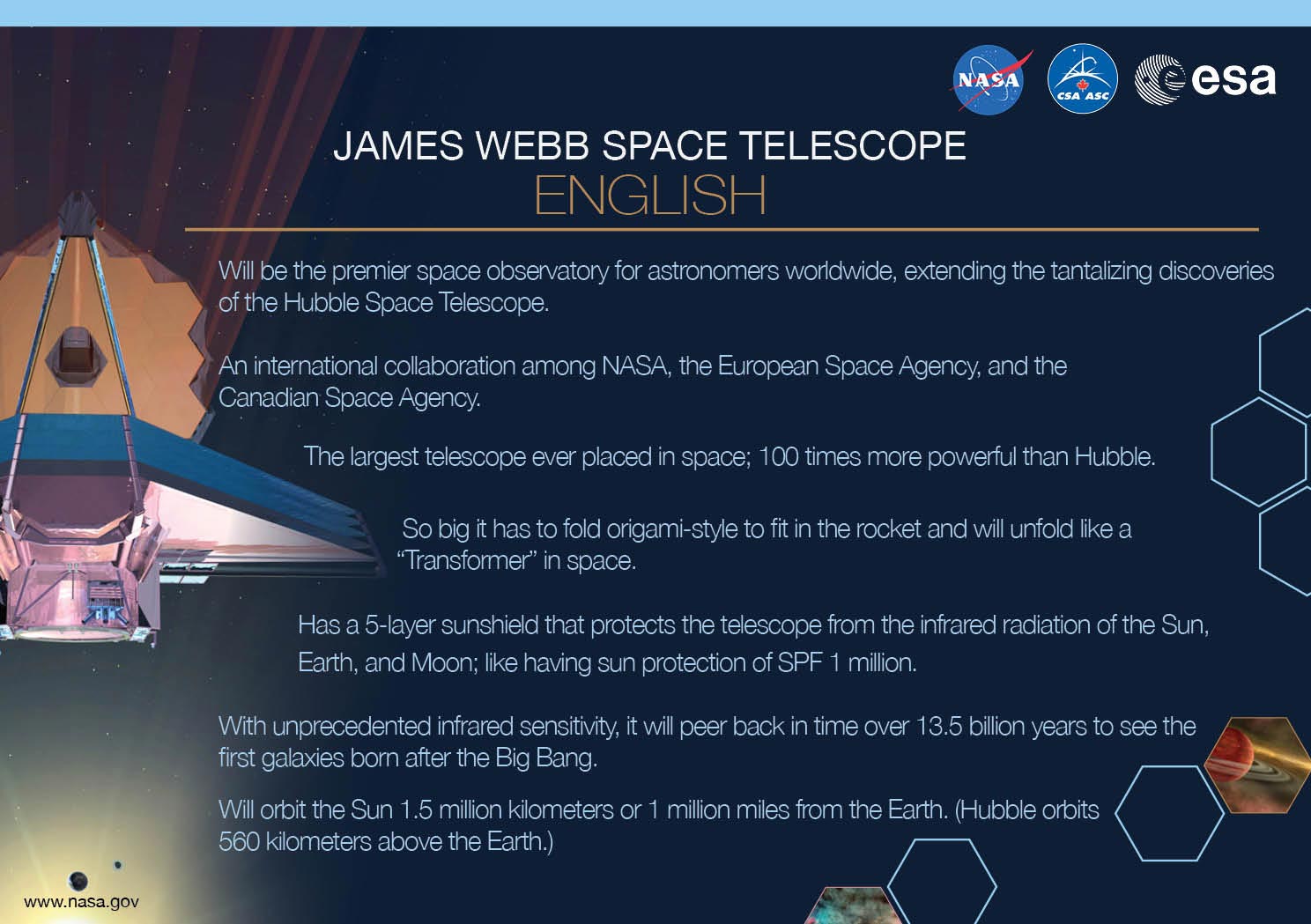
    James Webb Space Telescope Key Facts
    James Webb Space Telescope Key Facts. Credit: NASA/ESA/CSA

    The Premier Observatory of the Next Decade

    The James Webb Space Telescope will be a large infrared telescope with a 6.5-meter (21-foot) primary mirror. The telescope will be launched on an Ariane 5 rocket from French Guiana in 2021.

    Webb will be the premier observatory of the next decade, serving thousands of astronomers worldwide. It will study every phase in the history of our Universe, ranging from the first luminous glows after the Big Bang, to the formation of solar systems capable of supporting life on planets like Earth, to the evolution of our own Solar System.

    Webb was formerly known as the “Next Generation Space Telescope” (NGST); it was renamed in September 2002 after a former NASA administrator, James Webb.

    International Collaboration

    Webb is an international collaboration between NASA, the European Space Agency (ESA), and the Canadian Space Agency (CSA). The NASA Goddard Space Flight Center is managing the development effort. The main industrial partner is Northrop Grumman; the Space Telescope Science Institute will operate Webb after launch.

    Innovative Technologies

    Several innovative technologies have been developed for Webb. These include a primary mirror made of 18 separate segments that unfold and adjust to shape after launch. The mirrors are made of ultra-lightweight beryllium. Webb’s biggest feature is a tennis court sized five-layer sunshield that attenuates heat from the Sun more than a million times. The telescope’s four instruments — cameras and spectrometers — have detectors that are able to record extremely faint signals. One instrument (NIRSpec) has programmable microshutters, which enable observation up to 100 objects simultaneously. Webb also has a cryocooler for cooling the mid-infrared detectors of another instrument (MIRI) to a very cold 7 K so they can work.

    For more, read Comparing the Hubble and James Webb Space Telescopes.

    Never miss a breakthrough: Join the SciTechDaily newsletter.
    Follow us on Google and Google News.

    Astronomy James Webb Space Telescope NASA Popular
    Share. Facebook Twitter Pinterest LinkedIn Email Reddit

    Related Articles

    Webb Does the “Impossible” – Space Telescope Captures First Glimpse of an Exoplanet’s Interior

    Webb Space Telescope Cracks Case of Puffy “Microwaved Marshmallow” Exoplanet

    Super-Earth Surprise: Webb Finds Atmosphere on Rocky Exoplanet For the First Time

    Webb Space Telescope Reveals Extreme Starburst Galaxy’s Hidden Secrets

    Webb’s Ethanol Discovery Fuels Search for Alien Life

    Webb’s Historic Discovery: The Farthest Active Supermassive Black Hole Ever Found

    Webb Space Telescope Reveals “Mind-Blowing” Structure in 19 Nearby Spiral Galaxies

    Webb Telescope’s Startling Reveal: Many Early Galaxies Looked Like Pool Noodles and Surfboards

    Webb’s Infrared Eye Uncovers Bizarre “Cat’s Tail” Dust Structure in Beta Pictoris

    Leave A Reply Cancel Reply

    • Facebook
    • Twitter
    • Pinterest
    • YouTube

    Don't Miss a Discovery

    Subscribe for the Latest in Science & Tech!

    Trending News

    Largest-Ever Study Finds Medicinal Cannabis Ineffective for Anxiety, Depression, PTSD

    250-Million-Year-Old Egg Solves One of Evolution’s Biggest Mysteries

    Living With Roommates Might Be Changing Your Gut Microbiome Without You Knowing

    Century-Old Cleaning Chemical Linked to 500% Increased Risk of Parkinson’s Disease

    What if Your Memories Never Happened? Physicists Take a New Look at the Boltzmann Brain Paradox

    One of the Universe’s Largest Stars May Be Getting Ready To Explode

    Scientists Discover Enzyme That Could Supercharge Ozempic-Like Weight Loss Drugs

    Popular Sweetener Linked to DNA Damage – “It’s Something You Should Not Be Eating”

    Follow SciTechDaily
    • Facebook
    • Twitter
    • YouTube
    • Pinterest
    • Newsletter
    • RSS
    SciTech News
    • Biology News
    • Chemistry News
    • Earth News
    • Health News
    • Physics News
    • Science News
    • Space News
    • Technology News
    Recent Posts
    • Challenging the Narrative: New Study Shows U.S. Life Expectancy Is Rising Across All States
    • Mystery Illness Kills 5 in Burundi As Doctors Scramble for Answers
    • Bone-Strengthening Discovery Could Reverse Osteoporosis
    • The Most Elusive Number in Physics Just Got Even More Mysterious
    • Scientists Uncover Hidden Trigger Behind Stem Cell Aging
    Copyright © 1998 - 2026 SciTechDaily. All Rights Reserved.
    • Science News
    • About
    • Contact
    • Editorial Board
    • Privacy Policy
    • Terms of Use

    Type above and press Enter to search. Press Esc to cancel.