
Close Menu
    Facebook X (Twitter) Instagram
    SciTechDaily
    • Biology
    • Chemistry
    • Earth
    • Health
    • Physics
    • Science
    • Space
    • Technology
    Facebook X (Twitter) Pinterest YouTube RSS
    SciTechDaily
    Home»Space»Webb Space Telescope’s Infrared Universe: A New Window to the Cosmos
    Space

    Webb Space Telescope’s Infrared Universe: A New Window to the Cosmos

    By European Space Agency (ESA)March 28, 20223 Comments2 Mins Read
    Facebook Twitter Pinterest Telegram LinkedIn WhatsApp Email Reddit
    Share
    Facebook Twitter LinkedIn Pinterest Telegram Email Reddit
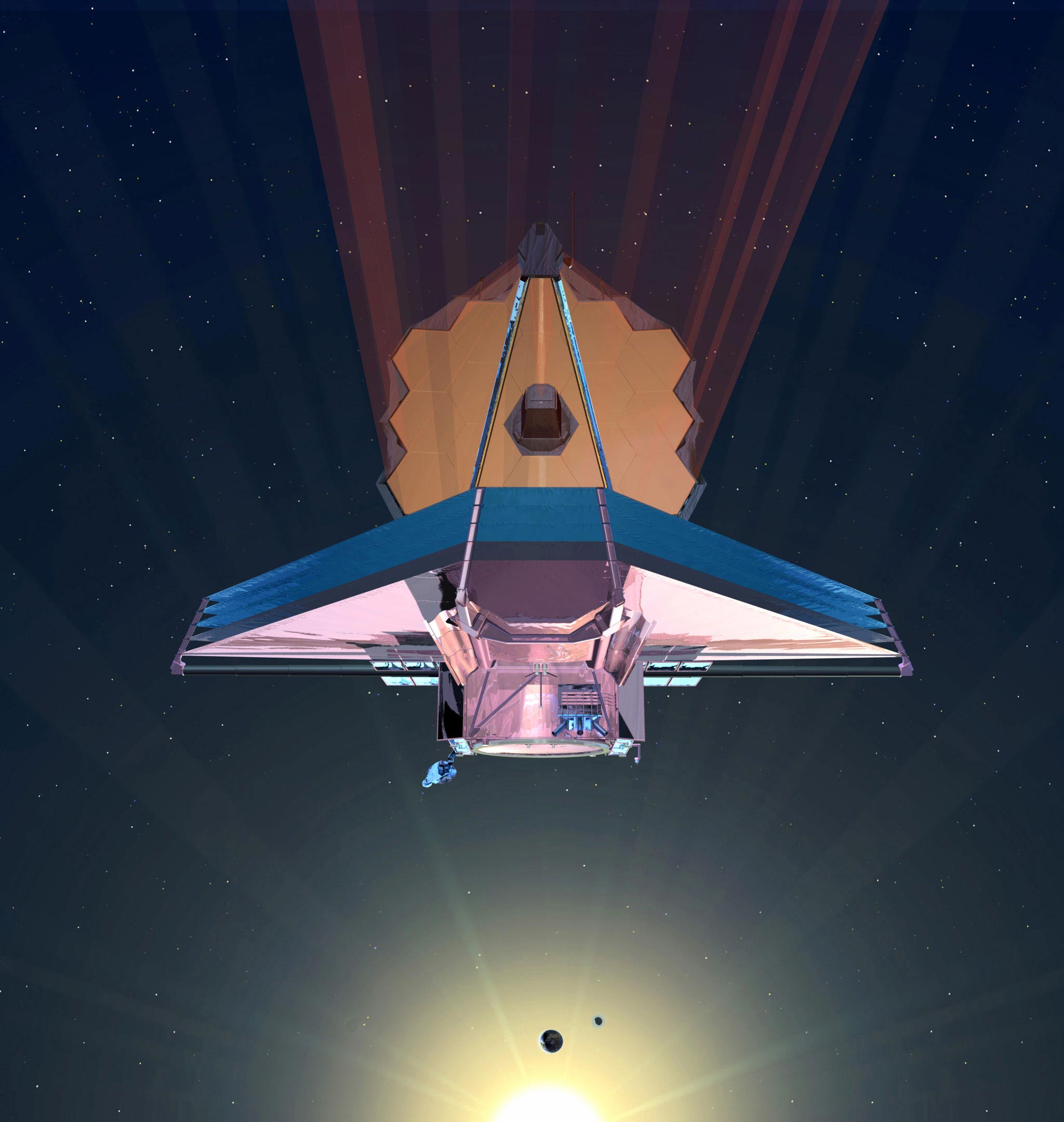
    Webb Telescope Artist's Conception
    Artist’s conception of the Webb Telescope in space. Credit: NASA

    The James Webb Space Telescope (Webb) will observe the Universe in the near-infrared and mid-infrared – at wavelengths longer than visible light.

    By viewing the Universe at infrared wavelengths with an unprecedented sensitivity Webb will open up a new window to the cosmos. With infrared wavelengths it can see the first stars and galaxies forming after the Big Bang. Its infrared vision also allows Webb to study stars and planetary systems forming inside thick clouds of gas and dust that are opaque to visible light.

    The primary goals of Webb are to study galaxy, star, and planet formation in the Universe. To see the very first stars and galaxies that formed in the early Universe, we have to look deep into space to look back in time (because it takes light time to travel from there to here, the farther out we look, the further we look back in time).

    The Universe is expanding, and therefore the farther we look, the faster objects are moving away from us, redshifting the light. Redshift means that light that is emitted as ultraviolet or visible light is shifted more and more to redder wavelengths, into the near- and mid-infrared part of the electromagnetic spectrum for very high redshifts. Therefore, to study the earliest star and galaxy formation in the Universe, we have to observe infrared light and use a telescope and instruments optimized for this light like Webb.

    Star formation in the local universe takes place in the centers of dense, dusty clouds, obscured from our eyes at normal visible wavelengths. Near-infrared light, with its longer wavelength, is less hindered by the small dust particles, allowing near-infrared light to seep through the dust clouds. By observing the emitted near-infrared light we can penetrate the dust and see the processes leading to star and planet formation.

    Objects of about Earth’s temperature emit most of their light at mid-infrared wavelengths. These temperatures are also found in dusty regions forming stars and planets, so with mid-infrared radiation we can see directly the glow of this slightly warm dust and study its distribution and properties.

    Never miss a breakthrough: Join the SciTechDaily newsletter.
    Follow us on Google and Google News.

    Astronomy Astrophysics European Space Agency James Webb Space Telescope Popular
    Share. Facebook Twitter Pinterest LinkedIn Email Reddit

    Related Articles

    Webb Reveals What Happens When a Sun Like Ours Dies

    Webb Captures “Impossible” Glow From Galaxy at the Edge of Time

    Galactic Genesis: Webb Space Telescope Reveals Massive Star-Forming Complex

    Webb Peers Into Frozen Heart of Molecular Cloud – Unveils Dark Side of Pre-Stellar Ice Chemistry

    Major Milestone: NASA’s Webb Space Telescope Discovers Earliest Galaxies in the Universe

    Galactic Collision: Webb Space Telescope Explores Frenzied Star Formation in Merging Galaxies

    Webb Space Telescope To Provide Details of Two Intriguing “Super-Earths” in the Milky Way

    Webb Space Telescope: Uncovering Hidden Parts of Our Solar System

    First James Webb Space Telescope General Observer Scientific Programs Selected

    3 Comments

    1. orrery on March 28, 2022 5:26 pm

      Dump the expanding universe crap – it negates any scientific credibility this site should have.

      Reply
      • Edward Armstrong on March 31, 2022 10:37 am

        Thanks very much for showing us all the true depth and total extent of creationist thinking.

        Reply
    2. Durian on March 29, 2022 12:31 am

      If the light we’re looking at is from the past then when the J.W is looking through space and observing stars and possible planets around those stars if there was intelligent life forms originally on those planets but are dead now or evolve past whatever wouldn’t it be able to see them I don’t mean the gases or the chemicals coming from the planet I mean actually see them flying around in space if there technology was advanced enough I would think there were civilizations everywhere you look in space couldn’t J.W technically be able read the aliens newspaper? just wondering, thinking about a long time ago in a galaxy far far away. M.T.F.B.W.Y

      Reply
    Leave A Reply Cancel Reply

    • Facebook
    • Twitter
    • Pinterest
    • YouTube

    Don't Miss a Discovery

    Subscribe for the Latest in Science & Tech!

    Trending News

    First-of-Its-Kind Discovery: Homer’s Iliad Found Embedded in a 1,600-Year-Old Egyptian Mummy

    Beyond Inflammation: Scientists Uncover New Cause of Persistent Rheumatoid Arthritis

    A Simple Molecule Could Unlock Safer, Easier Weight Loss

    Scientists Just Built a Quantum Battery That Charges Almost Instantly

    Researchers Unveil Groundbreaking Sustainable Solution to Vitamin B12 Deficiency

    Millions of People Have Osteopenia Without Realizing It – Here’s What You Need To Know

    Researchers Discover Boosting a Single Protein Helps the Brain Fight Alzheimer’s

    World-First Study Reveals Human Hearts Can Regenerate After a Heart Attack

    Follow SciTechDaily
    • Facebook
    • Twitter
    • YouTube
    • Pinterest
    • Newsletter
    • RSS
    SciTech News
    • Biology News
    • Chemistry News
    • Earth News
    • Health News
    • Physics News
    • Science News
    • Space News
    • Technology News
    Recent Posts
    • After Decades, MIT Researchers Capture the First 3D Atomic View of a Mysterious Material
    • Your Favorite Fishing Spot Is Turning Brown – and the Fish Are Changing
    • 380-Million-Year-Old Fish Fossil Reveals Secrets of Life’s First Steps Onto Land
    • Mezcal “Worm” in a Bottle Mystery: DNA Testing Reveals a Surprise
    • Scientists Turn Red Lettuce Green, Unlocking Hidden Nutrients
    Copyright © 1998 - 2026 SciTechDaily. All Rights Reserved.
    • Science News
    • About
    • Contact
    • Editorial Board
    • Privacy Policy
    • Terms of Use

    Type above and press Enter to search. Press Esc to cancel.