
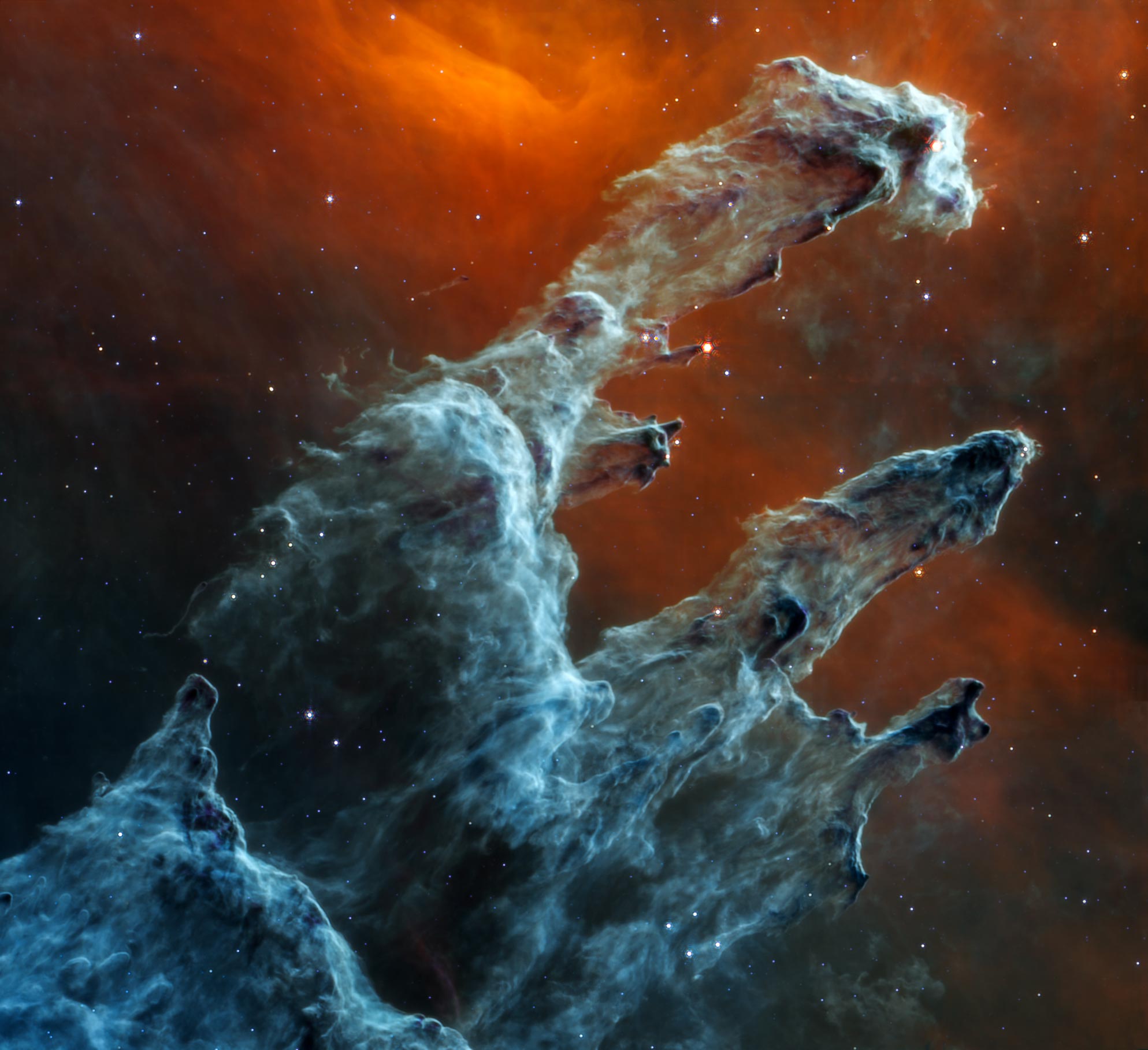
Webb Highlights the Velvet-Like Lining of Dust Throughout This Star-Forming Region, Including Shells Around Actively Forming Stars
As seen here, the Pillars of Creation appear otherworldly in mid-infrared light. NASA’S James Webb Space Telescope has captured an incredible scene that is large and lofty – and appears lit by flickering lanterns. A “ghost” haunts the crag in the lower left, a gargoyle-like shape snarls toward the middle of the frame, and a dark horse’s head charges out of the edge of the second pillar. The creepiest of all? Newly formed stars take on the appearance of protruding, bloodshot eyes. And in the background, dust dances like heavy, ancient curtains being pulled shut. Here, there is no raven to whisper, “Nevermore,” to harken to the classic Edgar Allan Poe poem.
Instead, dust in Webb’s image is like the dawn. It is an essential ingredient for star formation. Though cloaked, these pillars are bursting with activity. Newly forming stars hide within these dark gray chambers, and others, like red rubies, have jumped into view. Over time, Webb’s mid-infrared image will allow researchers to deeply explore the gas and dust in this region, and more precisely model how stars form over millions of years.
Compare NASA’s James Webb Space Telescope mid-infrared light image of the Pillars of Creation to its near-infrared light image in this short video tour. Thousands of stars have formed in this region, but interstellar dust cloaks the scene in mid-infrared light, which is why most of the stars appear to be missing. A quick dissolve to the near-infrared image proves they are still there, of course. While mid-infrared light specializes in detailing where dust is – and these pillars are flush with dust and gas – many stars in this region aren’t dusty enough to appear at these wavelengths. Instead, mid-infrared light reveals which of the young stars still have their dusty “cloaks.” These are the crimson orbs toward the fringes of the pillars. In contrast, the blue stars that dot the scene are aging, which means they have already shed most of their layers of gas and dust. How vast is this landscape? This bright red star and its dusty shroud are larger than the size of our entire solar system.
Haunting Portrait: NASA’s Webb Reveals Dust, Structure in Pillars of Creation
This image does not depict soot-tinged fingers reaching out. Nor is it an ethereal landscape of time-forgotten tombs. These pillars, densely filled with gas and dust, enshroud stars that are slowly forming over many millennia. This eerie, extremely dusty view of the Pillars of Creation was captured in mid-infrared light by NASA’s James Webb Space Telescope. It reveals a creepy new view of a familiar landscape.
Why does mid-infrared light set such a somber, chilling mood in Webb’s Mid-Infrared Instrument (MIRI) image? Interstellar dust cloaks the scene. And while mid-infrared light specializes in detailing where dust is, the stars aren’t bright enough at these wavelengths to appear. Instead, these looming, leaden-hued pillars of gas and dust gleam at their edges, only hinting at the activity within.
In this region, thousands and thousands of stars have formed. This is made explicitly clear when examining Webb’s recent Near-Infrared Camera (NIRCam) image (see image below). However, in MIRI’s view, the majority of the stars appear missing. Why? Many newly formed stars are no longer surrounded by enough dust to be detected in mid-infrared light. Instead, MIRI observes young stars that have not yet cast off their dusty “cloaks.” These are the crimson orbs toward the fringes of the pillars. In contrast, the blue stars that dot the scene are aging. This means that they have already shed most of their layers of gas and dust.

Mid-infrared light is particularly well suited for observing gas and dust in intricate detail. This is also unmistakable throughout the background. The darkest shades of gray are the densest areas of dust. The red region toward the top, which forms an uncanny V, like an owl with outstretched wings, is where the dust is diffuse and cooler. Notice that no background galaxies make an appearance – the interstellar medium in the densest part of the Milky Way’s disk is too swollen with gas and dust to allow their distant light to penetrate.
How vast is this landscape? Trace the topmost pillar, landing on the bright red star jutting out of its lower edge like a broomstick. This star and its dusty shroud are larger than the size of our entire solar system.
This scene was first captured by NASA’s Hubble Space Telescope in 1995 and revisited in 2014, but many other observatories, like NASA’s Spitzer Space Telescope, have also gazed deeply at the Pillars of Creation. Astronomers gain new information with every observation. Through their ongoing research, they build a deeper understanding of this star-forming region. Each wavelength of light and advanced instrument delivers far more precise counts of the gas, dust, and stars, which inform researchers’ models of how stars form. As a result of the new MIRI image, astronomers now have higher resolution data in mid-infrared light than ever before, and will analyze its far more precise dust measurements to create a more complete three-dimensional landscape of this distant region.
The Pillars of Creation is set within the vast Eagle Nebula, which is located around 6,500 light-years away from Earth.
The James Webb Space Telescope is the most powerful space telescope ever constructed and the world’s premier space science observatory. It will solve mysteries in our solar system, look beyond to distant worlds around other stars, and probe the mysterious structures and origins of our universe. Webb is an international program led by NASA with its partners, ESA (European Space Agency) and CSA (Canadian Space Agency).
Never miss a breakthrough: Join the SciTechDaily newsletter.
Follow us on Google and Google News.
6 Comments
I live in a remote village of Bangladesh. I am past 80 and watching and reading about the breathtaking images of pillars of creation taken by JWST. Long Live Science , God Almighty is Great
I see a 49er panning for gold and a silver dollar from the 1890s, plus two pet canaries and a collie-german shepherd mix I had as a child. The infrared spectrum is truly revealing.
These images are amazing and beautiful. I cant help just staring at them.
Welcome to scitechdaily.com
This is how space money should be spent. Manned Space flight is not worth the money spent.
… ” Pillars of Creation “, is this some erotic channel?