
Close Menu
    Facebook X (Twitter) Instagram
    SciTechDaily
    • Biology
    • Chemistry
    • Earth
    • Health
    • Physics
    • Science
    • Space
    • Technology
    Facebook X (Twitter) Pinterest YouTube RSS
    SciTechDaily
    Home»Space»Webb Space Telescope’s Eerie New View of “Pillars of Creation” Looks Supernatural
    Space

    Webb Space Telescope’s Eerie New View of “Pillars of Creation” Looks Supernatural

    By Carolyn Collins Petersen, Universe TodayNovember 2, 2022No Comments6 Mins Read
    Facebook Twitter Pinterest Telegram LinkedIn WhatsApp Email Reddit
    Share
    Facebook Twitter LinkedIn Pinterest Telegram Email Reddit
    James Webb Space Telescope Pillars of Creation
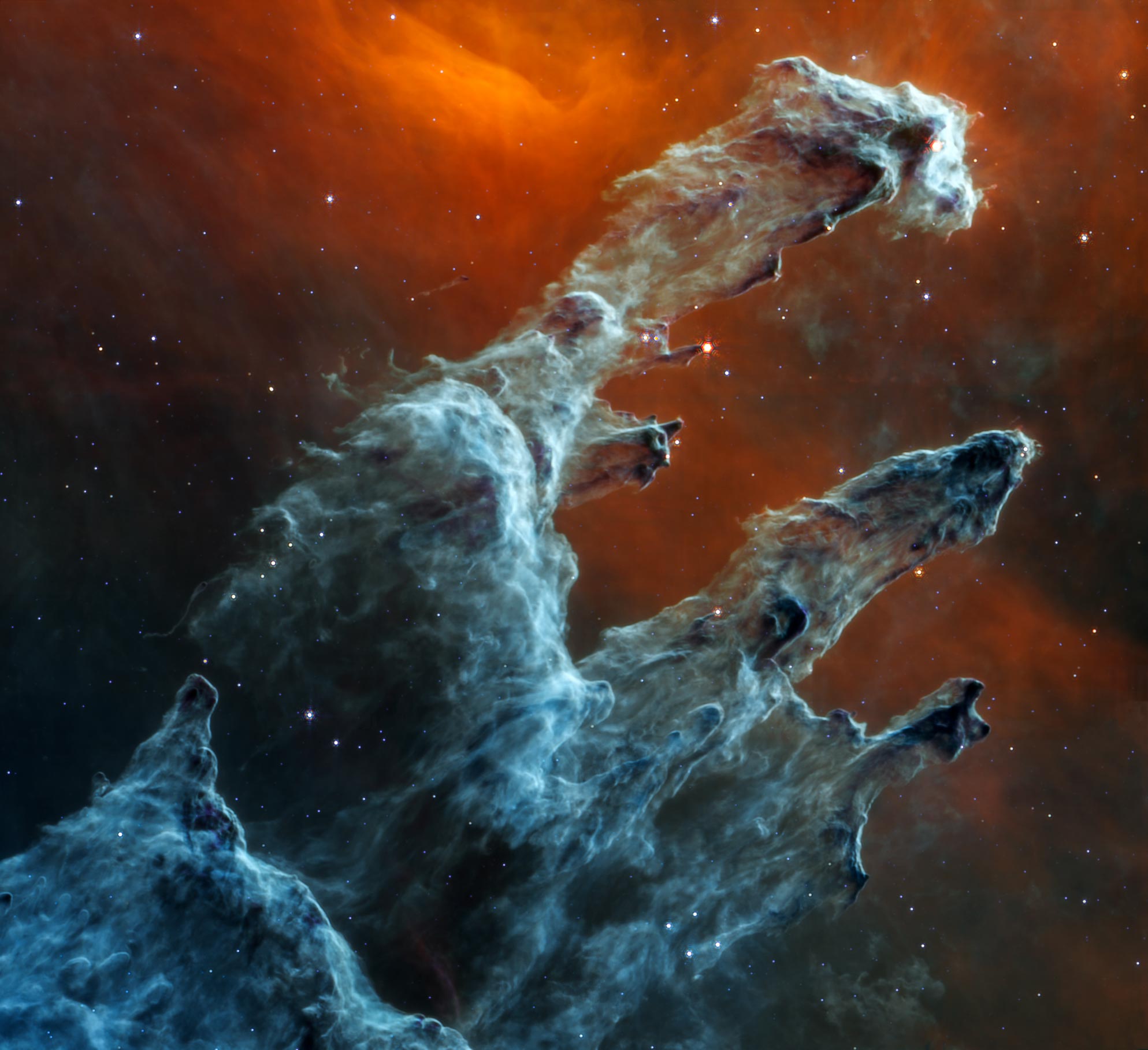
    The NASA/ESA/CSA James Webb Space Telescope’s mid-infrared view of the Pillars of Creation strikes a chilling and ghostly tone. Thousands of stars that exist in this region disappear from view — and seemingly endless layers of gas and dust become the centerpiece. Credit: Science: NASA, ESA, CSA, STScI, Image Processing: Joseph DePasquale (STScI), Alyssa Pagan (STScI)

    NASA’s James Webb Space Telescope (JWST) just keeps streaming the hits back to Earth. This time, data from the MIRI mid-infrared instrument onboard JWST shows a haunting view of the Pillars of Creation. Thousands of stars are embedded in those pillars, but many are “invisible” to MIRI.

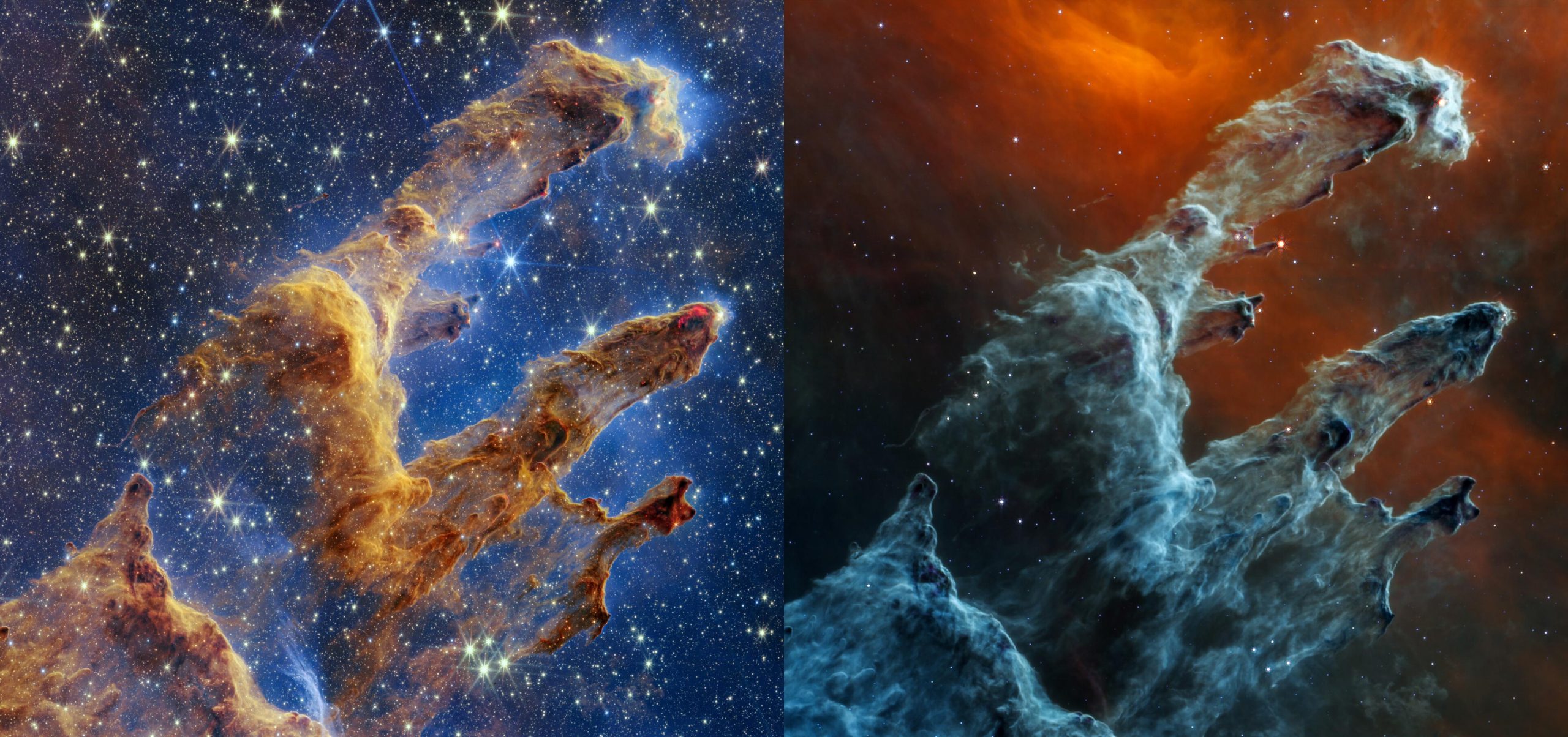
    In the latest image, the Pillars have a steely gray look about them. They almost look like cosmic gravestones instead of stellar birthplaces. Why is this? Mid-infrared light is an important part of the spectrum for astronomers interested in studying clouds of dust. It reveals gas and dust in intricate detail. The densest areas of dust in the pillars show up as the darkest shades of grey. The red V-shaped region toward the top is where the dust clouds are thinner and cooler.

    At these wavelengths, MIRI is only able to “see” the young stars still embedded in their gas and dust cocoons. They glow a mysterious red—almost like the eyes of jack-o-lanterns—at the tips of formations in the pillars. The blue-looking stars are older ones that have burst free and eaten their birth clouds away.

    The Pillars of Creation in Retrospect

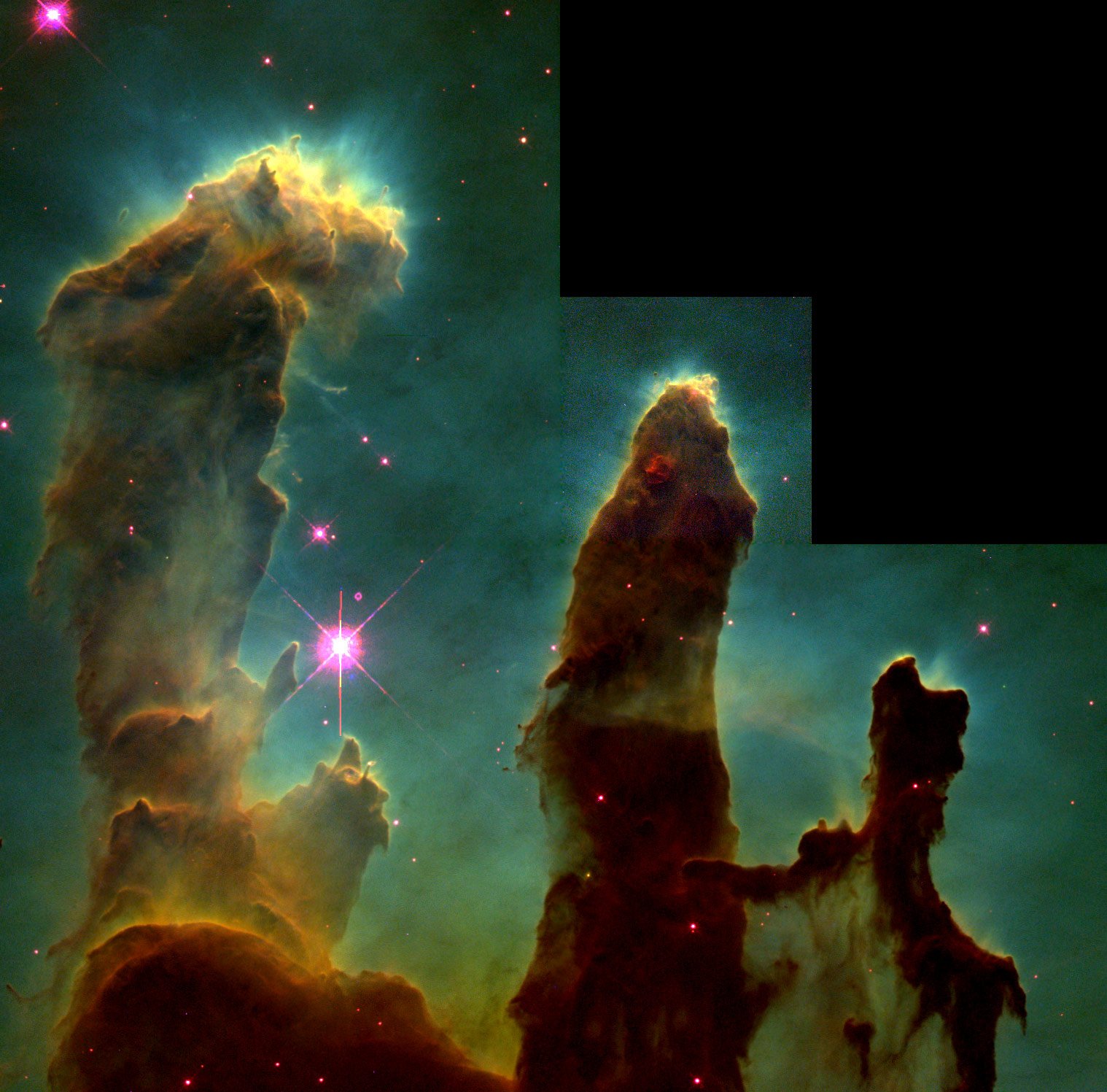
    This star-birth region has a long history of observations. It’s certainly visible to astronomers using backyard-type telescopes. However, it takes Hubble Space Telescope and now JWST to dig into the rich detail of this massive cloud. Hubble first looked at it in 1995, using the Wide Field and Planetary Camera 2. It returned 32 images, which were combined into a mosaic. The pillars are part of the Eagle Nebula, which was discovered in 1745 by the Swiss astronomer Jean-Philippe Loys de Chéseaux. It’s a diffuse emission nebula that covers a region of space about 70 x 55 light-years across and is located approximately 7,000 light-years away from Earth in the constellation Serpens. The pillars are a part of the nebula, and some of its tiniest stellar birthplaces are larger than our solar system.
    New Simulation Shows How the Pillars of Creation Were Created
    Eagle Nebula Pillars of Creation as seen by Hubble Space Telescope in 2005. Credit NASA, ESA, STScI, J. Hester and P. Scowen (ASU)

    When the first Hubble image appeared, astronomers could see the places where stars were born and are eating away at their gas clouds. However, they couldn’t see INTO the clouds. Those hungry stellar babies in their cocoons were dubbed “evaporating gaseous globules,” or EGGs. They’re in other stellar nurseries, giving astronomers a good idea of how star birth progresses in thick clouds of gas and dust.

    The Pillars of Creation have since been imaged again in 2014 by Hubble, as well as by the Chandra X-ray Observatory (which found no x-ray sources associated with the newborn stars). Spitzer Space Telescope also studied this region of space. It found evidence of hot gases that suggested a supernova exploded in the area. If it did, there’s little evidence of the shock wave hurting the stellar newborns or evaporating the rest of the cloud away.

    JWST’s Looks at the Pillars

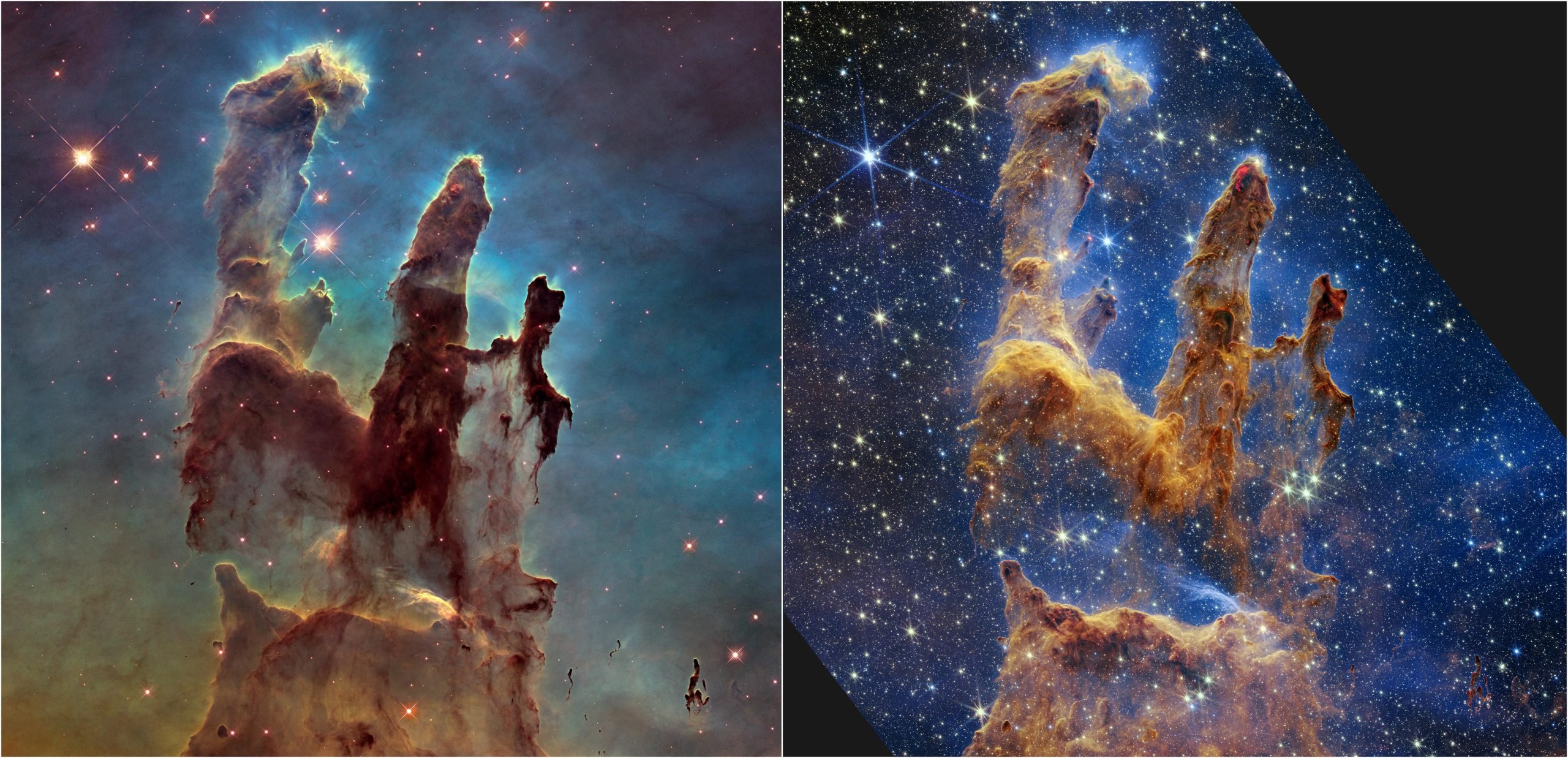
    The latest steely gray view of the Pillars of Creation set against the glowing red and gray backdrop isn’t JWST’s first rodeo with this region of space. Earlier in October, the science teams released a NIRCam (Near Infrared Camera) image of it. That view revealed many of the protostars forming inside those cosmic stalagmites in space. Thanks to NIRCam, we can peer right through the gas and dust, lifting the veil on star birth.
    Pillars of Creation (Hubble and Webb Images)
    A compare and contrast of a 2014 Hubble Space Telescope view of the Pillars of Creation and the October 19, 2022, JWST image. Both views show us what is happening locally. Although Hubble highlights many more thick layers of dust and Webb shows more of the stars, neither shows us the deeper universe. Dust blocks the view in Hubble’s image, but the interstellar medium plays a major role in Webb’s. It acts like thick smoke or fog, preventing us from peering into the deeper universe, where countless galaxies exist. Credit: NASA, ESA, CSA, STScI; Joseph DePasquale (STScI), Anton M. Koekemoer (STScI), Alyssa Pagan (STScI).

    The protostars as seen by NIRCam are the ones with multiple diffraction spikes. They’re still accreting mass, and when they get enough, they’ll collapse under their own gravity and slowly heat up. When they’re hot and massive enough, fusion will ignite in their cores. That’s when they become stars. The young stars in these pillars are probably only a few hundred thousand years old and won’t be finished forming for millions of years.

    The stellar birth process often creates jets that shoot out from the newborn stars. Those jets eat away at the remaining birth cloud materials. They sculpt the clouds, which is why the pillars look wavy and deformed.

    Understanding Star Formation from JWST Images

    Both of these JWST images of the Pillars of Creation give astronomers a more detailed look at star formation. While scientists have a pretty good overall view of how stars form, the intricate details are what they need. All that data about star birth will help create better models of such an important process.
    Webb Pillars of Creation NIRCam vs MIRI
    Compare and contrast the NIRCam view (left) with the MIRI view (right) from JWST to understand how each instrument sees the Pillars of Creation. Credit: NASA, ESA, CSA, STScI; J. DePasquale (STScI), A. Pagan (STScI), A. Koekemoer (STScI)

    By looking at populations of newborns like the ones in the Pillars, and mapping the huge clouds of gas and dust in this region, they’ll add to the store of knowledge about star birth. Images such as these also give a good look at what our own region of space must have looked like about five billion years ago. That’s when our own Sun and its stellar siblings began to form from a similar type of gas and dust cloud.

    Adapted from an article originally published on Universe Today.

    Never miss a breakthrough: Join the SciTechDaily newsletter.
    Follow us on Google and Google News.

    Astronomy James Webb Space Telescope
    Share. Facebook Twitter Pinterest LinkedIn Email Reddit

    Related Articles

    James Webb Space Telescope’s Journey to Space [Video]

    NASA’s $10 Billion New Observatory: James Webb Space Telescope Gets a Launch Date

    $10B Webb Space Telescope Completes Testing and Prepares for Trip to Europe’s Spaceport

    NASA’s $10 Billion James Webb Space Telescope Has Successfully Completed Testing

    Mapping the Universe’s Earliest Structures and Dark Matter Distribution With COSMOS-Webb

    NASA’s Webb Space Telescope to Explore a Neighboring, Dusty Planetary System

    Preparing for Webb Launch: Testing Progress Continues for the Most Powerful Space Science Telescope Ever Built

    James Webb Space Telescope Passes Key Launch Clearance Review

    NASA’s Webb Telescope Will Look Back in Time, Use Quasars to Unlock the Secrets of the Early Universe

    Leave A Reply Cancel Reply

    • Facebook
    • Twitter
    • Pinterest
    • YouTube

    Don't Miss a Discovery

    Subscribe for the Latest in Science & Tech!

    Trending News

    The Universe Is Expanding Too Fast and Scientists Can’t Explain Why

    “Like Liquid Metal”: Scientists Create Strange Shape-Shifting Material

    Early Warning Signals of Esophageal Cancer May Be Hiding in Plain Sight

    Common Blood Pressure Drug Shows Surprising Power Against Deadly Antibiotic-Resistant Superbug

    Scientists Uncover Dangerous Connection Between Serotonin and Heart Valve Disease

    Scientists Discover a “Protector” Protein That Could Help Reverse Hair Loss

    Bone-Strengthening Discovery Could Reverse Osteoporosis

    Scientists Uncover Hidden Trigger Behind Stem Cell Aging

    Follow SciTechDaily
    • Facebook
    • Twitter
    • YouTube
    • Pinterest
    • Newsletter
    • RSS
    SciTech News
    • Biology News
    • Chemistry News
    • Earth News
    • Health News
    • Physics News
    • Science News
    • Space News
    • Technology News
    Recent Posts
    • Drinking Alcohol To Cope in Your 20s Could Damage Your Brain for Life
    • Scientists Crack Alfalfa’s Chromosome Mystery After Decades of Debate
    • Ancient Ant-Plant Alliance Collapses As Predatory Wasps Move In
    • Scientists Discover Tiny New Spider That Hunts Prey 6x Its Size
    • Natural Component From Licorice Shows Promise for Treating Inflammatory Bowel Disease
    Copyright © 1998 - 2026 SciTechDaily. All Rights Reserved.
    • Science News
    • About
    • Contact
    • Editorial Board
    • Privacy Policy
    • Terms of Use

    Type above and press Enter to search. Press Esc to cancel.