
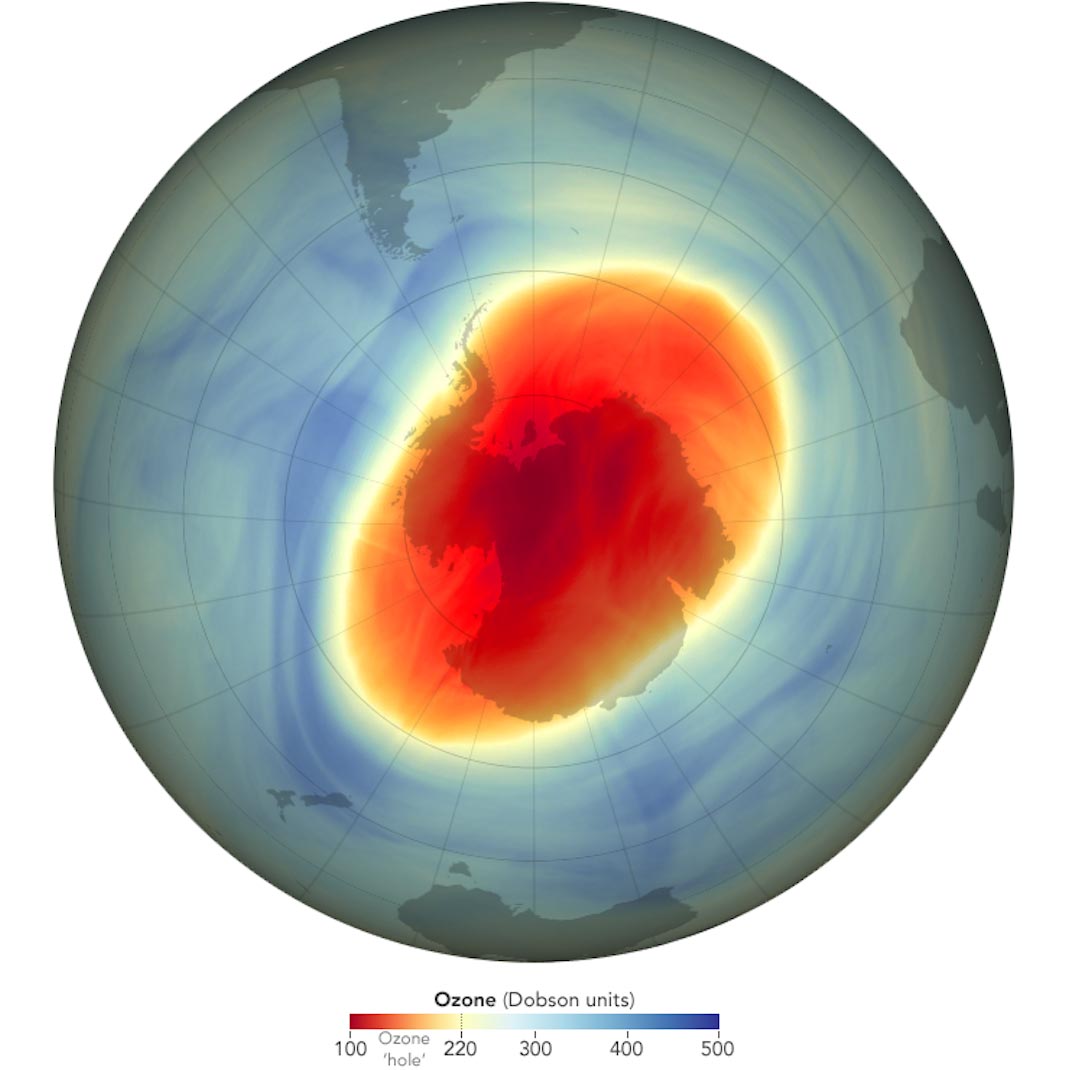
The depleted area of the ozone layer over the South Pole was slightly smaller than last year and generally continued the overall shrinking trend of recent years.
Between September 7, 2022, and October 13, 2022, the annual Antarctic ozone hole reached an average area of 23.2 million square kilometers (9.0 million square miles). This depleted area of the ozone layer over the South Pole was slightly smaller than the average for the same period last year. This marks a general continuation of the overall shrinking trend of recent years.
“Over time, steady progress is being made, and the hole is getting smaller,” said Paul Newman, chief scientist for Earth sciences at NASA’s Goddard Space Flight Center. “We see some wavering as weather changes and other factors make the numbers wiggle slightly from day to day and week to week. But overall, we see it decreasing through the past two decades. The elimination of ozone-depleting substances through the Montreal Protocol is shrinking the hole.”
Formation of the Ozone Hole Each September
Every September the ozone layer—the portion of the stratosphere that protects our planet from the Sun’s ultraviolet rays—thins to form an “ozone hole” above the South Pole. Each southern winter, chemically active forms of chlorine and bromine in the atmosphere, derived from human-produced compounds, attach to high-altitude polar clouds. The reactive chlorine and bromine then initiate ozone-destroying reactions as the Sun rises at the end of Antarctica’s winter.
At NASA and NOAA, scientists detect and measure the growth and breakup of the ozone hole with instruments aboard the Aura, Suomi NPP, and NOAA-20 satellites. On October 5, 2022, those satellites observed a single-day maximum ozone hole of 26.4 million square kilometers (10.2 million square miles), slightly larger than last year. The map at the top of this page shows the size and shape of the ozone hole over the South Pole on that day.
Ozone 101 is an explainer video outlining the fundamentals of the Ozone Hole. Let’s back up to the basics and understand what caused the Ozone Hole, its effects on the planet, and what scientists predict will happen in future decades. Credit: NASA’s Goddard Space Flight Center
When the polar sun rises, NOAA scientists also make measurements with a Dobson Spectrophotometer, an optical instrument that records the total amount of ozone between the surface and the edge of space—known as the total column ozone value. Globally, the total column average is about 300 Dobson Units. Scientists recorded a lowest total-column ozone value of 101 Dobson Units over the South Pole on October 3, 2022. At that time, ozone was almost completely absent at altitudes between 14 and 21 kilometers (8 and 13 miles)—a pattern very similar to last year.
Limited Impact from the Hunga Tonga Eruption
Some scientists were concerned about potential stratospheric impacts from the January 2022 eruption of the Hunga Tonga-Hunga Ha‘apai volcano. The 1991 Mount Pinatubo eruption released substantial amounts of sulfur dioxide that amplified ozone layer depletion. However, no direct impacts from Hunga Tonga have been detected in the Antarctic stratospheric data.
View the latest status of the ozone layer over the Antarctic with NASA’s ozone watch.
NASA Earth Observatory image by Joshua Stevens, using data courtesy of NASA Ozone Watch and GEOS-5 data from the Global Modeling and Assimilation Office at NASA GSFC. Video by NASA’s Goddard Space Flight Center.
Never miss a breakthrough: Join the SciTechDaily newsletter.
Follow us on Google and Google News.
3 Comments
NOOOO! (I feel like a billary supporter on Nov 9th!!!)
What?
How can Al B. Gore(d) & Gretta (my your teeth look big) Thunderbird make more 💰💰💰💰💰 if the planet doesn’t do what they say!!
There seems to be a contradiction in the article. Near the top, in bold, it says, “The depleted area of the ozone layer over the South Pole was slightly SMALLER than last year and generally continued the overall shrinking trend of recent years.” Then, near the bottom of the article, it states, “On October 5, 2022, those satellites observed a single-day maximum ozone hole of 26.4 million square kilometers …, slightly LARGER than last year.” It would appear that they are attempting to put a positive spin on a phenomenon that is sensitive to the weather.
Chief Scientist Newman claims “Over time, steady progress is being made, and the hole is getting smaller,”. If one goes to the link provided near the end of the article and scrolls down to “Annual Records,” it appears that the average area of the so-called ‘hole,’ and the ozone levels within it, have essentially plateaued since the early 1990s, with only a couple of notable exceptions.
I noticed this as well which I don’t even try and make sense of anymore as you did.