
Close Menu
    Facebook X (Twitter) Instagram
    SciTechDaily
    • Biology
    • Chemistry
    • Earth
    • Health
    • Physics
    • Science
    • Space
    • Technology
    Facebook X (Twitter) Pinterest YouTube RSS
    SciTechDaily
    Home»Earth»Aurora, Meet Airglow: Two of Earth’s Most Colorful Atmospheric Phenomena Meet in Stunning Photo From Space Station
    Earth

    Aurora, Meet Airglow: Two of Earth’s Most Colorful Atmospheric Phenomena Meet in Stunning Photo From Space Station

    By NASA Earth ObservatoryAugust 16, 2020No Comments3 Mins Read
    Facebook Twitter Pinterest Telegram LinkedIn WhatsApp Email Reddit
    Share
    Facebook Twitter LinkedIn Pinterest Telegram Email Reddit
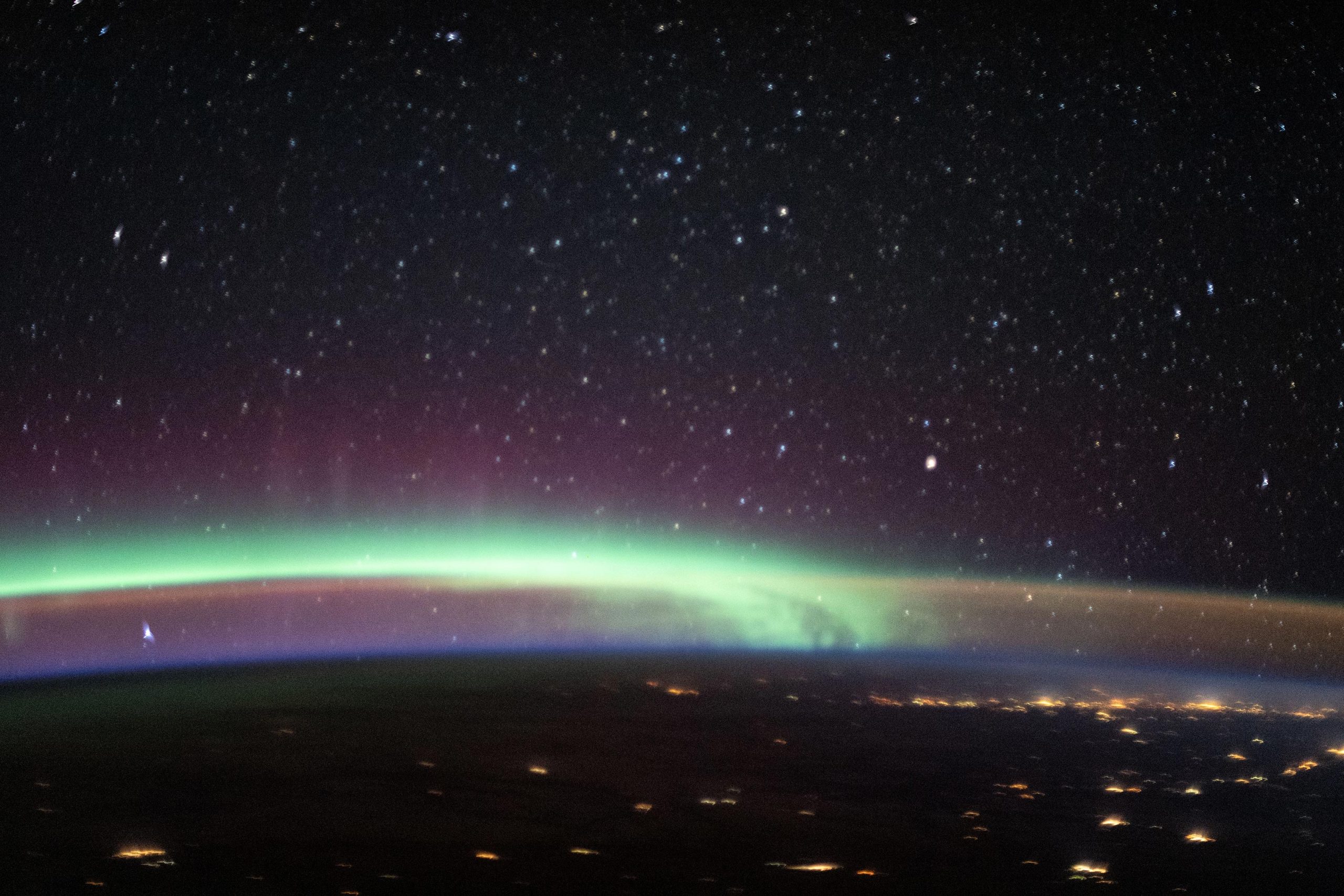
    Aurora Airglow March 2020
    March 16, 2020

    Two of Earth’s most colorful upper atmospheric phenomena, aurora and airglow, met just before dawn in this photo shot by an astronaut on the International Space Station (ISS). Wavy green, red-topped wisps of aurora borealis appear to intersect the muted red-yellow band of airglow as the ISS passed just south of the Alaskan Peninsula. The rising Sun, behind Earth’s limb at the time of this photo, adds a deep blue to the horizon. Light from cities in British Columbia and Alberta, Canada, joins starlight to dot the early morning skyscape.

    Though they appear at similar altitudes, aurora and airglow are produced by different physical processes. Nighttime airglow (or nightglow) is a type of chemiluminescence—the emission of light from chemical interactions between oxygen, nitrogen, and other molecules in the upper atmosphere. Airglow occurs all around the Earth, all the time. However, “nightglow” is much easier to spot over a dark Earth than “dayglow,” as airglow is just one billionth as bright as the Sun.

    Auroras, on the other hand, stem from interactions between solar energy and Earth’s magnetic field. The magnetic field funnels the energy into the upper atmosphere, where it interacts with the same atoms as airglow (mainly oxygen and nitrogen). This is why both phenomena can produce similar colors. The dynamic nature of Earth’s magnetic field moves the solar energy in irregular ways, causing each aurora event to be visually unique.

    Recently, the Earth Science and Remote Sensing Unit at NASA’s Johnson Space Center used machine learning to identify all of the photos that astronauts have taken of auroras over the past few decades. Search the Gateway to Astronaut Photograph of Earth database for “aurora” to see more than 270,000 photos of these magnetic marvels.

    Astronaut photograph ISS062-E-98264 was acquired on March 16, 2020, with a Nikon D5 digital camera using a 50-millimeter lens and is provided by the ISS Crew Earth Observations Facility and the Earth Science and Remote Sensing Unit, Johnson Space Center. The image was taken by a member of the Expedition 62 crew. The image has been cropped and enhanced to improve contrast, and lens artifacts have been removed. The International Space Station Program supports the laboratory as part of the ISS National Lab to help astronauts take pictures of Earth that will be of the greatest value to scientists and the public, and to make those images freely available on the Internet. Additional images taken by astronauts and cosmonauts can be viewed at the NASA/JSC Gateway to Astronaut Photography of Earth. Caption by Alex Stoken, Jacobs, JETS Contract at NASA-JSC.

    Never miss a breakthrough: Join the SciTechDaily newsletter.
    Follow us on Google and Google News.

    Astronaut Atmospheric Science Aurora International Space Station NASA NASA Earth Observatory Popular
    Share. Facebook Twitter Pinterest LinkedIn Email Reddit

    Related Articles

    Astronauts Reveal Dazzling Red Sprites: Stunning Phenomena Captured From Space Station [Video]

    NASA Picturing Earth: Behind the Scenes [Video]

    Cruising Past a Spectacular Aurora Borealis on the International Space Station

    Japan at Night: A Favorite Astronaut Photo

    Socked in Stratovolcano: Astronaut on ISS Captures Incredible View of Uninhabited Atlasov Island

    Ecologically Important El Bibane Lagoon Photographed by Astronaut Aboard the Space Station

    NASA Picturing Earth: Astronaut Photography In Focus [Video]

    Coloring the Great Salt Lake – Astronaut Takes Beautiful Photograph From Space Station

    Incredible Astronaut’s View of an Annular “Ring of Fire” Eclipse

    Leave A Reply Cancel Reply

    • Facebook
    • Twitter
    • Pinterest
    • YouTube

    Don't Miss a Discovery

    Subscribe for the Latest in Science & Tech!

    Trending News

    Your Blood Pressure Reading Could Be Wrong Because of One Simple Mistake

    Astronomers Stunned by Ancient Galaxy With No Spin

    Physicists May Be on the Verge of Discovering “New Physics” at CERN

    Scientists Solve 320-Million-Year Mystery of Reptile Skin Armor

    Scientists Say This Daily Walking Habit May Be the Secret to Keeping Weight Off After Dieting

    New Therapy Rewires the Brain To Restore Joy in Depression Patients

    Giant Squid Detected off Western Australia in Stunning Deep-Sea Discovery

    Popular Sugar-Free Sweetener Linked to Liver Disease, Study Warns

    Follow SciTechDaily
    • Facebook
    • Twitter
    • YouTube
    • Pinterest
    • Newsletter
    • RSS
    SciTech News
    • Biology News
    • Chemistry News
    • Earth News
    • Health News
    • Physics News
    • Science News
    • Space News
    • Technology News
    Recent Posts
    • Eating One Egg a Day Could Cut Alzheimer’s Risk by 27%
    • Hidden Warm Water Beneath Antarctica Could Rapidly Raise Global Sea Levels
    • Scientists Revive Ancient Chemistry Trick To Engineer Next-Generation Glass
    • Scientists Use AI To Supercharge Ultrafast Laser Simulations by More Than 250x
    • Scientists Just Found a Surprising Way To Destroy “Forever Chemicals”
    Copyright © 1998 - 2026 SciTechDaily. All Rights Reserved.
    • Science News
    • About
    • Contact
    • Editorial Board
    • Privacy Policy
    • Terms of Use

    Type above and press Enter to search. Press Esc to cancel.