
Rare warming events occurred over Antarctica as the polar vortex elongated and weakened.
The Antarctic stratosphere witnessed record-breaking warming in July 2024, disrupting the polar vortex and influencing global weather patterns. This rare event, differing significantly from the Arctic’s frequent warmings, may affect weather phenomena and ozone levels across the Southern Hemisphere.
Unprecedented Stratospheric Warming Over Antarctica
It’s been an unsettled winter in the atmosphere above Antarctica. About 30 kilometers above the continent’s icy surface, in the layer known as the stratosphere, a series of warming events took place starting in July 2024.
July temperatures in the stratosphere above Antarctica are typically around minus 80 degrees Celsius (minus 112 degrees Fahrenheit). On July 7, temperatures in the middle of the stratosphere jumped 15°C (27°F), setting a record for the warmest July temperatures observed in the stratosphere in the Antarctic region. The temperature then cooled off on July 22 before rising 17°C (31°F) on August 5.
These sudden stratospheric warming events surprised Lawrence Coy and Paul Newman, atmospheric scientists at NASA’s Goddard Space Flight Center. Coy and Newman develop complex data assimilation and reanalysis models of Earth’s atmosphere for NASA’s Global Modeling and Assimilation Office (GMAO). “The July event was the earliest stratospheric warming ever observed in GMAO’s entire 44-year record,” Coy said.
Impact on Polar Vortex and Wind Patterns
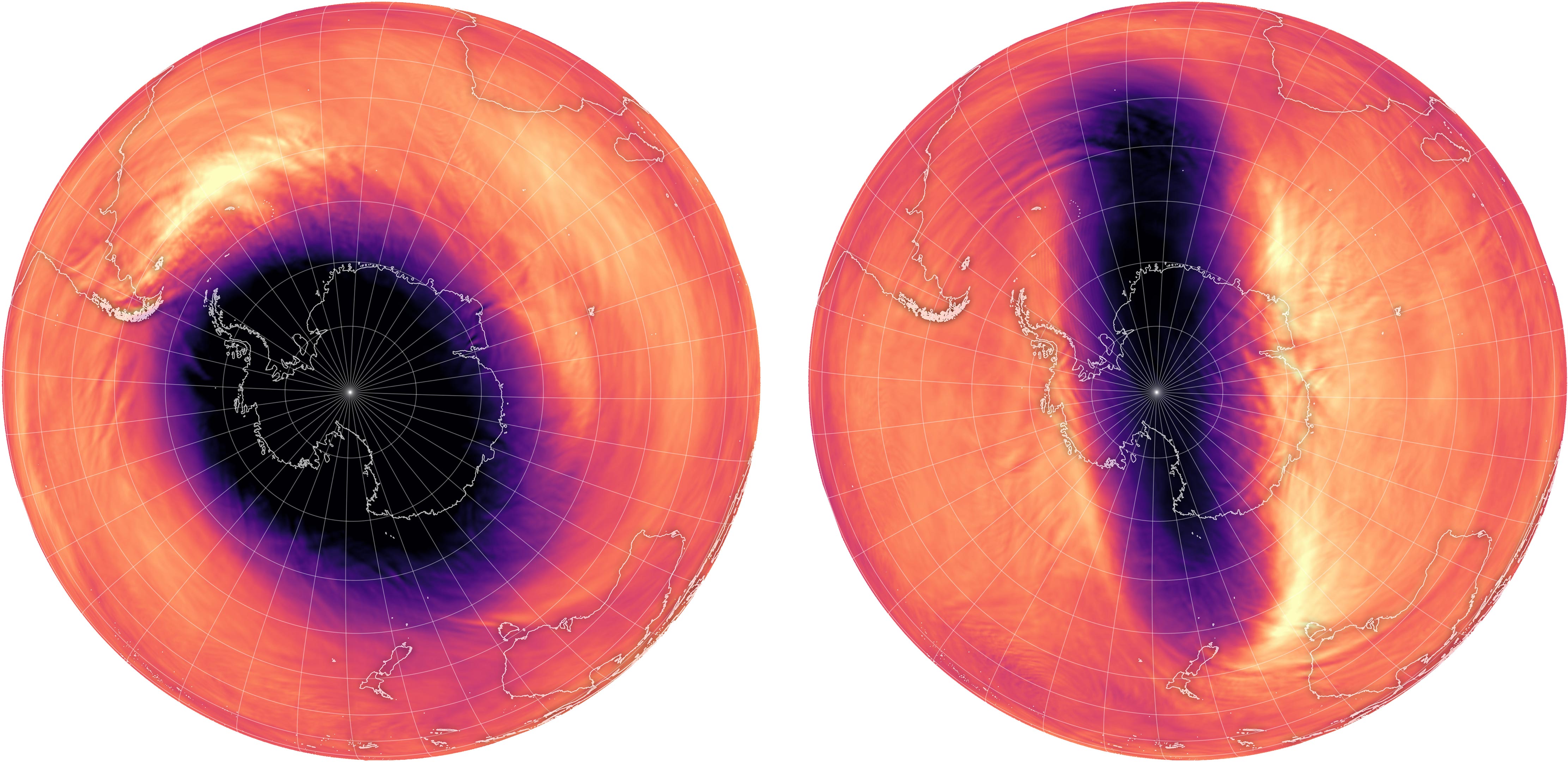
Westerly winds in this layer of the atmosphere loop around the South Pole in winter, moving about 300 kilometers (200 miles) per hour, forming what is known as the polar vortex. But sometimes something happens that disrupts this symmetric circumpolar flow, causing winds to weaken and the flow to change shape. Instead of circulating the South Pole, the polar vortex becomes elongated and winds weaken; the weakening winds result in considerable stratospheric warming over Antarctica.
The maps above show air temperatures in the middle stratosphere (at about 30 kilometers altitude or 10 hectopascals of pressure) for August 5, 2023 (left) and August 5, 2024 (right). The elongation of the polar vortex and higher temperatures closer to the pole are evident in the 2024 map. Data for the maps are from NASA’s GEOS forward processing (GEOS-FP) model, which assimilates meteorological data from satellite, aircraft, and ground-based observing systems.
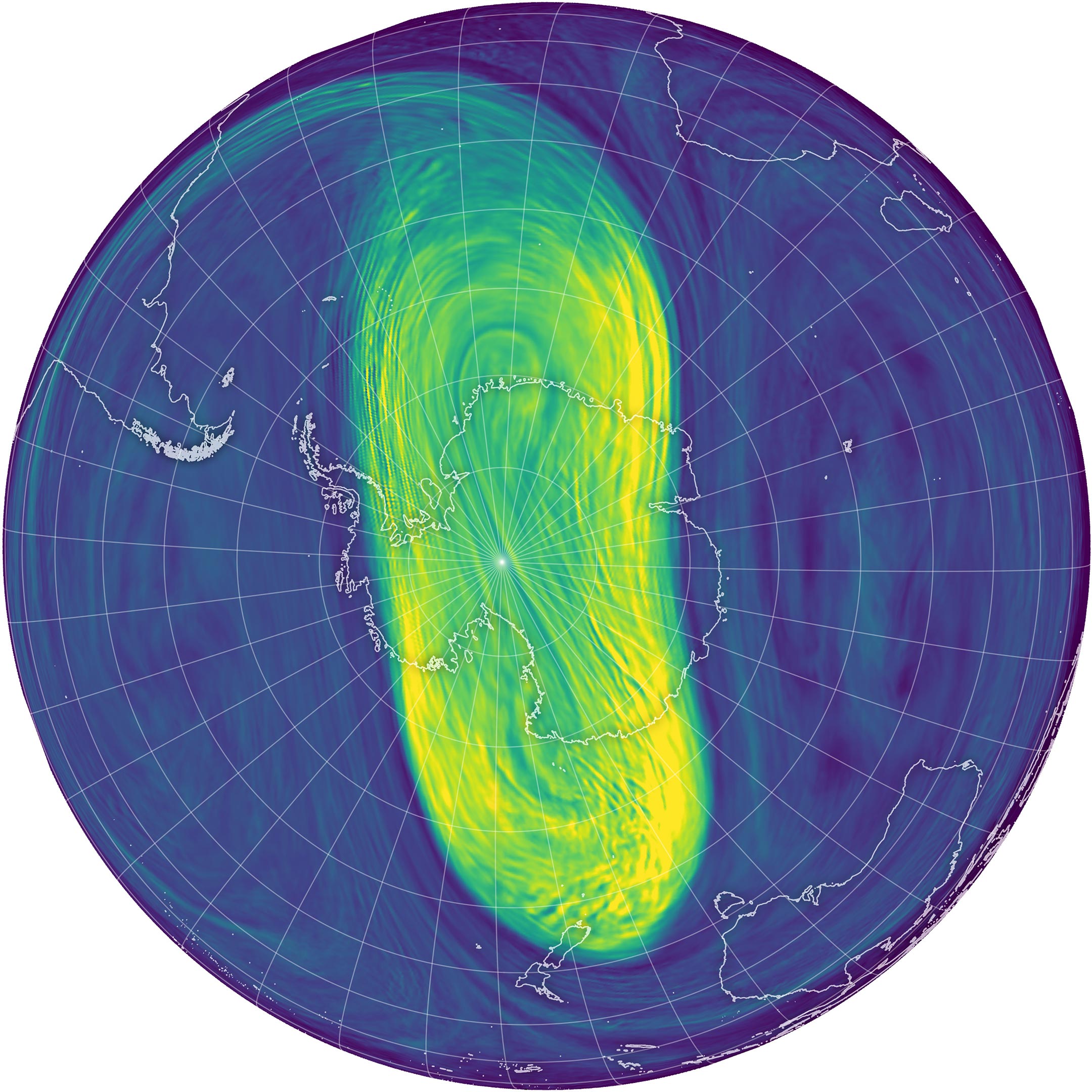
The map below shows potential vorticity—a quantity that describes how air masses are spinning—in the stratosphere on August 5, 2024. Areas of high potential vorticity appear yellow and have a clockwise circulation; areas of low potential vorticity appear purple and have a counterclockwise circulation. The polar vortex had elongated and weakened, and the flow of wind was shaped like a peanut instead of its usual circular pattern.
Comparing Southern and Northern Hemisphere Events
Unlike in the Arctic, which experiences sudden stratospheric warming events about once a year, the polar vortex in the Southern Hemisphere is typically much less active. “Sudden warming events happen in the Antarctic once every five years or so, much less frequently than the Arctic,” Coy said. The reason for this, Coy added, is likely that there is more terrain in the Northern Hemisphere that can disrupt wind flow in the troposphere—the layer of air closest to the ground. These large-scale tropospheric weather systems move upward into the stratosphere and disrupt the polar vortex.
Weather in the Antarctic troposphere was also unusual in July. Temperatures more than 4°C (7.2°F) above average covered large parts of the Antarctic continent, and for the Antarctic region as a whole, the month tied July 1991 as the fifth-warmest July on record. However, Newman noted that attributing the weather that people experience in the troposphere—including a July snowstorm in Australia—to sudden stratospheric warming is not clear cut.

Implications for Weather and Ozone Concentrations
Researchers also continue to investigate the origin of disturbances at the surface that end up disrupting the stratosphere. “Variations in sea surface temperatures and sea ice can perturb these large-scale weather systems in the troposphere that propagate upwards,” Newman said. “But the attribution of why these systems develop is really difficult to do.”
Within the stratosphere, scientists have shown that sudden warming events are tied to higher concentrations of ozone over Antarctica. The stratospheric ozone layer protects life on Earth by absorbing ultraviolet light, which damages DNA in plants and animals (including humans) and can lead to skin cancer. The change of circulation that comes with a stratospheric warming event draws ozone from other latitudes toward the polar region. So far in 2024, the ozone hole over the Southern Hemisphere has been smaller than usual.
NASA Earth Observatory images by Wanmei Liang, using GEOS-FP data courtesy of Lawrence Coy and the Global Modeling and Assimilation Office at NASA GSFC.
Never miss a breakthrough: Join the SciTechDaily newsletter.
Follow us on Google and Google News.
8 Comments
Unlike in the Arctic, which experiences sudden stratospheric warming events about once a year, the polar vortex in the Southern Hemisphere is typically much less active. The synchronous effect of countless vortices makes fluid motion more complex.
Researchers work very hard. However, many conventional knowledge are pseudoscience, so it is important to distinguish them. Please witness the exemplary collaboration between theoretical physicists and experimentalists (https://scitechdaily.com/microscope-spacecrafts-most-precise-test-of-key-component-of-the-theory-of-general-relativity/#comment-854286). Some people in contemporary physics has always lived in a self righteous children’s story world. Whose values have been overturned by such a comical and ridiculous reality?
If worse come to worst, and the entire ice sheet suddenly melts, there’s still a bright side to it: all the most polluting cities of the world will go under.
I call that a natural correction, folks.
“This rare event, differing significantly from the Arctic’s frequent warmings, may affect weather phenomena and ozone levels across the Southern Hemisphere.”
It should be emphasized that the event generally results in less destruction of ozone and therefore higher levels of ozone. However, from the time of the Southern Winter Solstice, about June 20th, there is little direct sunlight south of the Antarctic Circle until the Southern Vernal Equinox, about September 22nd, when sunlight finally reaches the South Pole. That is, because of the long slant range through the atmosphere, which scatters and absorbs UV more strongly than visible light, the lowered ozone level isn’t really a problem. Additionally, some of the light that does reach the ground between the Solstice (when the sun doesn’t rise above the horizon) and Equinox also passes through a region of ozone-enriched stratospheric air outside the Antarctic Circumpolar Vortex. When the vortex breaks up, typically in early-October, the ozone-enriched air is finally able to move into the former interior of the vortex, and quickly replenishes the missing ozone. When the sun reaches its highest level in the sky, about December 21, when protection is most needed, the ozone levels are invariably back to normal.
There is a lot that the public isn’t told about the phenomenon, and when it is expanded upon, it is poorly explained. That may because some of the researchers are so focused on details of their specialty that they don’t have a good grasp of the big picture.
All doom and gloom here. Just so you all know, wonter in Australia is June, July and August. So we normaly get “snow storms” at that time of year. So nothing really sensational in that comment in the story.
Although this will further accelerate Thwaites Glacier collapse which will put coastal nuclear power stations at ever increasing meltdown risk but hey..nothing sensational…
Your unexamined (and even unstated) assumption is that Thwaites Glacier IS collapsing. At best, some irresponsible researchers have speculated that it COULD collapse. You have equated “could” with “is.” They are not logically equivalent — but hey..nothing rational…
Thanks, I know we are kept in the dark a lot. You are lifting the dark sheets a little, if only sowing some curiosity.
In case you missed it, you might want to read this:
https://scitechdaily.com/rethinking-the-doomsday-glacier-scientists-challenge-alarming-antarctic-ice-collapse-predictions/