

Artemis II is so perfectly on course that NASA skipped a burn—while the crew gears up for a once-in-a-lifetime view of the Moon’s hidden side.
NASA’s Artemis II crew continues its journey toward the Moon on an exceptionally accurate path, allowing flight controllers to cancel the spacecraft’s first planned outbound trajectory correction burn. Teams at mission control in NASA’s Johnson Space Center in Houston confirmed that Orion is already on the correct flight path for its upcoming lunar flyby on Monday, April 6.
The canceled maneuver was originally the first of three scheduled trajectory adjustments designed to fine-tune Orion’s speed and direction. Any needed corrections can still be made during later burns if required, but for now, the spacecraft remains right where it needs to be.
First Humans Beyond Earth Orbit Since Apollo
Following a successful translunar injection burn on April 2, the Artemis II astronauts began their second full day in space after about eight hours of rest. With that milestone maneuver complete, NASA astronauts Reid Wiseman, Victor Glover, and Christina Koch, along with CSA (Canadian Space Agency) astronaut Jeremy Hansen, became the first humans to travel beyond Earth orbit since the Apollo era in 1972.
Mission control woke the crew at 1 p.m. EDT with the song “…In a Daydream,” by the Freddy Jones Band, marking the start of a busy schedule focused on deep space operations, spacecraft systems, and science preparations. At that time, Orion was about 99,900 statute miles from Earth and closing in on the Moon, which was roughly 161,750 statute miles away.
Trajectory Holds Steady Without Adjustment
Although a trajectory correction burn had been planned for later in the day, it ultimately was not needed. These short engine firings are typically used after major maneuvers to make small adjustments to a spacecraft’s path. The planned burn would have lasted about eight seconds and changed Orion’s velocity by 0.7 feet per second.
Instead, the spacecraft’s current trajectory proved accurate enough to skip the maneuver entirely, highlighting the precision of the mission’s navigation so far.
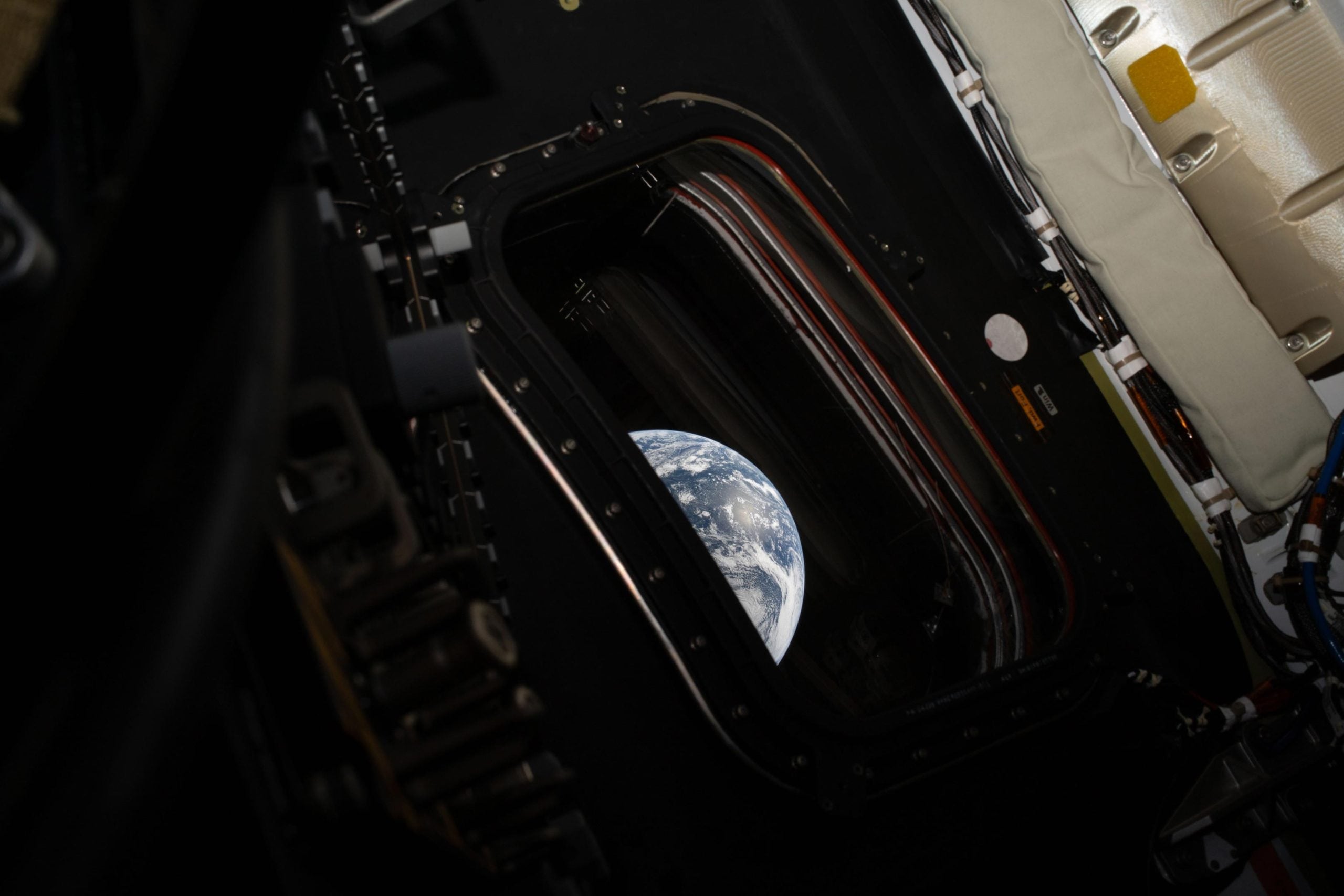
Preparing for a Rare View of the Moon’s Far Side
As Orion continues toward the Moon, scientists and engineers are finalizing plans for a six-hour observation period during the upcoming flyby. During this time, the alignment of the Sun, Moon, and spacecraft will allow the crew to see about 20% of the Moon’s far side illuminated.
This region, which cannot be seen from Earth, includes features such as the Orientale basin, Pierazzo crater, and Ohm crater. Several of these formations are expected to be visible to the astronauts without the aid of instruments.
Inside the spacecraft, the crew has been preparing for these observations by organizing equipment, setting up cameras, and practicing movement in microgravity within the tight cabin space, roughly comparable to the size of two minivans. They are also configuring handheld cameras with 80-400-millimeter and 14-24-millimeter lenses that will be used to capture images during the flyby.
Health Tests and Deep Space Communications
The astronauts also carried out medical training exercises, including demonstrations of CPR and choking response procedures, to evaluate how emergency care could be handled in space. Maintaining physical health remains a priority, with all four crew members continuing regular workouts using Orion’s flywheel exercise system to support cardiovascular fitness.
Later in the day, Christina Koch tested Orion’s emergency communication capabilities using NASA’s Deep Space Network. The system was successfully evaluated as the spacecraft moved farther from Earth.
In addition, the Orion Artemis II Optical Communications System connected with two ground stations in the United States, sending high-definition video and other mission data back to Earth. The information was quickly relayed to mission control in Houston, confirming that communication systems were performing as expected during the mission’s early deep-space phase.
Never miss a breakthrough: Join the SciTechDaily newsletter.
Follow us on Google and Google News.
2 Comments
You’re all being played, this isn’t by NASA! WAIT FOR THE DISCLOSURE! YOU WERE ALL PUNKED!
You’re all being played, this isn’t by NASA! WAIT FOR THE DISCLOSURE! YOU WERE ALL PUNKED!