
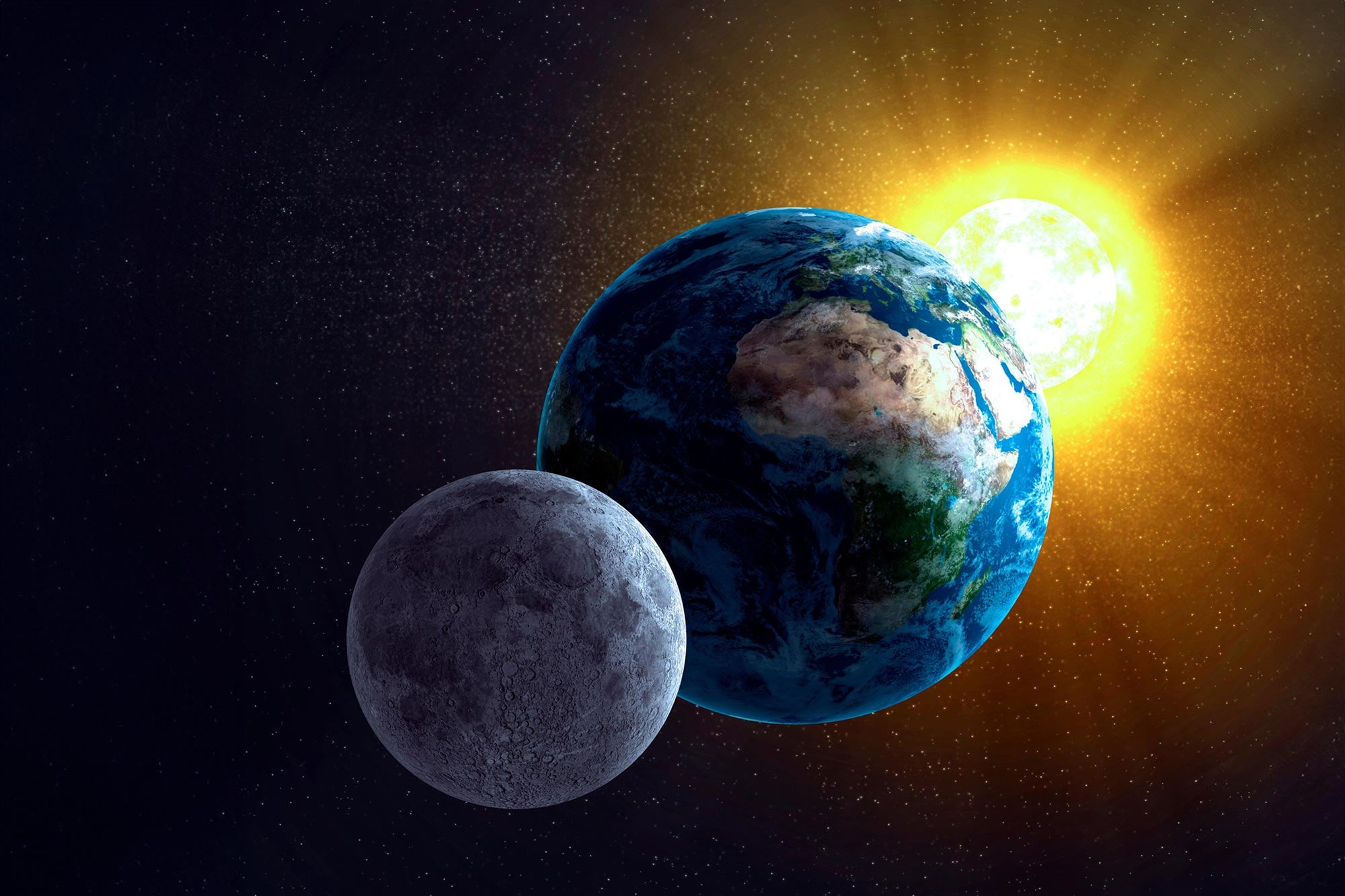
Strange magnetic surges above the Moon have baffled scientists for years. A new model points to an unexpected plasma interaction as the culprit.
It is well known that the Moon lacks a strong magnetosphere. Without this protective layer, the solar wind directly bombards its surface, strips away material, and electrically charges the fine, hazardous dust that covers it. Yet for about 60 years, scientists have observed brief surges in magnetic strength in certain regions, with some reaching up to 10 times the Moon’s usual background levels.
These events, known as “lunar external magnetic enhancements” (LEMEs), have remained unexplained since their discovery. Researchers have struggled to understand both their origin and how they extend far enough above the surface to be detected by spacecraft.
A new study in The Astrophysical Journal Letters by Shu-Hua Lai and colleagues at National Central University in Taiwan proposes that these signals are produced by a previously unrecognized form of the Kelvin-Helmholtz instability.
This instability can sometimes be seen on Earth as rolling, wave-like cloud patterns. It occurs when two fluids, or in space two streams of plasma, move past each other at different speeds, creating a velocity shear that drives the formation of waves.
Limits of Previous KHI Models
In the case of LEMEs, scientists knew the solar wind slammed into these “minimagnetospheres” created by surface anomalies of magnetic material in lunar regolith. But, they believed the KHI caused by this interaction would be localized to only the boundary where the two meet. It couldn’t explain why they were seeing magnetic fields on spacecraft hundreds of kilometers above the surface.
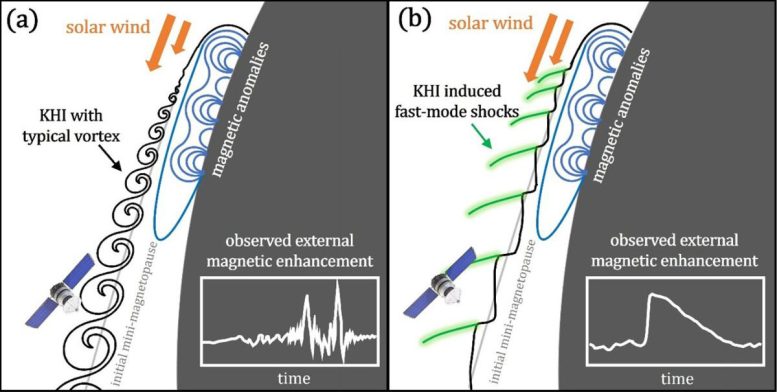
Like many physical phenomena, KHI requires a lot of complex math, and Dr. Shu-Hua and her colleagues realized that, to explain these LEMEs, scientists were using a simplified form of math for the calculation of how the KHI would appear at the boundary. Instead, they were interested in using what is known as a “nonlinear” branch of the same phenomena.
Basically, they used some more advanced math to model the KHI in a way that better reflected what they believed was actually happening at the boundary between the minimagnetosphere caused by the magnetic material in the Moon’s surface and the solar wind.
To prove their idea, they turned to simulations – in this case, non-linear magnetohydrodynamic simulations. They created three “cases” that each represented different solar wind speeds and that resulted in different types of KHI “regimes.” The two cases with higher wind speeds resulted in a “shock-dominated” KHI regime that produced fast, upward-propagating shock waves of magnetic fields – matching much of the data collected by spacecraft on LEMEs over the years.
Video describing the Lunar Vertex mission, which will explore more of the Moon’s magnetic anomalies. Credit: Taiwan Space Union YouTube Channel
Simulation Results and Magnetic Field Amplification
However, even at slow solar wind speeds, the “vortex-dominated” KHI regime that was created still locally amplified the magnetic field up to around 30-40 times the ambient level near the boundary layer. But, surprisingly, even in this regime, the waves from the near-surface vortex still propagate upwards into denser plasma, creating secondary waves at much higher altitudes.
Most importantly, the simulation data matched some real observations collected by Lunar Prospector back in 1998. It proved that the nonlinear version of the KHI instability was capable of producing the types of magnetic fields seen in the data. And the fact that all the different types of magnetic field shocks and vortices could be accounted for by this improvement in the mathematical modeling showcases how a simple tweak in how scientists look at a problem could break open a decades-long mystery.
It isn’t only the Moon this study could be applicable to, though. The researchers note that this same mechanism is likely happening on Mars. Recent observations from MAVEN have already confirmed that KHI can develop in the Martian plasma environment, and there are plenty of Martian crustal anomalies analogous to those on the Moon that could interact in the same way. So, in fact, in addition to explaining a 60-year-old mystery, this new model of KHI plasma interactions could hold clues about the space environment on plenty of other weakly magnetized bodies across our solar system.
Reference: “Shock-like Magnetic Enhancements Generated by Kelvin–Helmholtz Instability above Weakly Magnetized Bodies” by Shu-Hua Lai, Kaiti Wang and Ya-Hui Yang, 2 March 2026, The Astrophysical Journal Letters.
DOI: 10.3847/2041-8213/ae4745
Adapted from an article originally published in UniverseToday.
Never miss a breakthrough: Join the SciTechDaily newsletter.
Follow us on Google and Google News.