
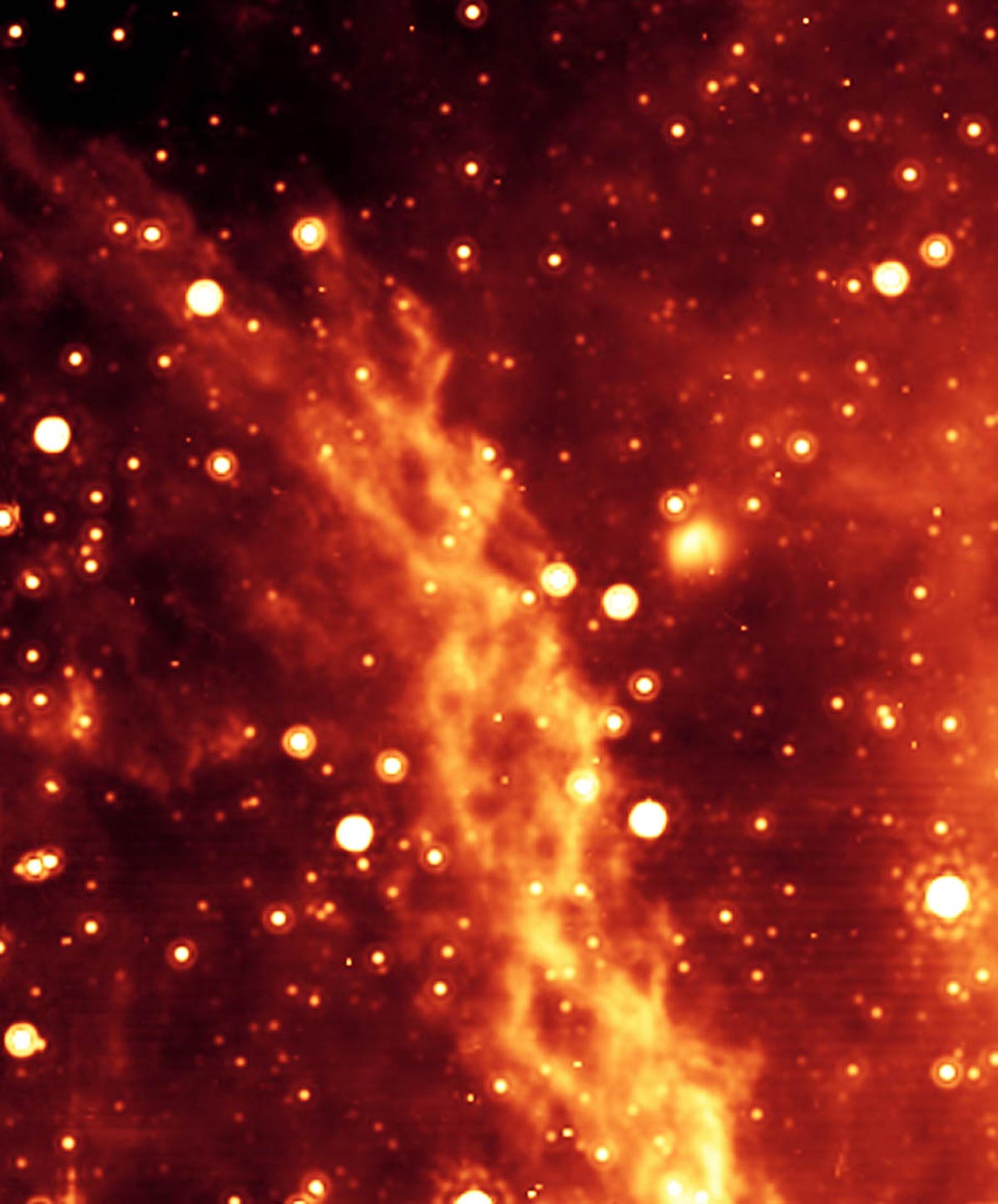
Caltech experiments uncovered a stable double helix state in plasma flux ropes. The same principles explain cosmic structures such as the Double Helix Nebula.
Research into the Sun’s outer atmosphere has led Caltech applied physics professor Paul Bellan and his former graduate student Yang Zhang (PhD ’24) to identify a previously unknown equilibrium state of magnetic fields and the plasma they contain. The solar corona, the Sun’s outermost atmospheric layer, is far less dense than the surface, yet it reaches temperatures a million times higher.
This region is dominated by powerful magnetic fields that trap plasma, a hot mixture of charged particles (electrons and ions). The newly identified equilibrium, known as a double helix, is not limited to the corona but also appears in much larger cosmic systems, including the Double Helix Nebula near the center of the Milky Way.
Solar activity such as flares often takes the shape of magnetic flux ropes, which are twisted tubes of magnetic field filled with plasma. One way to picture a flux rope is to imagine a garden hose filled with plasma and wrapped in a spiral stripe. Along the hose runs an electric current, while the spiral represents the helical magnetic field surrounding it. Because plasma carries electric charge, it conducts current and becomes bound—or “frozen”—to the magnetic field.
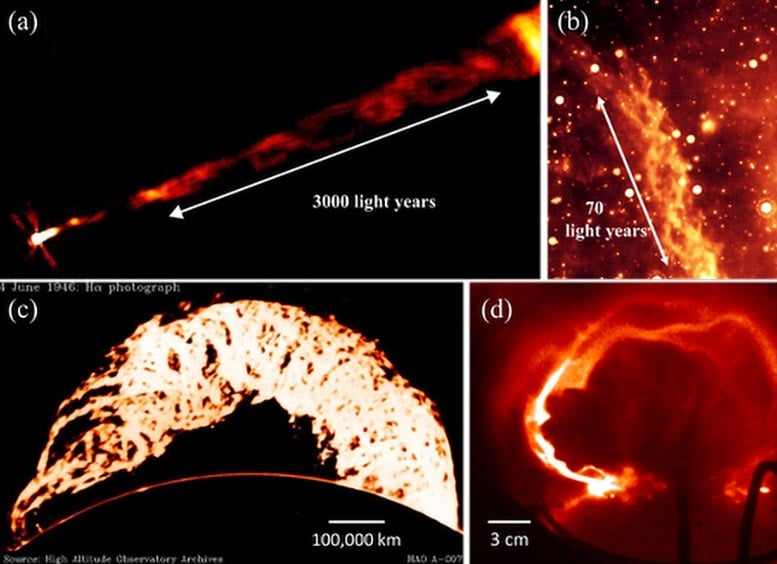
These magnetic flux ropes appear across a remarkable range of scales, from small laboratory setups to massive solar flares spanning hundreds of thousands of kilometers. In astrophysics, similar rope-like structures can extend across hundreds or even thousands of light-years.
Creating plasma braids in the lab
Inside a large vacuum chamber, Bellan and Zhang (now a NASA Jack Eddy postdoctoral fellow at Princeton) created miniature versions of solar flares measuring just 10 to 50 centimeters in length. Yang describes the process: “We have two electrodes inside the vacuum chamber, which has coils producing a magnetic field spanning the electrodes. Then we apply high voltage across the electrodes to ionize initially neutral gas to form a plasma. The resulting magnetized plasma configuration automatically forms a braided structure.”
In this setup, two flux ropes entwine to form a double helix. Remarkably, this braided formation was found to be self-stabilizing—it held its shape without either tightening or unraveling. In their recent publication, Zhang and Bellan show that this equilibrium state can be mathematically described and predicted with precision.
While the physics of single flux ropes is well documented, far less was known about braided flux ropes, particularly in cases where the electric currents in both strands flow in the same direction. Previous studies had mainly modeled the alternative case, with currents moving in opposite directions, but this is believed to be uncommon in real astrophysical environments.
The same-direction current pattern is of special interest because it should, in theory, be vulnerable to distortion through kinking or expansion driven by hoop forces—effects that scientists have observed in both solar braids and lab-based plasma experiments. By contrast, when currents flow in opposite directions (a “no-net-current” state), these distortions are not expected to occur.
Rethinking assumptions about merging
Previously, scientists assumed that braided flux ropes where the strands have current flowing in the same direction would always merge, because parallel currents magnetically attract each another. However, in 2010, researchers at Los Alamos National Laboratory found that such flux ropes instead bounce off one another as they come closer together.
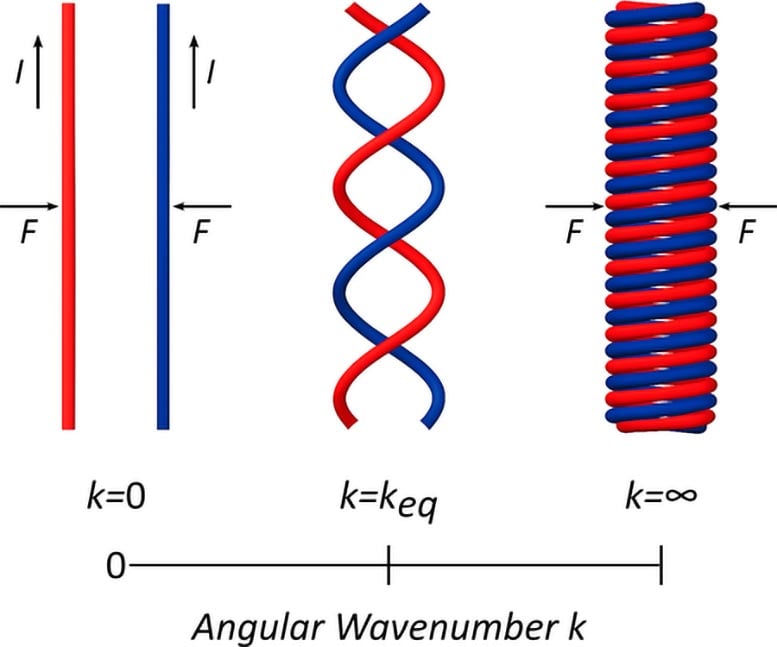
“There was clearly something more complicated going on when the flux ropes are braided, and now we have shown what that is,” Bellan says. “If you have electrical currents flowing along two helical wires that wrap around each other to form a braided structure, as seen in our lab, the components of the two currents flowing along the length of the two wires are parallel and attract, but the components of the two currents flowing in the wrapping direction are anti-parallel and repel. This combination of both attractive and repulsive forces means there will be a critical helical angle at which these opposing forces balance, producing an equilibrium. If the helical flux ropes twist tighter, there will be too much magnetic repulsion; if they twist more loosely, there will be too much magnetic attraction. At the critical angle of twist, the helical structure arrives at its lowest energy state, or equilibrium.”
Building a mathematical model
The next task was to create a mathematical model of this behavior—something not previously done. Using what Bellan describes as “brute force mathematics,” Zhang created a set of equations that could apply to multiple flux tubes in various configurations, including braided ropes, and showed there is indeed a state at which the attractive and repulsive forces balance each other, creating an equilibrium. “And as an unexpected bonus, Yang can calculate the magnetic fields inside and outside the flux ropes, and the current and pressure inside them,” Bellan says, “giving us a full picture of the behavior of these braided structures.”
Zhang tested his mathematical model against the Double Helix Nebula, an astrophysical plasma formation located 25,000 light-years from Earth that covers a 70 light-year swath of space, to see if the equations could describe a large model as well as it did the structures he and Bellan created in the lab. “What was rather amazing about this calculation is that Yang didn’t really need to know much about the nebula,” Bellan says.
“Just knowing the diameter of the strands and the periodicity of the twist, numbers that can be observed astronomically, Yang was able to predict the angle of twist that yielded an equilibrium structure, and that was consistent with observations of this nebula. One of the most exciting aspects of this research is that magnetohydrodynamics, the theory of magnetized plasmas, turns out to be fantastically scalable. When I first started looking into this, I thought the phenomena of magnetic structures at different scales were qualitatively similar, but because their sizes are so different, they couldn’t be described by the same equations. It turns out that this is not so. What we see in lab experiments and in solar and astrophysical observations are governed by the same equations.”
Reference: “Magnetic Double Helix” by Yang Zhang and Paul M. Bellan, 30 July 2025, Physical Review Letters.
DOI: 10.1103/sz9k-6l22
Never miss a breakthrough: Join the SciTechDaily newsletter.
Follow us on Google and Google News.
4 Comments
B note 2509051252_Source1.Reinterpreting
Source 1.
https://scitechdaily.com/caltech-physicists-discover-double-helix-a-new-equilibrium-state-of-cosmic-plasma/
1
Physicists at the California Institute of Technology have discovered a new equilibrium state of cosmic plasma: a “double helix.”
California Institute of Technology September 4, 2025
_Double helix nebulae. These points are stars that emit infrared light, mostly red giants and red supergiants.
【>>>>>
> Most nebulae around galaxies are the energy sources of accretion disks that make stars or black holes.
> The nebula quickly creates a plasma band nqvixer to form stars or black holes
<<<Sung-woon’s magnetic field band forms an accretion disk, and after the residual stars whirl wildly make the big star’s seed msbase4.*672.graphic, huh…
>Accelerate the band of high-temperature plasma with an nqvixer. Uh-huh.
*
<<>>>>
>The flux of the magnetic field is blue at nqvixer and the plasma is red. Long twists and knots of entanglement appear where the two parallel lines meet.
<<<<>>>
> The double line of magnetic field flux in the laboratory is compared to the rope of the Sun’s plasma.
> The problem seems to be approaching the target, where the linear magnetic field and plasma are intertwined like a mass of nqcells, but in reality, it seems to be a flow of n.pointer(sample2.2p) pairs from the point of view that is not the target standard. Huh.
2-1. Making Plasma Braid in the Laboratory
Bellan and Zhang (now a postdoctoral researcher at Princeton University NASA Jack Eddy) have produced a small version of a solar flare that is only 10 to 50 cm long inside a large vacuum chamber.
_Yang describes the process as follows: “There are two electrodes inside the vacuum chamber, which have coils that produce magnetic fields across the electrodes.
_Then, a high voltage is applied to the electrode to ionize the initial neutral gas to form plasma. As a result, the magnetized plasma structure automatically forms a twisted structure.”
2-2.
_In this structure, two flux ropes are entangled in one another to form a double helix.
_Surprisingly, this twisted shape has been found to stabilize itself. In other words, it remains in shape without being tightened or loosened.
_In a recently published paper, Zhang and Bellan showed that these equilibrium states can be described and predicted mathematically accurately.
_Figure of two wires with the same current direction. At k=0, the wires move parallel to each other and attract each other.
_At k=∞, wires are tightly coiled and repelled. At the midpoint, wires attract and repel each other to the same extent, achieving stable equilibrium. Source: Yang Chang, Caltech Bellan Plasma Laboratory
2-3.
_While the physics of a single flux rope is well known, much less is known for twisted flux ropes, especially for the case where two-strand currents flow in the same direction.
【>>>>
>Nqvixer is a two-stranded energy band (current, gravitational wave, light wave, etc.) that flows close to each other as if twisted.
<<<<】
_Previous studies have mainly modeled other cases in which current flows in opposite directions, but these are considered rare in real astrophysical environments.
3.
_The co-directional current patterns are particularly interesting, as they should theoretically be susceptible to twisting or distortion due to expansion by hoop forces.
_The scientists observed these effects in both solar braid and laboratory-based plasma experiments.
_Conversely, this distortion is not expected to occur when the current flows in the opposite direction (in the "no net current" state).
3-1. Household inventory for mergers
_Previously, scientists assumed that twisted flux ropes with currents flowing in the same direction would always merge.
Nice article! What determines the radius of the helix? The article explains how two components of the force that balance determine the slope of the helix, radians/length, in cylindrical coordinates; but what determines the radius of the helix?
The animation for how electricity flows double helically in a wire was developed and made public 15 years ago: https://www.youtube.com/@MagneticUniverse
The discovery maybe a lot more important , seeing is believing entanglement of space-time and how the helix is not observable without contrast , I have a thought that the helix configuration exists in the 3D rendering of the gravity well that holds planets in their position , same at the quantum with regards to the entanglement .