
Close Menu
    Facebook X (Twitter) Instagram
    SciTechDaily
    • Biology
    • Chemistry
    • Earth
    • Health
    • Physics
    • Science
    • Space
    • Technology
    Facebook X (Twitter) Pinterest YouTube RSS
    SciTechDaily
    Home»Space»Collapsing Plasma May Hold the Key to Cosmic Magnetism
    Space

    Collapsing Plasma May Hold the Key to Cosmic Magnetism

    By Tata Institute of Fundamental ResearchApril 6, 20262 Comments4 Mins Read
    Facebook Twitter Pinterest Telegram LinkedIn WhatsApp Email Reddit
    Share
    Facebook Twitter LinkedIn Pinterest Telegram Email Reddit
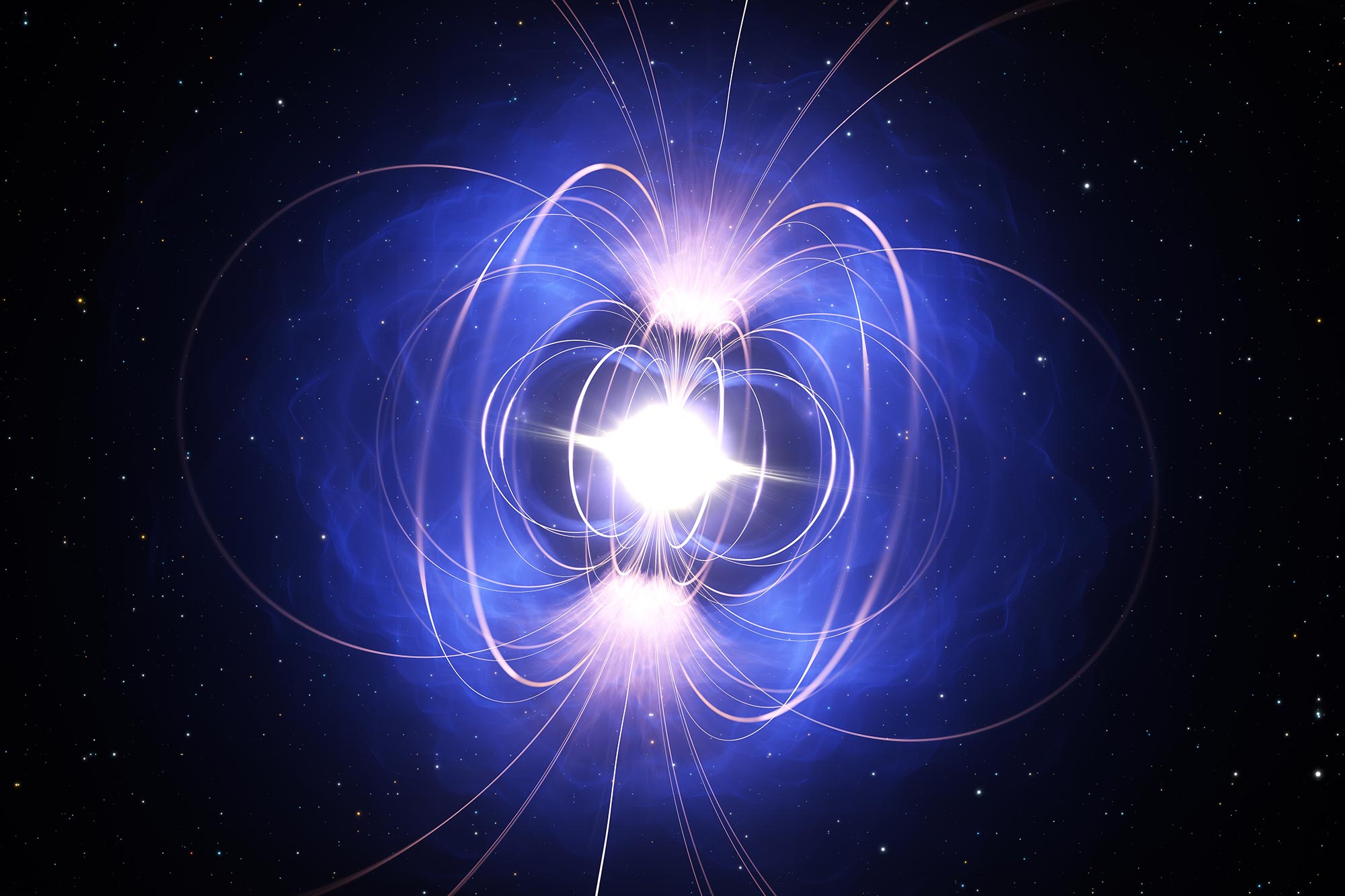
    Magnetar Neutron Star With Powerful Magnetic Field
    Magnetic fields stretching across entire galaxies may form far faster than traditional theories predict. By examining how collapsing plasma behaves during galaxy formation, researchers uncover a mechanism that accelerates magnetic growth beyond standard expectations. Credit: Shutterstock

    Galactic magnetic fields may arise surprisingly fast, driven by collapsing plasma and turbulent flows.

    How quickly can a galaxy develop organized magnetic fields that stretch across thousands of light-years? Traditional models suggest this process takes billions of years, yet observations of real galaxies point to much faster timelines.

    A study published in Physical Review Letters offers a possible solution to this mismatch. The researchers propose that as plasma clouds collapse during galaxy formation, they can rapidly boost the growth of magnetic fields.

    Most visible matter in the universe exists as plasma, a state that responds to forces such as gravity, temperature differences, and rotation. These forces can generate turbulence, and under such conditions, dynamo theory predicts that existing magnetic fields become stronger. This theory remains the main tool scientists use to explain how cosmic magnetic fields originate.

    “However, dynamo theory has its limitations,” says Pallavi, an assistant professor at the International Centre for Theoretical Sciences (ICTS) and a co-author of the study. “In particular, it struggles to explain observations of young galaxies with robust magnetic fields across thousands of light-years.”

    A New Perspective on Galaxy Formation

    The study examines how dynamo processes might behave differently during the early stages of galaxy formation. It focuses on a collapsing cloud of ionized gas, a key step in building galaxies. “When the galaxy is forming, gravity itself can stir the plasma, which can amplify magnetic fields,” says Irshad, a graduate student at ICTS and the study’s lead author.

    Using analytical methods, the researchers show that this gravity-driven motion can speed up the development of magnetic fields. Their results suggest that these fields could form much earlier than previously believed.

    They link this effect to changes in turbulent motion during collapse. Turbulence creates swirling patterns called eddies, similar to currents in flowing water. The rate at which magnetic fields grow depends on how quickly these eddies rotate, known as the turnover rate.

    As the cloud contracts, this turnover rate increases. The team found that this leads to “super exponential” growth in magnetic strength, offering a way to explain the strong magnetic fields seen in young galaxies. Their numerical results also indicate that these fields can become stronger than predictions based on standard dynamo theory.

    Mathematical Framework and Limitations

    To carry out their analysis, the researchers used a mathematical approach known as “supercomoving coordinates.” In cosmology, this method accounts for the expansion of the universe.

    “These coordinates essentially make the equations of a collapsing galaxy the same as a static galaxy, making the calculations very straightforward,” says Irshad. “This works well for a uniformly collapsing spherical system, but we would need to extend this study for more realistic cases.”

    Despite these insights, key questions remain. “There’s still much to learn in this ‘zeroth-order question you ask about the timescale’ too,” says Pallavi. Scientists are developing computational models to simulate how structures form in the universe, and this study provides predictions that could help test and refine those models.

    Although magnetic forces are usually much weaker than gravity in shaping cosmic structures, the findings suggest that strong, ordered magnetic fields may have emerged earlier than expected. Over time, these fields may have played a subtle but lasting role in guiding the evolution of the universe.

    Reference: “Turbulent Dynamos in a Collapsing Cloud” by Muhammed Irshad P., Pallavi Bhat, Kandaswamy Subramanian and Anvar Shukurov, 5 March 2026, Physical Review Letters.
    DOI: 10.1103/fp1v-xrr5

    Never miss a breakthrough: Join the SciTechDaily newsletter.
    Follow us on Google and Google News.

    Astrophysics Cosmology Galaxy Magnetic Fields Plasma Physics Popular Tata Institute of Fundamental Research
    Share. Facebook Twitter Pinterest LinkedIn Email Reddit

    Related Articles

    Universe’s First Magnetic Fields Were As Weak as Human Brain Waves

    Earth Could Be in a Massive Cosmic Bubble That’s Warping the Universe, Astrophysicists Reveal

    Galaxy Clusters Unveil New Evidence for Prevailing Theory of Universe

    Remarkable Similarities – New Analysis Reveals Links Between Galaxies Near and Far

    The Hunt for Cosmic Dawn: HERA Doubles Sensitivity to Unlock the Secrets of the Early Universe

    Unlocking One of the Most Profound Cosmological Mysteries: How the Universe Got Its Magnetic Field

    The Sun Is Spinning Round Again: Solving Part of the “Solar Problem”

    Probing the Nature of Dark Matter Using Gravitational Waves

    Scientists Use 196 Lasers To Recreate the Conditions Inside Gigantic Galaxy Clusters – “One of the Most Awe-Inspiring Things in the Universe”

    2 Comments

    1. kamir bouchareb st on April 6, 2026 12:05 pm

      good

      Reply
    2. Steve Nordquist on April 9, 2026 1:11 am

      We are made of -star stuff- cosmic susceptibility.

      Reply
    Leave A Reply Cancel Reply

    • Facebook
    • Twitter
    • Pinterest
    • YouTube

    Don't Miss a Discovery

    Subscribe for the Latest in Science & Tech!

    Trending News

    Collapsing Plasma May Hold the Key to Cosmic Magnetism

    This Breakthrough Solar Panel Generates Power From Both Sunlight and Raindrops

    Scientists Uncover New Metabolic Effects Beyond Weight Loss of Mounjaro

    Scientists Discover Cancer Tumors Are “Addicted” to This Common Antioxidant

    1,800 Miles Down: Scientists Uncover Mysterious Movements at the Edge of Earth’s Core

    Scientists Discover Hidden “Good Fats” in Green Rice That Could Transform Nutrition

    Your Child’s Clothes Could Contain Toxic Lead, Study Finds

    Researchers Break a 150-Year-Old Math Law With a Surprising Donut Discovery

    Follow SciTechDaily
    • Facebook
    • Twitter
    • YouTube
    • Pinterest
    • Newsletter
    • RSS
    SciTech News
    • Biology News
    • Chemistry News
    • Earth News
    • Health News
    • Physics News
    • Science News
    • Space News
    • Technology News
    Recent Posts
    • The Mystery of the Notes: Why No One Knows How This 120-Year-Old Song Should Sound
    • Scientists Discover 132-Million-Year-Old Dinosaur Tracks on South Africa’s Coast
    • Scientists Uncover the Secret Ingredient Behind the Spark That May Have Started Life on Earth
    • Natural Oils vs. Antibiotics: The Swine Study That Could Change Farming
    • The Biggest Volcanic Event in Earth’s History Transformed an Entire Oceanic Plate
    Copyright © 1998 - 2026 SciTechDaily. All Rights Reserved.
    • Science News
    • About
    • Contact
    • Editorial Board
    • Privacy Policy
    • Terms of Use

    Type above and press Enter to search. Press Esc to cancel.