
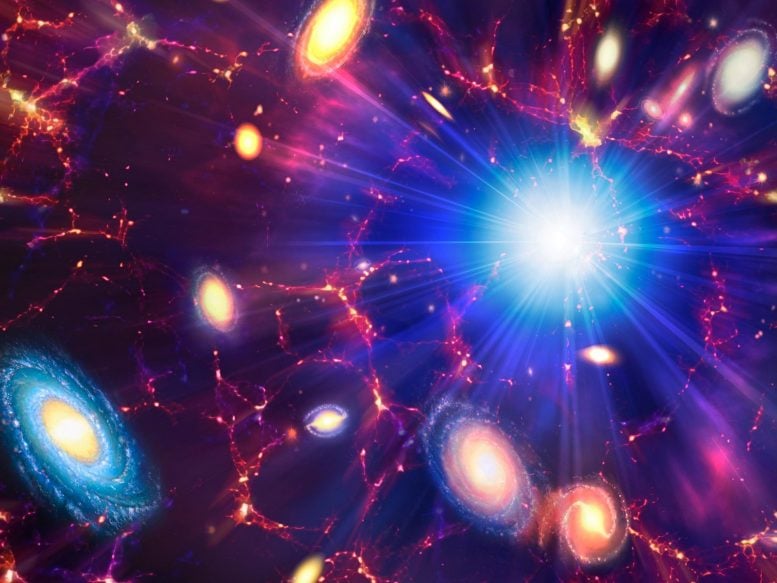
Physicists from SLAC National Accelerator Laboratory and Stanford University have found fresh evidence supporting the Lambda-CDM model of the universe, using data derived from the structure of galaxy clusters. They observed a consistent relationship between cluster mass, central concentration, and redshift, reinforcing the validity of the standard cosmological model. The team plans to expand its research by increasing the size of its observational and simulated datasets.
Cosmologists have discovered new support for the standard model of cosmology through their analysis of the structure of galaxy clusters.
A recent study conducted by a team of physicists from the Department of Energy’s SLAC National Accelerator Laboratory and Stanford University has produced in-depth measurements of X-ray emission from galaxy clusters. These measurements have revealed the internal distribution of matter within the clusters and, as a result, have provided the scientists with an opportunity to examine the Lambda-CDM theory, the current prevailing explanation for the structure and evolution of the universe.
Getting there wasn’t an easy task, however.
Here’s the trouble: Inferring the mass distributions of galaxy clusters from their X-ray emission is most reliable when the energy in the gas within clusters is balanced by the pull of gravity, which holds the whole system together. Measurements of the mass distributions in real clusters, therefore, focus on those that have settled down to a “relaxed” state. When comparing to theoretical predictions, it is, therefore, essential to take this selection of relaxed clusters into account.
Keeping this in mind, Stanford physics graduate student Elise Darragh-Ford and her colleagues examined computer-simulated clusters produced by the The Three Hundred Project. First, they computed what the X-ray emission for each simulated cluster should look like. Then, they applied the same observational criteria used to identify relaxed galaxy clusters from real data to the simulated images to winnow the set down.
Consistency Between Observations and Simulations
The researchers next measured the relationships between three properties – the cluster mass, how centrally concentrated this mass is, and the redshift of the clusters, which reflects how old the universe was when the light we observe was emitted – for both the simulated Three Hundred Project clusters and 44 real clusters observed with NASA’s Chandra X-ray Observatory.
The team found consistent results from both data sets: overall, clusters have become more centrally concentrated over time, while at any given time, less massive clusters are more centrally concentrated than more massive ones. “The measured relationships agree extremely well between observation and theory, providing strong support for the Lambda-CDM paradigm,” said Darragh-Ford.
In the future, the scientists hope to be able to expand the size of both the observed and simulated galaxy cluster data sets in their analysis. SLAC-supported projects coming online in the next few years, including the Rubin Observatory’s Legacy Survey of Space and Time and the fourth-generation cosmic microwave background experiment (CMB-S4), will help identify a much larger number of galaxy clusters, while planned space missions, such as the European Space Agency’s ATHENA satellite, can follow up with X-ray measurements. SLAC cosmologists are also working to expand the size and accuracy of computer simulations of the cosmos, making it possible to study galaxy clusters in greater detail and place stringent limits on alternative cosmological scenarios.
Reference: “The Concentration–Mass relation of massive, dynamically relaxed galaxy clusters: agreement between observations and ΛCDM simulations” by Elise Darragh-Ford, Adam B Mantz, Elena Rasia, Steven W Allen, R Glenn Morris, Jack Foster, Robert W Schmidt and Guillermo Wenrich, 23 February 2023, Monthly Notices of the Royal Astronomical Society.
DOI: 10.1093/mnras/stad585
The study was funded by the National Aeronautics and Space Administration and the DOE Office of Science.
Never miss a breakthrough: Join the SciTechDaily newsletter.
Follow us on Google and Google News.
4 Comments
Nice picture. Really helps.
Q.) How can they simulate such beautiful realistic-looking galaxies?
A.) They can’t, because the standard model with General Relativity + dark matter is one big bad cosmic joke on everyone.
Galaxy clusters do not support a prevailing theory of the universe.
Where is the evidence to support the prevailing theory that galactic clusters provide insight into the formation of tge universe not onky doesn’t make any sense but is groundless. The contextualization of this groundless theory is its completely devoid of scientific inference.
The dark matter is made of invisible particles that put a gravitational charge on ordinary matter