
Close Menu
    Facebook X (Twitter) Instagram
    SciTechDaily
    • Biology
    • Chemistry
    • Earth
    • Health
    • Physics
    • Science
    • Space
    • Technology
    Facebook X (Twitter) Pinterest YouTube RSS
    SciTechDaily
    Home»Space»Solar Flares Are 6.5 Times Hotter Than We Thought
    Space

    Solar Flares Are 6.5 Times Hotter Than We Thought

    By University of St. AndrewsSeptember 13, 20253 Comments3 Mins Read
    Facebook Twitter Pinterest Telegram LinkedIn WhatsApp Email Reddit
    Share
    Facebook Twitter LinkedIn Pinterest Telegram Email Reddit
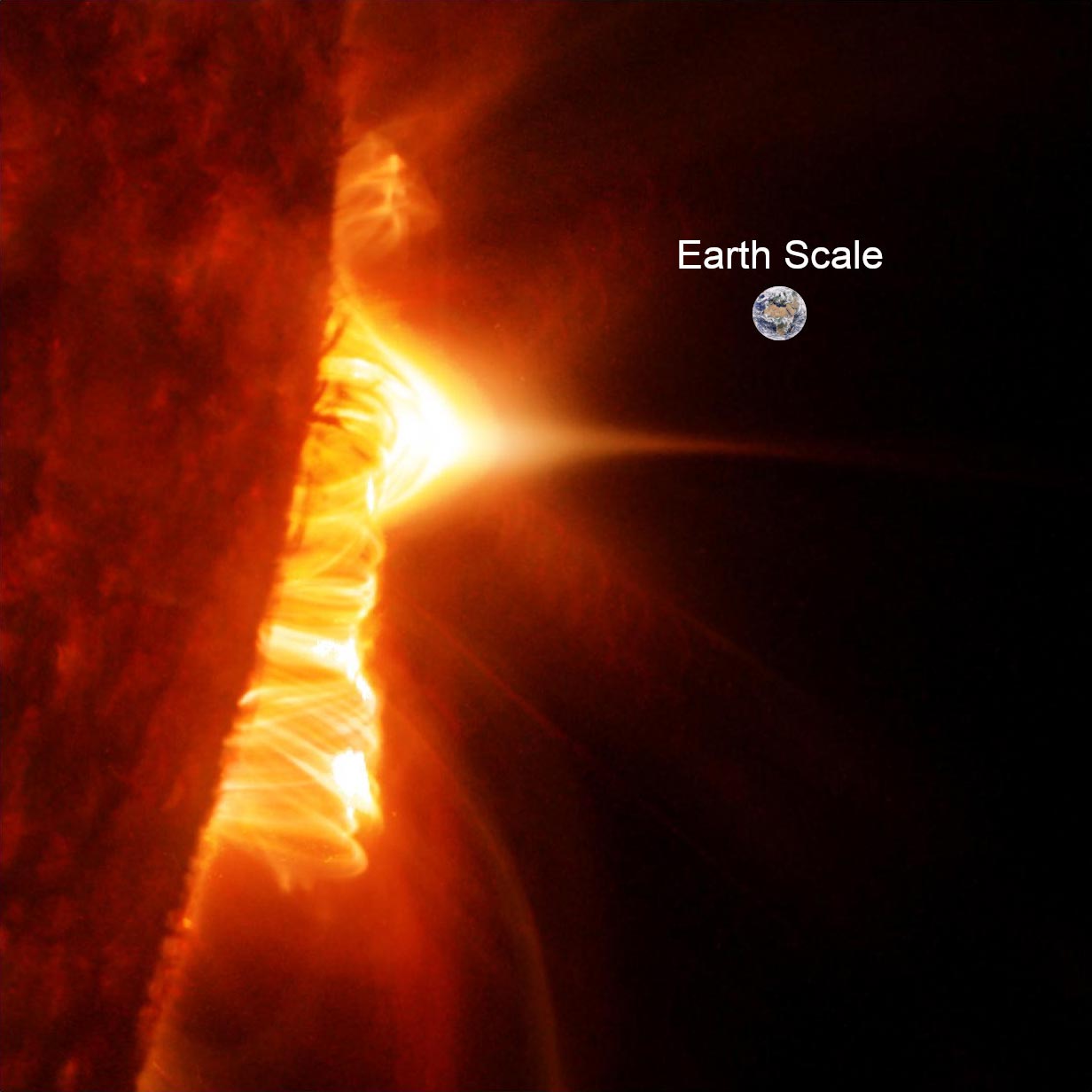
    Solar Limb Flare and Scaled Earth
    A solar limb flare with a comparatable scale of Earth. Credit: Created by Alexander Russell (University of Andrews) using the open-source SunPy Python package and data from NASA’s Solar Dynamics Observatory space telescope via NASA EPIC Team

    Solar flares heat ions much more strongly than electrons. The finding offers a new explanation for spectral line broadening.

    Recent work from the University of St Andrews suggests that particles in solar flares can become 6.5 times hotter than earlier estimates, offering an unexpected resolution to a mystery about the Sun that has persisted for half a century.

    Solar flares are powerful bursts of energy in the Sun’s outer atmosphere that raise temperatures to more than 10 million degrees. These explosive events dramatically increase the amount of solar X-rays and radiation that reach Earth, posing risks to spacecraft, astronauts, and the planet’s upper atmosphere.

    The study, published in Astrophysical Journal Letters, examined how solar flares heat plasma to temperatures beyond 10 million degrees. This plasma, composed of electrons and ions, behaves in ways that differ from long-standing assumptions. The researchers discovered that the ions, which are positively charged and account for half of the plasma, can reach temperatures above 60 million degrees.

    Ions heated more strongly than electrons

    Drawing on findings from other fields, the research team led by Dr. Alexander Russell, Senior Lecturer in Solar Theory in the School of Mathematics and Statistics, concluded that solar flares are very likely to heat ions much more intensely than electrons.
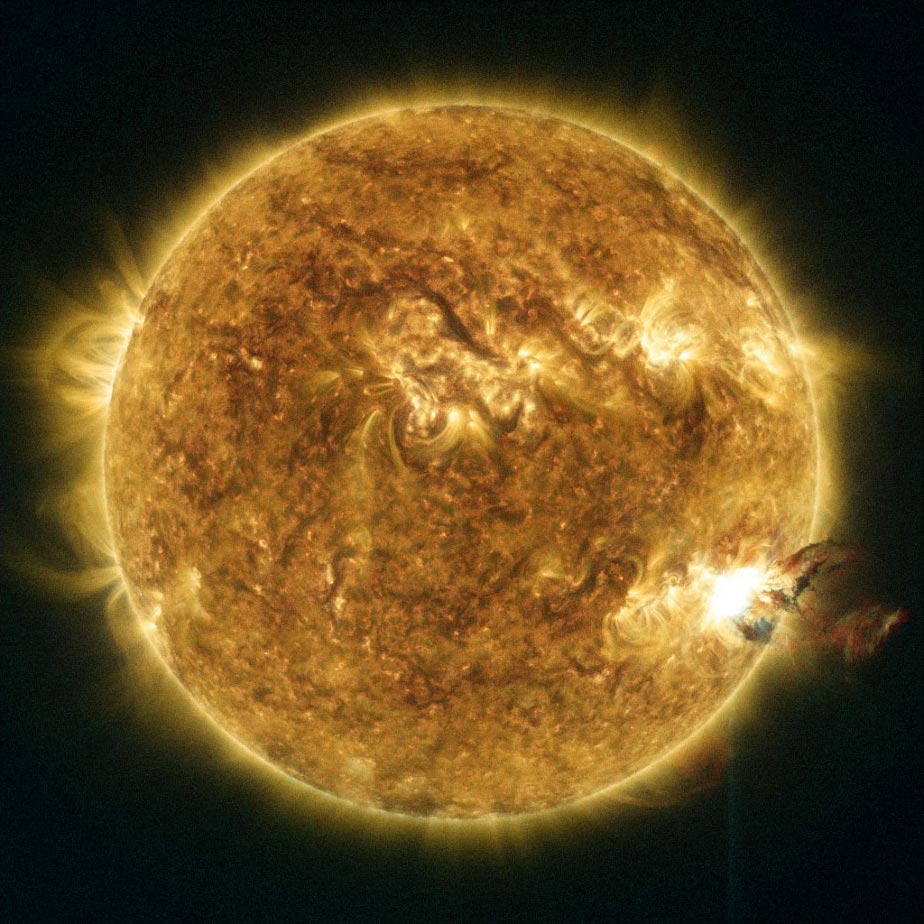
    Image of a Solar Flare
    Solar flares. Credit: Created by Alexander Russell (University of Andrews) using the open-source SunPy Python package and data from NASA’s Solar Dynamics Observatory space telescope via NASA EPIC Team

    Dr Russell, said: “We were excited by recent discoveries that a process called magnetic reconnection heats ions 6.5 times as much as electrons. This appears to be a universal law, and it has been confirmed in near-Earth space, the solar wind and computer simulations. However, nobody had previously connected work in those fields to solar flares.”

    Challenging old assumptions in solar physics

    “Solar physics has historically assumed that ions and electrons must have the same temperature. However, redoing calculations with modern data, we found that ion and electron temperature differences can last for as long as tens of minutes in important parts of solar flares, opening the way to consider super-hot ions for the first time.”

    “What’s more,” he added, is that the new ion temperature fits well with the width of flare spectral lines, potentially solving an astrophysics mystery that has stood for nearly half a century.”

    There has been a long-standing question since the 1970s about why flare spectral lines, bright enhancements in the solar radiation at specific “colors” in extreme-ultraviolet and X-ray light, are broader than expected. Historically, it was believed that this could only be due to turbulent motions, but that interpretation has come under pressure as scientists have tried to identify the nature of the turbulence. After nearly 50 years, the new work argues for a paradigm shift where the ion temperature can make a large contribution to explaining the enigmatic line widths of solar flare spectra.

    Reference: “Solar Flare Ion Temperatures” by Alexander J. B. Russell, Vanessa Polito, Paola Testa, Bart De Pontieu and Sergey A. Belov, 3 September 2025, The Astrophysical Journal Letters.
    DOI: 10.3847/2041-8213/adf74a

    Never miss a breakthrough: Join the SciTechDaily newsletter.
    Follow us on Google and Google News.

    Astrophysics Plasma Physics Solar Flares Sun University of St. Andrews
    Share. Facebook Twitter Pinterest LinkedIn Email Reddit

    Related Articles

    Mysterious Aurora-Like Radio Emissions Uncovered Above a Sunspot

    Solar Flares in a Lab? Caltech’s Miniature Marvels Unlock Cosmic Secrets

    Incredible New Views of the Sun – As You’ve Never Seen It Before

    Scientists Analyze Sunquakes: Can Ripples on the Sun Help Predict Solar Flares?

    First Physics-Based Method for Predicting Large Solar Flares

    Astronomers Reveal How a Magnetic Cage Stopped a Solar Eruption

    VLA Provides New Insights into Solar Flares

    NASA Spacecraft Observe Magnetic Reconnection in Action

    New Light Shed on the Origins of Extreme Space Storms

    3 Comments

    1. Laura F. Jones on September 13, 2025 4:56 pm

      Great

      Reply
    2. Laura F. Jones on September 13, 2025 4:56 pm

      cat

      Reply
    3. Robert on September 14, 2025 9:14 am

      What a statement – We’re 6.5 times off. Let’s put this in perfect context: we have a giant scale where the left side has all the Noble recipients, all the college physics teachers and their institutions and the other, reality; and where the balance goes starkly off kilter – in 2025.
      And then these same geniuses are changing the billions of year old genetic balance with CRISPR for money. What could go wrong?

      Reply
    Leave A Reply Cancel Reply

    • Facebook
    • Twitter
    • Pinterest
    • YouTube

    Don't Miss a Discovery

    Subscribe for the Latest in Science & Tech!

    Trending News

    Monster Storms on Jupiter Unleash Lightning Beyond Anything on Earth

    Scientists Create “Liquid Gears” That Spin Without Touching

    The Simple Habit That Could Help Prevent Cancer

    Millions Take These IBS Drugs, But a New Study Finds Serious Risks

    Scientists Unlock Hidden Secrets of 2,300-Year-Old Mummies Using Cutting-Edge CT Scanner

    Bread Might Be Making You Gain Weight Even Without Eating More Calories

    Scientists Discover Massive Magma Reservoir Beneath Tuscany

    Europe’s Most Active Volcano Just Got Stranger – Here’s Why Scientists Are Rethinking It

    Follow SciTechDaily
    • Facebook
    • Twitter
    • YouTube
    • Pinterest
    • Newsletter
    • RSS
    SciTech News
    • Biology News
    • Chemistry News
    • Earth News
    • Health News
    • Physics News
    • Science News
    • Space News
    • Technology News
    Recent Posts
    • Scientists Discover Plants “Scream” – We Just Couldn’t Hear Them Until Now
    • 25-Year Study Uncovers Hidden Paths and Early Warning Signs of Blood Cancer
    • Not Just Snoring – New Research Reveals Sleep Apnea May Be Damaging Your Muscles
    • Scientists Discover a Surprising Reason Intermittent Fasting Extends Life
    • Scientists Discover a New Meteor Shower From a Mysterious Crumbling Asteroid
    Copyright © 1998 - 2026 SciTechDaily. All Rights Reserved.
    • Science News
    • About
    • Contact
    • Editorial Board
    • Privacy Policy
    • Terms of Use

    Type above and press Enter to search. Press Esc to cancel.