
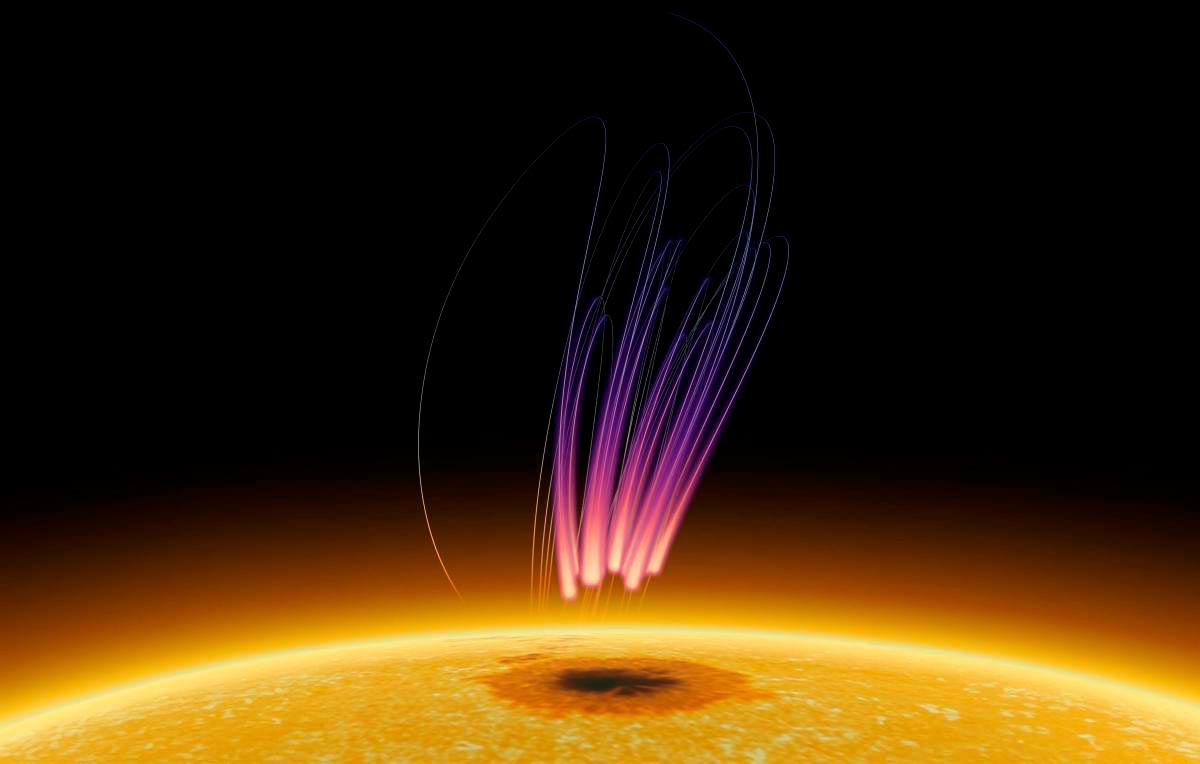
Researchers at the New Jersey Institute of Technology have documented extraordinary, long-lasting radio emissions from a sunspot, offering new insights into solar and stellar magnetic phenomena.
In a study published in Nature Astronomy, astronomers from New Jersey Institute of Technology’s Center for Solar-Terrestrial Research (NJIT-CSTR) have detailed radio observations of an extraordinary aurora-like display — occurring 40,000 km (25,000 mi) above a relatively dark and cold patch on the Sun, known as a sunspot.
Characteristics of the Novel Radio Emission
Researchers say the novel radio emission shares characteristics with the auroral radio emissions commonly seen in planetary magnetospheres such as those around Earth, Jupiter, and Saturn, as well as certain low-mass stars.
The discovery offers new insights into the origin of such intense solar radio bursts and potentially opens new avenues for understanding similar phenomena in distant stars with large starspots, according to the study’s lead author and NJIT-CSTR scientist, Sijie Yu.
Unique Features of the Sunspot Radio Bursts
“We’ve detected a peculiar type of long-lasting polarized radio bursts emanating from a sunspot, persisting for over a week,” said Yu. “This is quite unlike the typical, transient solar radio bursts typically lasting minutes or hours. It’s an exciting discovery that has the potential to alter our comprehension of stellar magnetic processes.”
Comparison With Earth’s Auroras
Famous auroral light shows that are visible across the sky of Earth’s polar regions, like the Aurora Borealis or Aurora Australis, occur as solar activities disturb Earth’s magnetosphere, which facilitates the precipitation of charged particles to the Earth’s polar region where the magnetic field converges, and interacts with oxygen and nitrogen atoms in the high atmosphere. Accelerating toward the north and south poles, such electrons can generate intense radio emissions at frequencies around a few hundred kHz.
Yu’s team says the newly observed solar radio emissions, detected over a vast sunspot region temporarily forming where magnetic fields on the Sun’s surface are particularly strong, differ from previously known solar radio noise storms — both spectrally and temporally.
Mechanism Behind the Sunspot Radio Emissions
“Our spatially, temporally, and spatially resolved analysis suggests that they are due to the electron-cyclotron maser (ECM) emission, involving energetic electrons trapped within converging magnetic field geometries,” explained Yu. “The cooler and intensely magnetic areas of sunspots provide a favorable environment for the ECM emission to occur, drawing parallels with the magnetic polar caps of planets and other stars and potentially providing a local solar analog to study these phenomena.”
“However, unlike the Earth’s auroras, these sunspot aurora emissions occur at frequencies ranging from hundreds of thousands of kHz to roughly 1 million kHz — a direct result of the sunspot’s magnetic field being thousands of times stronger than Earth’s.”
“Our observations reveal that these radio bursts are not necessarily tied to the timing of solar flares either,” added Rohit Sharma, a scientist from the University of Applied Sciences Northwestern Switzerland (FHNW) and co-author of the study. “Instead, sporadic flare activity in nearby active regions seems to pump energetic electrons into large-scale magnetic field loops anchored at the sunspot, which then power the ECM radio emission above the region.”
The “sunspot radio aurora” is thought to exhibit rotational modulation in sync with the solar rotation, producing what Yu describes as a “cosmic lighthouse effect.”
“As the sunspot traverses the solar disk, it creates a rotating beam of radio light, similar to the modulated radio aurora we observe from rotating stars,” Yu noted. “As this sunspot radio aurora represents the first detection of its kind, our next step involves retrospective analysis. We aim to determine if some of the previously recorded solar bursts could be instances of this newly identified emission.”
Potential Impact on Astrophysical Models
The solar radio emissions, albeit weaker, are likened to stellar auroral emissions observed in the past and may suggest that starspots on cooler stars, much like sunspots, could be the sources of the certain radio bursts observed in various stellar environments.
“This observation is among the clearest evidence of radio ECM emissions we have seen from the Sun. The characteristics resemble some of those observed on our planets and other distant stars, leading us to consider the possibility that this model could be potentially applicable to other stars with starspots,” said Bin Chen, NJIT-CSTR associate professor of physics and a co-author.
The team says the latest insight, linking the behavior of our Sun and the magnetic activities of other stars, could have implications for astrophysicists to rethink their current models of stellar magnetic activity.
“We’re beginning to piece together the puzzle of how energetic particles and magnetic fields interact in a system with the presence of long-lasting starspots, not just on our own Sun but also on stars far beyond our solar system,” said NJIT solar researcher Surajit Mondal.
“By understanding these signals from our own Sun, we can better interpret the powerful emissions from the most common star type in the universe, M-dwarfs, which may reveal fundamental connections in astrophysical phenomena,” added Dale Gary, NJIT-CSTR distinguished professor of physics.
Reference: “Detection of long-lasting aurora-like radio emission above a sunspot” by Sijie Yu, Bin Chen, Rohit Sharma, Timothy S. Bastian, Surajit Mondal, Dale E. Gary, Yingjie Luo and Marina Battaglia, 13 November 2023, Nature Astronomy.
DOI: 10.1038/s41550-023-02122-6
The research team — including collaborators Marina Battaglia from FHNW, Tim Bastian of the National Radio Astronomy Observatory, and Yingjie Luo from the University of Glasgow — used broadband dynamic radio imaging spectroscopy observations from the Karl G. Jansky Very Large Array to achieve the discovery.
Never miss a breakthrough: Join the SciTechDaily newsletter.
Follow us on Google and Google News.