

Close Menu
    Facebook X (Twitter) Instagram
    SciTechDaily
    • Biology
    • Chemistry
    • Earth
    • Health
    • Physics
    • Science
    • Space
    • Technology
    Facebook X (Twitter) Pinterest YouTube RSS
    SciTechDaily
    Home»Chemistry»Simple New Technique Transforms “Forever Chemicals” Into Valuable Compounds
    Chemistry

    Simple New Technique Transforms “Forever Chemicals” Into Valuable Compounds

    By Osaka Metropolitan UniversityNovember 16, 20231 Comment2 Mins Read
    Facebook Twitter Pinterest Telegram LinkedIn WhatsApp Email Reddit
    Share
    Facebook Twitter LinkedIn Pinterest Telegram Email Reddit
    Chemistry Reaction Catalyst Concept
    Chemists have innovated a method to convert persistent PFAS into valuable fluorine-decorated N-heterocyclic carbenes (NHCs), potentially revolutionizing applications in several chemistry and materials science fields.

    Scientists have developed an innovative approach to incorporate harmful perfluoroalkenes into N-heterocyclic carbene ligands.

    Commonly known as “forever chemicals,” PFAS (Perfluoroalkyl and Polyfluoroalkyl Substances) are notorious for their persistence in both the environment and our bodies. However, chemists from Osaka Metropolitan University have developed a simple yet innovative technique that can transform these harmful substances into valuable compounds.

    Breakthrough in PFAS Conversion

    A research group led by Professor Masato Ohashi and Assistant Professor Kenichi Michigami of the Graduate School of Science at Osaka Metropolitan University has successfully synthesized ligands called fluorine-decorated N-heterocyclic carbenes (NHCs) from perfluoroalkenes, a type of PFAS (Perfluoroalkyl and Polyfluoroalkyl Substances).
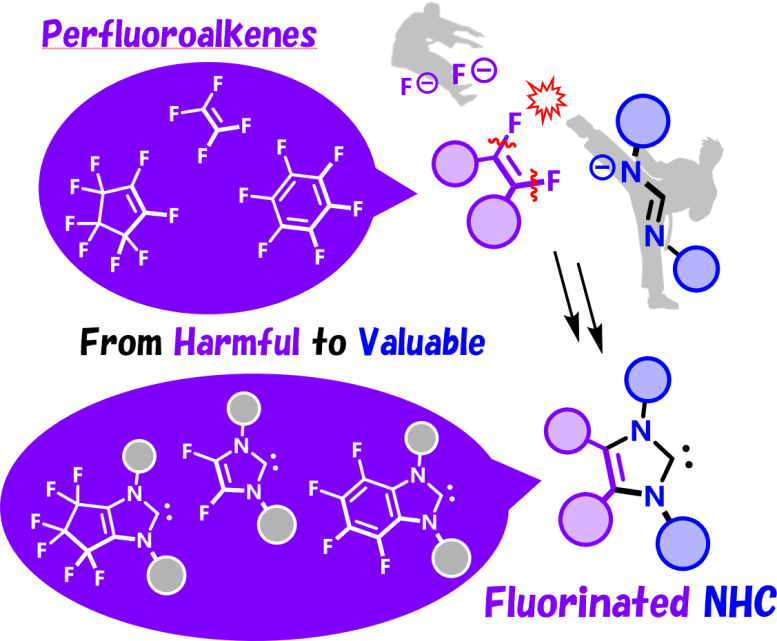
    Converting PFAS Into Valuable Carbenes
    The conversion was achieved by simply removing two fluorine atoms from 1,2-difluoroalkene derivatives. Credit: Kenichi Michigami, Osaka Metropolitan University

    The NHCs developed in this study play significant roles in stabilizing unstable molecules as well as enhancing the performance of their ligated transition metal complexes.

    The Process of Synthesis

    The synthesis of fluorinated NHCs was achieved simply by removing two fluorine atoms from 1,2-difluoroalkene derivatives. Owing to the small size of fluorine atoms, the electron-accepting ability of the NHC ligand can be enhanced without substantially changing its steric properties.

    “Our results enable the easy transformation of harmful PFAS into functional NHCs,” explained Dr. Michigami. “The versatile applications of fluorinated NHCs show potential advantages in various fields such as fluorine chemistry, organometallic chemistry, catalysis chemistry, and materials science.”

    Reference: “N-Heterocyclic Carbenes with Polyfluorinated Groups at the 4- and 5-Positions from [3 + 2] Cycloadditions between Formamidinates and cis-1,2-Difluoroalkene Derivatives” by Masato Ohashi, Kota Ando, Shoichi Murakami, Kenichi Michigami and Sensuke Ogoshi, 26 September 2023, Journal of the American Chemical Society.
    DOI: 10.1021/jacs.3c06331

    The study was funded by the Japan Society for the Promotion of Science and the Japan Ministry of Education, Culture, Sports, Science and Technology (MEXT). 

    Never miss a breakthrough: Join the SciTechDaily newsletter.
    Follow us on Google and Google News.

    Materials Science Osaka Metropolitan University PFAS
    Share. Facebook Twitter Pinterest LinkedIn Email Reddit

    Related Articles

    Scientists Unveil Eco-Friendly Breakthrough To Eliminate “Forever Chemicals”

    Bye-Bye Teflon? This Slick New Material Could Change Cookware Forever

    Lightweight, Flexible, and Efficient: Unlocking the Secrets of Electron Behavior in Organic Devices

    New Material State “Defies” Laws of Physics

    “Molecular Levers” Accelerate Reactions

    Forming the Smallest Ice Crystals in the World

    Computer Model Helps Remove Greenhouse Gases From Power Plants

    Scientists Examine Platinum-Based Catalyst Design

    Using X-Ray Imaging to Help Improve Lithium-Sulfur Battery Technology

    1 Comment

    1. Lawrence Brown on November 17, 2023 5:00 am

      I question the use of the prefix “per” when naming fluoroalkenes, because “perfluoro” implies total substitution of fluorine on the parent molecule, yet alkenes can undergo many addition reactions which open the double bond and add 2 more substituents. However, this is very useful chemistry and may present yet another path to remediating PFAS pollution. My comment concerns nomenclature, not novelty nor purpose.

      Reply
    Leave A Reply Cancel Reply

    • Facebook
    • Twitter
    • Pinterest
    • YouTube

    Don't Miss a Discovery

    Subscribe for the Latest in Science & Tech!

    Trending News

    Scientists Say This Natural Hormone Reverses Obesity by Targeting the Brain

    35-Million-Year-Old Mystery: Strange Arachnid Discovered Preserved in Amber

    Is AI Really Just a Tool? It Could Be Altering How You See Reality

    JWST Reveals a “Forbidden” Planet With a Baffling Composition

    The Protein “Sabotaging” Aging Muscle Recovery Could Be Key to Surviving Aging

    This Diet–Gut Interaction Could Transform Fat Into a Calorie-Burning Machine

    Scientists Discover Hidden Virus Linked to Colorectal Cancer

    Scientists Discover 132-Million-Year-Old Dinosaur Tracks on South Africa’s Coast

    Follow SciTechDaily
    • Facebook
    • Twitter
    • YouTube
    • Pinterest
    • Newsletter
    • RSS
    SciTech News
    • Biology News
    • Chemistry News
    • Earth News
    • Health News
    • Physics News
    • Science News
    • Space News
    • Technology News
    Recent Posts
    • 500 Million Years Ago, Life Changed Forever: Scientists Reveal the DNA Changes That Helped Animals Move Onto Land
    • Surprise RNA Discovery Challenges Long-Held Beliefs About How Genes Work
    • Your IQ at 23 Could Predict Your Wealth at 27, Study Finds
    • 320 Light-Years Away, a Planet Confirms a Fundamental Cosmic Assumption
    • Astronomers Solve Decades-Long Mystery About Saturn’s Spin – “Something Strange Was Happening”
    Copyright © 1998 - 2026 SciTechDaily. All Rights Reserved.
    • Science News
    • About
    • Contact
    • Editorial Board
    • Privacy Policy
    • Terms of Use

    Type above and press Enter to search. Press Esc to cancel.