
Close Menu
    Facebook X (Twitter) Instagram
    SciTechDaily
    • Biology
    • Chemistry
    • Earth
    • Health
    • Physics
    • Science
    • Space
    • Technology
    Facebook X (Twitter) Pinterest YouTube RSS
    SciTechDaily
    Home»Chemistry»Cheaper, Faster New Way To Continuously Produce Amines – Chemical Building Blocks Used in Many Products
    Chemistry

    Cheaper, Faster New Way To Continuously Produce Amines – Chemical Building Blocks Used in Many Products

    By North Carolina State UniversityMay 4, 2022No Comments4 Mins Read
    Facebook Twitter Pinterest Telegram LinkedIn WhatsApp Email Reddit
    Share
    Facebook Twitter LinkedIn Pinterest Telegram Email Reddit
    Cheaper, Faster Way to Produce Hindered Amines
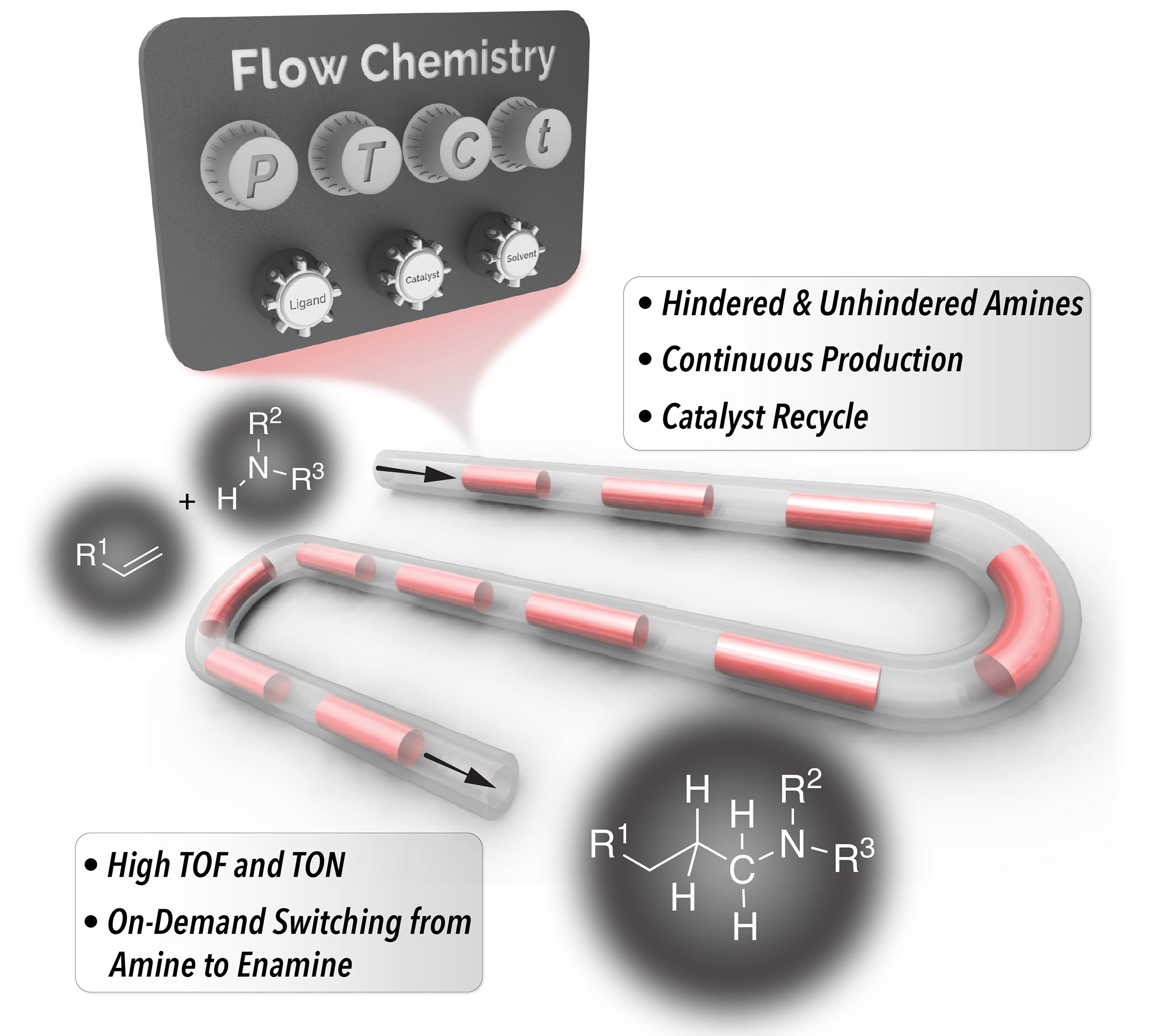
    Researchers at North Carolina State University have developed a faster, less expensive technique for producing hindered amines – a class of chemicals used as building blocks in products ranging from pharmaceuticals and agrochemicals to detergents and organic light-emitting diodes. The success of the new technique is made possible by two things. First, by using a continuous flow reactor that allows for continuous flow of both gases and liquids in a segmented flow format, the researchers were able to make the kinetics of the reaction far more efficient. Second, the new technique makes use of a co-catalyst – fluorinated benzoic acid – which reduces the amount of energy needed to perform some of the necessary reactions in the process. Credit: Milad Abolhasani, NC State University

    A new technique allows rapid and cost-efficient production of hindered amines using a continuous flow reactor, eliminating toxic byproducts.

    Researchers at North Carolina State University have developed a faster, less expensive technique for producing hindered amines – a class of chemicals used as building blocks in products ranging from pharmaceuticals and agrochemicals to detergents and organic light-emitting diodes.

    “Hindered amines are used in a tremendous variety of products, but all of the existing techniques for producing these amines are complicated and expensive,” says Milad Abolhasani, corresponding author of a paper on the new technique and an associate professor of chemical and biomolecular engineering at NC State. “We set out to develop a better method for synthesizing these hindered amines, and we were successful.”

    One of the less expensive techniques for producing hindered amines is hydroaminomethylation, or HAM. However, the chemical industry has largely avoided using HAM, because there are too many ways things can go wrong – leaving producers with undesirable chemicals instead of the functionalized amines they were trying to make. Researchers have improved the HAM process over the years. But all of the techniques for avoiding undesirable byproducts have meant extending the timeframe of the HAM process, so that it takes hours to perform all of the necessary reactions. Until now.

    Continuous Flow Reactor for Efficient Production

    “We’ve developed a HAM technique that makes use of continuous flow reactor technologies to produce hindered amines more efficiently,” Abolhasani says. “Our HAM process takes less than 30 minutes in most cases. The only products are hindered amines and water. And we are able to recycle the primary catalyst, rhodium/N-Xantphos, which further drives down costs.”

    The success of the new technique is made possible by two things. First, by using a continuous flow reactor that allows for continuous flow of both gases and liquids in a segmented flow format, the researchers were able to make the kinetics of the reaction far more efficient. Second, the new technique makes use of a co-catalyst – fluorinated benzoic acid – which reduces the amount of energy needed to perform some of the necessary reactions in the HAM process.

    Ultimately, this technique drives down the cost of producing hindered amines using inexpensive feedstock, allowing users to produce them more quickly and with no toxic byproducts.

    “By designing a cooperative catalyst system, we’ve demonstrated that the rate of the HAM reactions in our system can be 70 times higher than the existing state-of-the-art processes,” says Malek Ibrahim, first author of the paper and a former postdoctoral researcher at NC State. “This process is also a good example for how flow chemistry platforms can improve catalyst turnover frequency, which is increasingly important as the price of rhodium catalysts goes up.”

    The new technique is particularly attractive for decentralized manufacturing operations, since the small footprint of the necessary equipment and its scalability allows users to efficiently produce hindered amines on-site and on-demand.

    Dual Capability: Producing Amines and Enamines

    “What’s more, the same technique can also be used to produce enamines – which are other chemical building blocks – on demand, simply by tuning the solvents we use in the flow reactor,” Ibrahim says. “You can literally switch back and forth between producing amines and enamines without having to stop the production process, since the only thing you’re changing is the solvent mixture.”

    The researchers have filed a provisional patent on the new technique and are now looking for industrial partners to put the technique into widespread use.

    The research paper will be published on May 4, 2022, in the journal Nature Communications. The work was done with start-up funding from NC State.

    Reference: “Recyclable Cooperative Catalyst for Accelerated Hydroaminomethylation of Hindered Amines in a Continuous Segmented Flow Reactor” by Malek Y. S. Ibrahim and Milad Abolhasani, 4 May 2022, Nature Communications.
    DOI: 10.1038/s41467-022-30175-0

    Never miss a breakthrough: Join the SciTechDaily newsletter.
    Follow us on Google and Google News.

    Catalysts Chemical Engineering Industrial Engineering North Carolina State University Organic Chemistry
    Share. Facebook Twitter Pinterest LinkedIn Email Reddit

    Related Articles

    Increasing the Efficiency of Chemical Reactions To Help Decarbonize Fuels and Chemicals

    Scientists Can Now Design Single Atom Catalysts for Important Chemical Reactions

    Engineers Develop a New Water Treatment Technology That Could Also Help Mars Explorers

    New Catalyst Makes Styrene Manufacturing Cheaper and Greener

    Mysterious Organic Scum Boosts Chemical Reaction Efficiency – Discovery May Reduce Environmental Impact of Manufacturing

    “Swiss Army Knife” Nanoparticle Catalyst Can Make Natural Gas Burn Cleaner

    Key Step Toward Cleaner, More Efficient Mass-Production of Hydrogen From Water

    Super-Particles: The Importance of Good Neighbors in Catalysis

    More Efficient, Environmentally Friendly Ethylene Production With New Catalyst

    Leave A Reply Cancel Reply

    • Facebook
    • Twitter
    • Pinterest
    • YouTube

    Don't Miss a Discovery

    Subscribe for the Latest in Science & Tech!

    Trending News

    Largest-Ever Study Finds Medicinal Cannabis Ineffective for Anxiety, Depression, PTSD

    250-Million-Year-Old Egg Solves One of Evolution’s Biggest Mysteries

    Living With Roommates Might Be Changing Your Gut Microbiome Without You Knowing

    Century-Old Cleaning Chemical Linked to 500% Increased Risk of Parkinson’s Disease

    What if Your Memories Never Happened? Physicists Take a New Look at the Boltzmann Brain Paradox

    One of the Universe’s Largest Stars May Be Getting Ready To Explode

    Scientists Discover Enzyme That Could Supercharge Ozempic-Like Weight Loss Drugs

    Popular Sweetener Linked to DNA Damage – “It’s Something You Should Not Be Eating”

    Follow SciTechDaily
    • Facebook
    • Twitter
    • YouTube
    • Pinterest
    • Newsletter
    • RSS
    SciTech News
    • Biology News
    • Chemistry News
    • Earth News
    • Health News
    • Physics News
    • Science News
    • Space News
    • Technology News
    Recent Posts
    • Scientists Say This Overlooked Organ Could Hold the Key to Longer Life
    • Want Less Stress? Landmark Study Points to a Simple Habit
    • Scientists Reveal Eating Fruits and Vegetables May Increase Your Risk of Lung Cancer
    • AI Reveals Explosive Growth of Floating Algae Across the World’s Oceans
    • 5.5 Million Bees Discovered Living Beneath a New York Cemetery
    Copyright © 1998 - 2026 SciTechDaily. All Rights Reserved.
    • Science News
    • About
    • Contact
    • Editorial Board
    • Privacy Policy
    • Terms of Use

    Type above and press Enter to search. Press Esc to cancel.