
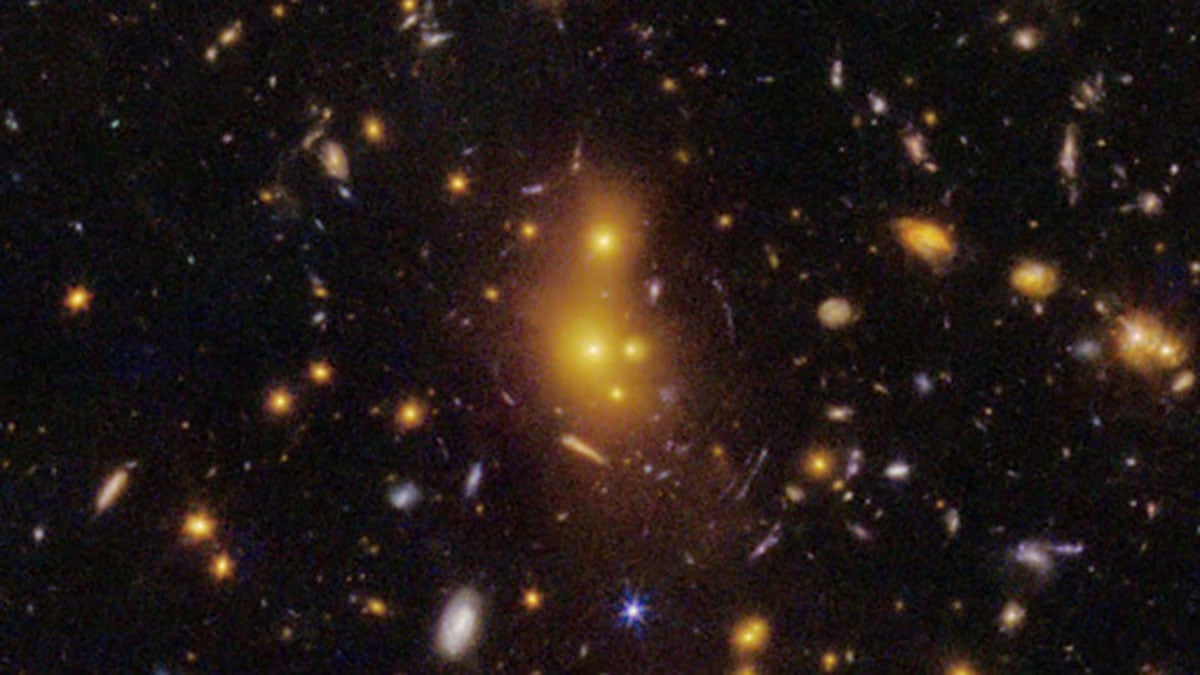
New observations from NASA’s James Webb Space Telescope deepen the mystery of a young but unexpectedly mature galaxy cluster in the early universe that challenges leading ideas about cosmic evolution.
A remarkably dense and massive galaxy cluster from a period when such structures were not expected to be so fully developed is putting pressure on current theories of cosmic evolution. In three recent papers, a group led by scientists at IPAC, a science and data center for astrophysics and planetary science at Caltech, has shown that the cluster is the most distant known example of strong gravitational lensing by a galaxy cluster.
The findings, based on observations from NASA’s James Webb Space Telescope (JWST), were presented at the 248th meeting of the American Astronomical Society.
Astronomers recognized that the galaxy cluster, known as XLSSC 122, was unusual as soon as they first observed it. Although it lies more than 10 billion light-years away, in a period when other galaxy groupings were only beginning to assemble, the cluster looked highly evolved, meaning large and organized like galaxy clusters seen in the nearby modern universe.
JWST’s unmatched ability to collect light and resolve fine detail has now revealed that XLSSC 122 happens to line up with one or more galaxies even farther away. Because of that chance alignment, the cluster’s powerful gravity bends the light from the more distant galaxy, creating an extremely rare effect called strong gravitational lensing. That effect has allowed scientists to make newly precise measurements of XLSSC 122’s mass.
“When we got those first images back from JWST, we said, ‘wow, look at this, there’s strong lensing coming from this cluster!’” said Kyle Finner, a staff scientist at IPAC and lead author of the first paper studying the cluster. “XLSSC 122 has now set the record for the most distant galaxy cluster displaying strong lensing, which is a valuable tool for astronomers.”
This fortunate lensing alignment has given astronomers their most detailed view so far of how mass is distributed inside an early galaxy cluster from the era known as “cosmic noon,” roughly 10 billion years ago. During that critical period, galaxy clusters began forming in large numbers as the universe reached its peak rate of star formation, producing stars at a pace up to 100 times faster than today.
XLSSC 122 continued to defy expectations. Its mass is packed extremely tightly toward the center of the cluster. Finding such a concentrated structure so early in cosmic history is difficult to reconcile with standard cosmological models, which predict a much slower buildup of massive structures.
“XLSSC 122 is one of the first clusters we know of that formed in the universe, and it has a mass concentration that doesn’t agree with our cosmological model predictions,” said Finner.
After identifying the strong lensing, Finner and colleagues published two additional papers, led first by Zachary Scofield and Hyungjin Joo at Yonsei University, using JWST to study other features of XLSSC 122. Together, the results make XLSSC 122 a key example of galaxy cluster formation during cosmic noon.
Seeing in the dark
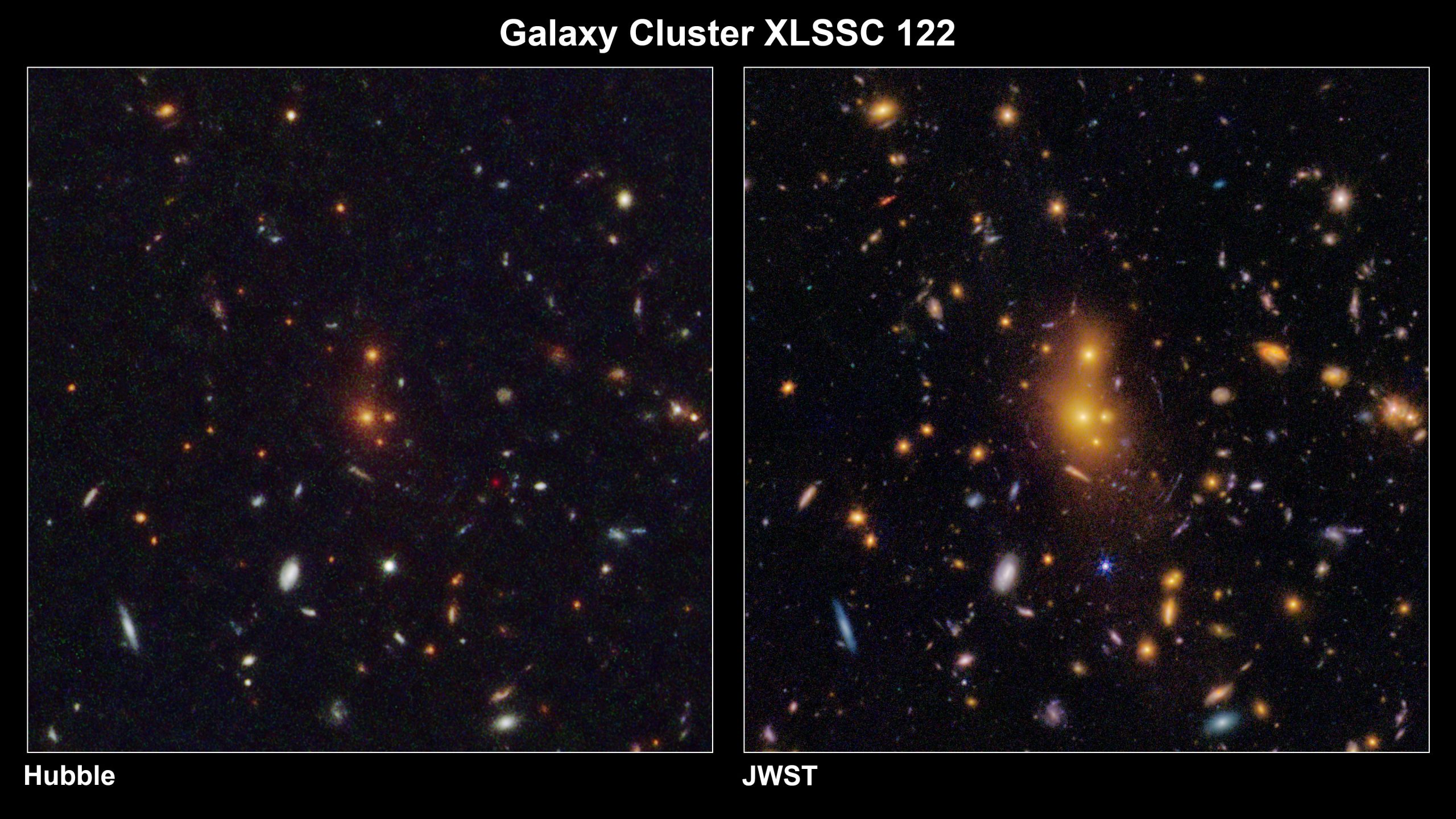
XLSSC 122 was first detected in 2014 through an X-ray survey by the European Space Agency’s XMM-Newton spacecraft. Later observations from the Hubble Space Telescope helped confirm the cluster’s distance, about 10.4 billion light years, and its unexpectedly mature structure.
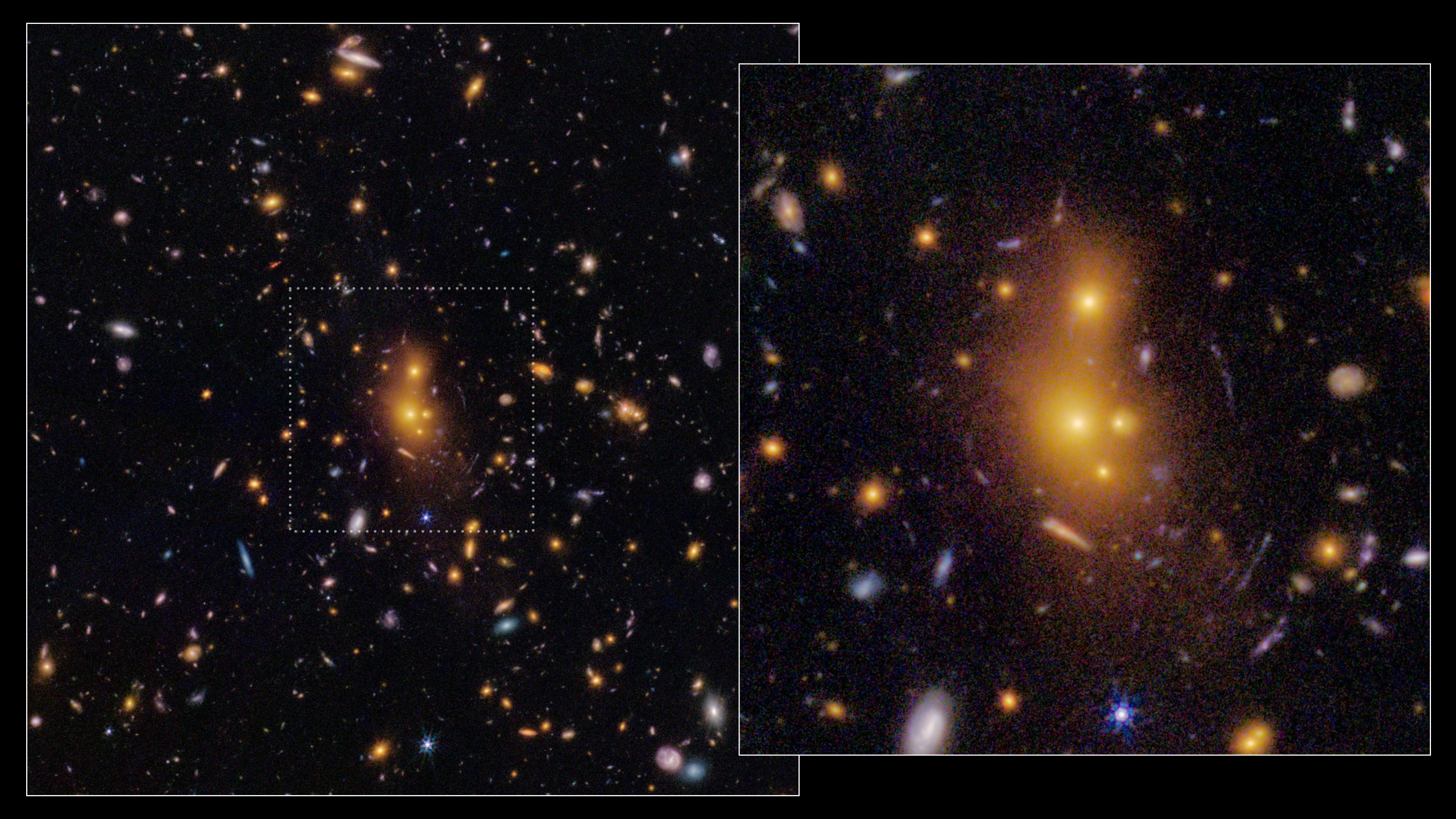
Hubble data did not show clear evidence of strong lensing, which appears in JWST images as arcs of light around the cluster’s center. Seeing those arcs with JWST was therefore an important surprise. “Before JWST, we couldn’t do this level of science in the early, distant universe,” said Finner.
The visible matter in XLSSC 122, including its bright stars and glowing gas, contributes only a small part of the strong lensing effect. Most of the effect comes from dark matter, the invisible and still poorly understood substance that has gravity but produces no direct detectable signal. Current estimates suggest that dark matter outweighs ordinary matter, the material that makes up stars, planets, and people, by about five to one.
Dark matter is central to cosmology because it helps hold galaxies together and shapes the large-scale structure of the universe, where galaxies gather into groups and eventually into huge filaments spanning space. Measuring the distribution of dark matter in XLSSC 122 provides a strong test of that framework and of how well it explains the growth of cosmic structure since the Big Bang 13.8 billion years ago.
“Strong lensing is a way to measure the dark matter without actually seeing the dark matter,” said Finner. “It gives us a sensitive probe of our cosmological models.”
A complete view of the galaxy cluster
For their second paper, Finner and colleagues examined a subtler form of gravitational lensing known as weak lensing. Strong lensing is visually obvious, but weak lensing causes much smaller distortions in the shapes of galaxies. Those tiny effects can be detected only through statistical analysis.
Strong lensing allowed the group to measure the cluster’s central region, while weak lensing helped reveal the mass farther out, including the wider cluster environment and its outer galaxy members. “Weak gravitational lensing can constrain mass much further out, so you can get a better picture of the surrounding cluster area,” said Finner.
This broader view, combined with X-ray and radio wave observations from several other telescopes, showed that XLSSC 122 is still merging as its galaxies continue coming together. The second study also supported the first study’s conclusion that XLSSC 122 has a very large, centrally concentrated mass.
In the third and most recent paper, Finner and colleagues used JWST to trace XLSSC 122’s intracluster light, a faint glow produced by stars drifting freely between galaxies in the cluster. This is the earliest known detection of intracluster light and adds another piece to the cluster’s story. The widespread nature of the intracluster light supports the idea that XLSSC 122 is merging, with stars thrown out of colliding galaxies before they have settled into the cluster’s powerful gravitational core.
The group also found that the central shape of the intracluster light closely matches the dark matter concentrations revealed by strong gravitational lensing. If the same pattern appears in other galaxy clusters, especially early ones, it could give astronomers another way to locate hidden dark matter.
“In this cluster, the intracluster light essentially traces the dark matter,” said Finner. “That light tells us that the cluster is in a merging state.”
The more, the merrier
Finner and colleagues now hope to identify and study many more extremely distant galaxy clusters.
JWST is not designed to discover large numbers of such rare objects because it intentionally observes narrow, targeted areas of the sky. Instead, astronomers need wide-area sky surveys in X-rays, like the one that found XLSSC 122, along with radio telescope surveys to identify promising candidates. Another especially useful method is the Sunyaev-Zel’dovich effect, in which apparent “holes” can appear in observations of the cosmic microwave background, the afterglow of the Big Bang. These holes form when that ancient light is scattered by high-energy particles in galaxy clusters, revealing where the clusters are.
If more objects like XLSSC 122 are found, with unusual dark matter concentrations and unexpectedly early maturity, cosmologists may need to rethink important parts of their models of how the universe developed.
“It’s still early in the JWST era,” said Finner, “and if we can start to get data on tens or hundreds of these types of objects at this stage in the universe, then we can really start putting our cosmological models to the test.”
References:
“JWST Discovery of Strong Lensing from a Galaxy Cluster at Cosmic Noon: Giant Arcs and a Highly Concentrated Core of XLSSC 122” by Kyle Finner, Sangjun Cha, Zachary P. Scofield, M. James Jee, Yu-heng Lin, Hyungjin Joo, Hyosun Park, Takahiro Morishita, Andreas Faisst, Bomee Lee, Wuji Wang and Ranga-Ram Chary, 21 November 2025, The Astrophysical Journal Letters.
DOI: 10.3847/2041-8213/ae1d80
“An Active Galaxy Cluster Merger at Cosmic Noon Revealed by JWST Weak Lensing and Multiwavelength Probes” by Zachary P. Scofield, Kyle Finner, Hyungjin Joo, M. James Jee, Wonki Lee, Sangjun Cha, Jinhyub Kim, Yu-heng Lin, Ranga-Ram Chary, Andreas Faisst and Bomee Lee, 23 February 2026, The Astrophysical Journal Letters.
DOI: 10.3847/2041-8213/ae447a
“Mature but Still Growing: JWST Detection of the Earliest Intracluster Light at z ∼ 2” by Hyungjin Joo, M. James Jee, Kyle Finner, Zachary P. Scofield, Sangjun Cha, Jinhyub Kim, Ranga-Ram Chary, Andreas Faisst and Bomee Lee, 22 April 2026, The Astrophysical Journal Letters.
DOI: 10.3847/2041-8213/ae5c9f
Never miss a breakthrough: Join the SciTechDaily newsletter.
Follow us on Google and Google News.