
Close Menu
    Facebook X (Twitter) Instagram
    SciTechDaily
    • Biology
    • Chemistry
    • Earth
    • Health
    • Physics
    • Science
    • Space
    • Technology
    Facebook X (Twitter) Pinterest YouTube RSS
    SciTechDaily
    Home»Space»Observations of Massive Galaxies in the Early Universe Reveal Rare Dark-Matter Haloes
    Space

    Observations of Massive Galaxies in the Early Universe Reveal Rare Dark-Matter Haloes

    By D. P. Marrone, Harvard-Smithsonian Center For AstrophysicsFebruary 2, 2018No Comments3 Mins Read
    Facebook Twitter Pinterest Telegram LinkedIn WhatsApp Email Reddit
    Share
    Facebook Twitter LinkedIn Pinterest Telegram Email Reddit
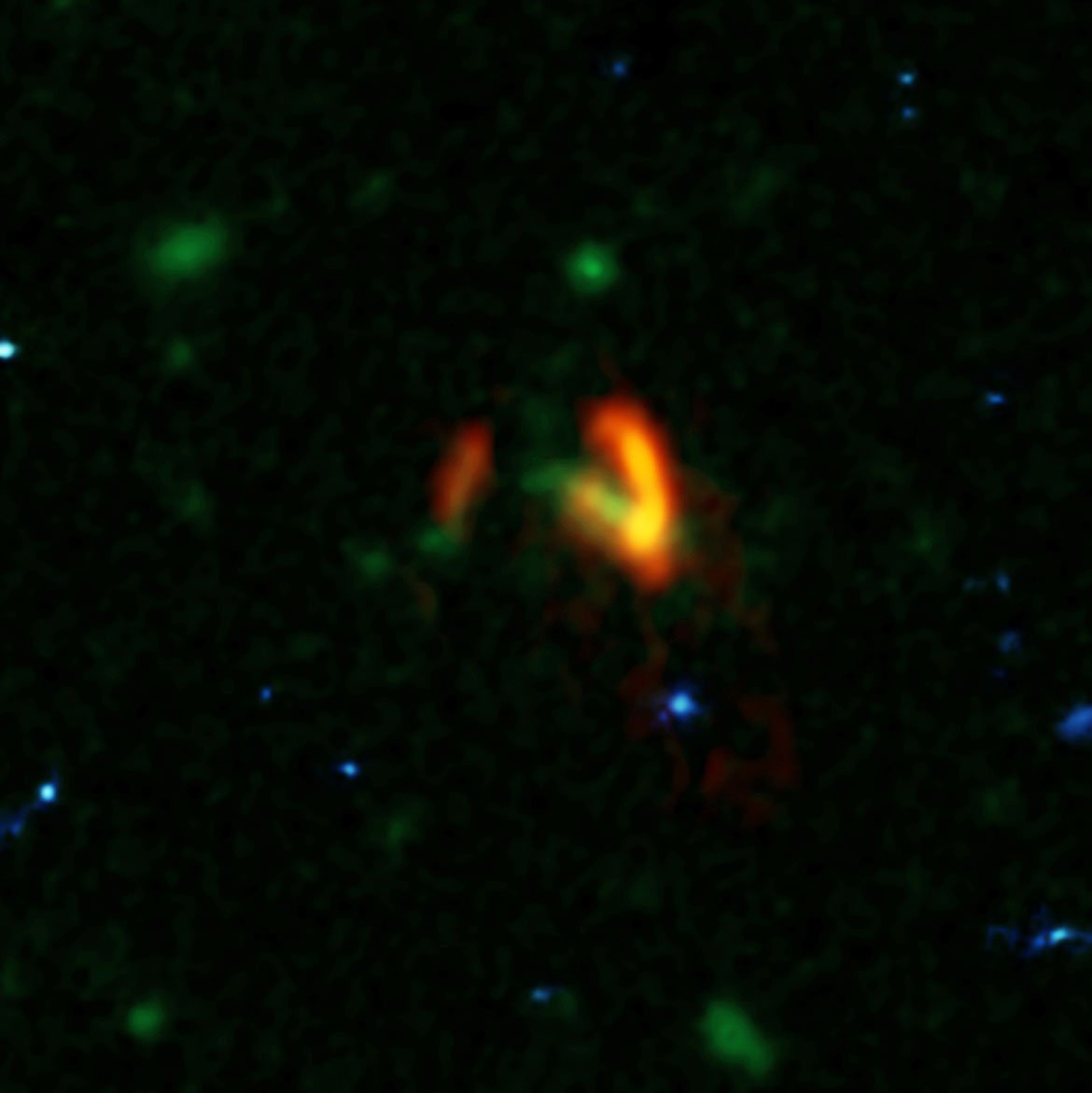
    Massive Galaxies in the Early Universe SPT0311-58
    The giant galaxy SPT0311-58, dating only 780 million years after the big bang. This false-color composite image combines near infrared Hubble (green and blue) and millimeter ALMA (red) images. With a mass of about 100 billion solar-masses, this galaxy in the very early universe is seen merging with a less massive neighbor and producing stars at a rate of about 2900 solar masses per year. Credit: Marrone et al. 2018

    The South Pole Telescope (SPT) is a 10-meter-diameter telescope in the Antarctic that has been operating at millimeter- and submillimeter-waves for a decade; the CfA is an institutional member of the collaboration. For the past six years it has been surveying the sky in a search for galaxies in the first few billion years of cosmic history; they are thought to be preferentially detectable at these wavelengths because their dust has been heated by the ultraviolet light of young stars. One of SPT discoveries, the galaxy SPT0311–58, has upon further investigation turned out to date from an epoch a mere 780 million years after the big bang. It is the most distant known case of this postulated but previously undetected population of optically dim but infrared luminous clusters.

    CfA astronomers Chris Hayward, Matt Ashby and Tony Stark are members of the SPT team that made the discovery and then followed up with the Spitzer Space Telescope, the ALMA array, the Hubble Space Telescope, and the Gemini optical/infrared telescope. The scientists were able to determine the cluster’s distance and epoch from the redshift of its spectral features, including a line of ionized carbon, and to characterize the overall emission properties across a wider range of wavelengths. The Spitzer and Hubble images of the source revealed the presence of a foreground galaxy that is acting as a gravitational lens to magnify SPT0311-58 and thus greatly facilitated its detection. The ALMA measurements at high spatial resolution found that the original source is actually two galaxies less than twenty-five thousand light-years apart. The implication is that these two galaxies are in the midst of colliding.

    The masses of the two galaxies are nearly one hundred billion and ten billion solar masses, respectively. The larger one is more massive than any other known galaxy at this early time in cosmic evolution, a period during which many galaxies are thought to be just forming, and is very bright, making new stars at a rate of about 2900 solar masses per year (thousands of times faster than the Milky Way). Although current models of cosmic evolution do not preclude such giant systems from existing at such early times, the observation does push the models to its limits. The results also imply that there should be a dark-matter halo present with more than 100 billion solar masses, among the rarest dark-matter haloes that should exist in the early universe.

    Reference: “Galaxy Growth in a Massive Halo in the First Billion Years of Cosmic History” by D. P. Marrone, J. S. Spilker, C. C. Hayward, J. D. Vieira, M. Aravena, M. L. N. Ashby, M. B. Bayliss, M. Béthermin, M. Brodwin, M. S. Bothwell, J. E. Carlstrom, S. C. Chapman, Chian-Chou Chen, T. M. Crawford, D. J. M. Cunningham, C. De Breuck, C. D. Fassnacht, A. H. Gonzalez, T. R. Greve, Y. D. Hezaveh, K. Lacaille, K. C. Litke, S. Lower, J. Ma, M. Malkan, T. B. Miller, W. R. Morningstar, E. J. Murphy, D. Narayanan, K. A. Phadke, K. M. Rotermund, J. Sreevani, B. Stalder, A. A. Stark, M. L. Strandet, M. Tang and A. Weiß, 6 December 2017, Nature.
    DOI: 10.1038/nature24629

    Never miss a breakthrough: Join the SciTechDaily newsletter.
    Follow us on Google and Google News.

    ALMA Astronomy Cosmology Dark Matter Galaxy Evolution Gemini Observatory Harvard-Smithsonian Center for Astrophysics Hubble Space Telescope Spitzer Space Telescope
    Share. Facebook Twitter Pinterest LinkedIn Email Reddit

    Related Articles

    Astronomers Just Reconstructed a Galaxy’s 12-Billion-Year History

    Ancient Dusty Galaxies Discovered at the Edge of the Universe Rewrite Cosmic History

    Giant Cosmic Cotton Ball: A Dark Matter Deficient Galaxy

    Hubble Image of the Week – Evolution in Slow Motion

    LMT Reveals Gas and Dust Properties of Distant Galaxies

    Magnetic Winds From a Young Star in the Orion Nebula

    Study Suggest Spiral Galaxies Are Larger Than Previously Thought

    Using Infrared Images from Hubble & Spitzer, Scientists Discover 25 Distant Galaxies

    New Model May Rule Out the Presence of Dark Matter

    Leave A Reply Cancel Reply

    • Facebook
    • Twitter
    • Pinterest
    • YouTube

    Don't Miss a Discovery

    Subscribe for the Latest in Science & Tech!

    Trending News

    Artificial Sweeteners May Harm Future Generations, Study Suggests

    Splashdown! NASA Artemis II Returns From Record-Breaking Moon Mission

    What If Consciousness Exists Beyond Your Brain

    Scientists Finally Crack the 100-Million-Year Evolutionary Mystery of Squid and Cuttlefish

    Beyond “Safe Levels”: Study Challenges What We Know About Pesticides and Cancer

    Researchers Have Found a Dietary Compound That Increases Longevity

    Scientists Baffled by Bizarre “Living Fossil” From 275 Million Years Ago

    Your IQ at 23 Could Predict Your Wealth at 27, Study Finds

    Follow SciTechDaily
    • Facebook
    • Twitter
    • YouTube
    • Pinterest
    • Newsletter
    • RSS
    SciTech News
    • Biology News
    • Chemistry News
    • Earth News
    • Health News
    • Physics News
    • Science News
    • Space News
    • Technology News
    Recent Posts
    • What if Dark Matter Has Two Forms? Bold New Hypothesis Could Explain a Cosmic Mystery
    • Researchers Expose Hidden Chemistry of “Ore-Forming” Elements in Biology
    • Geologists Reveal the Americas Collided Earlier Than We Thought
    • 20x Difference: Study Reveals True Source of Airborne Microplastics
    • Scientists Uncover Hidden Force Powering Yellowstone’s Supervolcano
    Copyright © 1998 - 2026 SciTechDaily. All Rights Reserved.
    • Science News
    • About
    • Contact
    • Editorial Board
    • Privacy Policy
    • Terms of Use

    Type above and press Enter to search. Press Esc to cancel.