
Close Menu
    Facebook X (Twitter) Instagram
    SciTechDaily
    • Biology
    • Chemistry
    • Earth
    • Health
    • Physics
    • Science
    • Space
    • Technology
    Facebook X (Twitter) Pinterest YouTube RSS
    SciTechDaily
    Home»Space»CfA Astronomers Map Substructure in the HST Frontier Fields
    Space

    CfA Astronomers Map Substructure in the HST Frontier Fields

    By Harvard-Smithsonian Center for AstrophysicsJuly 21, 2017No Comments3 Mins Read
    Facebook Twitter Pinterest Telegram LinkedIn WhatsApp Email Reddit
    Share
    Facebook Twitter LinkedIn Pinterest Telegram Email Reddit
    Mapping Dark Matter
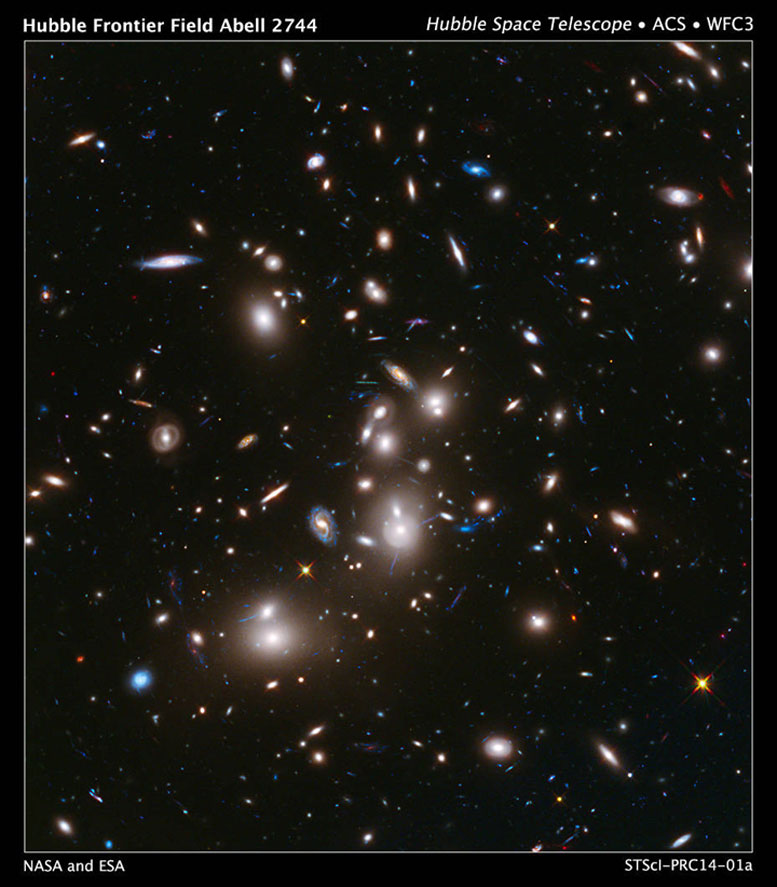
    Abell 2744, a cluster of galaxies whose dark matter halo has imaged more distant galaxies as seen in this Hubble Space Telescope image. Credit: NASA/ESA/Hubble

    Astronomers have compared the Hubble image of Abell 2744 to simulations of dark matter lensing and found excellent agreement, indicating that current models of dark matter behavior on the large scale are quite good.

    About eighty-five percent of the matter in the universe is in the form of dark matter, whose nature remains a mystery. The rest of the matter in the universe is of the kind found in atoms. Astronomers studying the evolution of galaxies in the universe find that dark matter exhibits gravity and, because it is so abundant, it dominates the formation of large-scale structures in the universe like clusters of galaxies. Dark matter is hard to observe directly, needless to say, and it shows no evidence of interacting with itself or other matter other than via gravity, but fortunately it can be traced by modeling sensitive observations of the distributions of galaxies across a range of scales.

    Galaxies generally reside at the centers of vast clumps of dark matter called haloes because they surround the clusters of galaxies. Gravitational lensing of more distant galaxies by dark matter haloes offers a particularly unique and powerful probe of the detailed distribution of dark matter. So-called strong gravitational lensing creates highly distorted, magnified, and occasionally multiple images of a single source; so-called weak lensing results in modestly yet systematically deformed shapes of background galaxies that can also provide robust constraints on the distribution of dark matter within the clusters.

    CfA astronomers Annalisa Pillepich and Lars Hernquist and their colleagues compared gravitationally distorted Hubble images of the galaxy cluster Abell 2744 and two other clusters with the results of computer simulations of dark matter haloes. They found, in agreement with key predictions in the conventional dark matter picture, that the detailed galaxy substructures depend on the dark matter halo distribution, and that the total mass and the light trace each other. They also found a few discrepancies: the radial distribution of the dark matter is different from that predicted by the simulations, and the effects of tidal stripping and friction in galaxies are smaller than expected, but they suggest these issues might be resolved with more precise simulations. Overall, however, the standard model of dark matter does an excellent and reassuring job of describing galaxy clustering.

    Reference: “Mapping Substructure in the HST Frontier Fields Cluster Lenses and in Cosmological Simulations” by Priyamvada Natarajan, Urmila Chadayammuri, Mathilde Jauzac, Johan Richard, Jean-Paul Kneib, Harald Ebeling, Fangzhou Jiang, Frank van den Bosch, Marceau Limousin, Eric Jullo, Hakim Atek, Annalisa Pillepich, Cristina Popa, Federico Marinacci, Lars Hernquist, Massimo Meneghetti and Mark Vogelsberger, 6 February 2017, MNRAS.
    DOI: 10.1093/mnras/stw3385

    Never miss a breakthrough: Join the SciTechDaily newsletter.
    Follow us on Google and Google News.

    Astrophysics Cosmology Dark Matter Harvard-Smithsonian Center for Astrophysics Hubble Space Telescope
    Share. Facebook Twitter Pinterest LinkedIn Email Reddit

    Related Articles

    Giant Cosmic Cotton Ball: A Dark Matter Deficient Galaxy

    Hubble Telescope Discovers A Galaxy With No Dark Matter

    Observations of Massive Galaxies in the Early Universe Reveal Rare Dark-Matter Haloes

    Astronomers Identify a Signature of Dark Matter Annihilation

    Calculations Show the Ideal Time to Study the Cosmos

    Hubble Reveals GJ1214b is a Waterworld Enshrouded by a Steamy Atmosphere

    The Bolshoi Simulation: Boxing the Universe

    Baryon Oscillation Spectroscopic Survey Measures the Universe’s Expansion and Dark Energy

    SN Primo Is Farthest Type Ia Supernova Discovered

    Leave A Reply Cancel Reply

    • Facebook
    • Twitter
    • Pinterest
    • YouTube

    Don't Miss a Discovery

    Subscribe for the Latest in Science & Tech!

    Trending News

    AI Could Detect Early Signs of Alzheimer’s in Under a Minute – Far Before Traditional Tests

    What if Dark Matter Has Two Forms? Bold New Hypothesis Could Explain a Cosmic Mystery

    This Metal Melts in Your Hand – and Scientists Just Discovered Something Strange

    Beef vs. Chicken: Surprising Results From New Prediabetes Study

    Alzheimer’s Breakthrough: Scientists Discover Key Protein May Prevent Toxic Protein Clumps in the Brain

    Quantum Reality Gets Stranger: Physicists Put a Lump of Metal in Two Places at Once

    Scientists May Have Found the Key to Jupiter and Saturn’s Moon Mystery

    Scientists Uncover Brain Changes That Link Pain to Depression

    Follow SciTechDaily
    • Facebook
    • Twitter
    • YouTube
    • Pinterest
    • Newsletter
    • RSS
    SciTech News
    • Biology News
    • Chemistry News
    • Earth News
    • Health News
    • Physics News
    • Science News
    • Space News
    • Technology News
    Recent Posts
    • Ancient “Rock” Microbes May Reveal How Complex Life Began
    • Hidden “Trade Winds” Inside Cells Could Explain Cancer Spread
    • Humans Owe Their Eyes to a Tiny One-Eyed “Cyclops”
    • Researchers Capture Quantum Interference in One of Nature’s Rarest Atoms
    • Ancient DNA Reveals Irish Goats Have a 3,000-Year-Old Lineage Still Alive Today
    Copyright © 1998 - 2026 SciTechDaily. All Rights Reserved.
    • Science News
    • About
    • Contact
    • Editorial Board
    • Privacy Policy
    • Terms of Use

    Type above and press Enter to search. Press Esc to cancel.