
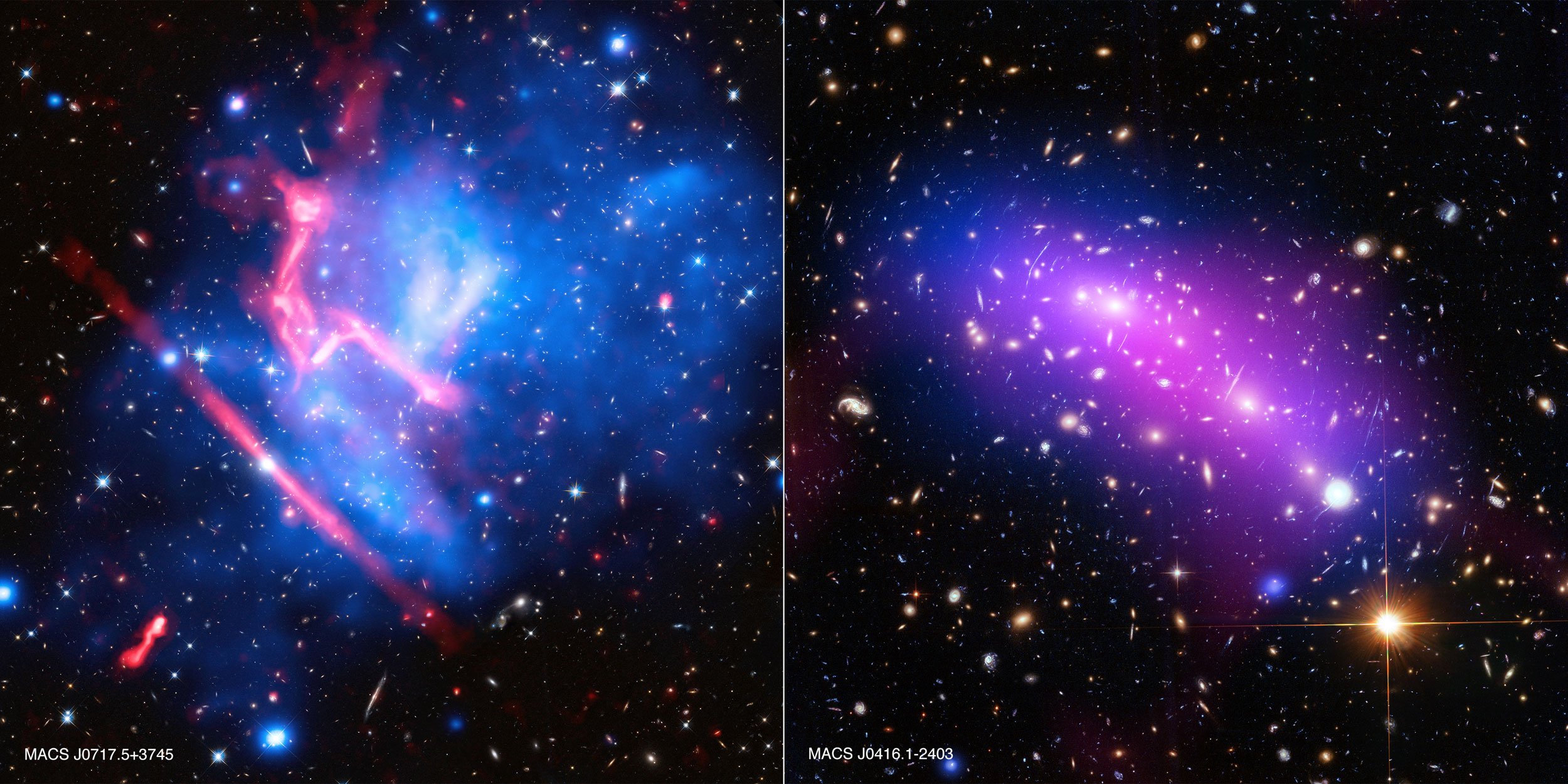
Astronomers are using data from NASA’s Chandra X-ray Observatory, the Hubble Space Telescope, and the NSF’s Jansky Very Large Array to learn more about galaxy clusters, including how they grow via collisions.
Galaxy clusters are enormous collections of hundreds or even thousands of galaxies and vast reservoirs of hot gas embedded in massive clouds of dark matter, invisible material that does not emit or absorb light but can be detected through its gravitational effects. These cosmic giants are not merely novelties of size or girth – rather they represent pathways to understanding how our entire universe evolved in the past and where it may be heading in the future.
To learn more about clusters, including how they grow via collisions, astronomers have used some of the world’s most powerful telescopes to look at different types of light. They have focused long observations with these telescopes on a half dozen galaxy clusters. The name for this galaxy cluster project is the “Frontier Fields”.
Two of these Frontier Fields galaxy clusters, MACS J0416.1-2403 (abbreviated MACS J0416) and MACS J0717.5+3745 (MACS J0717 for short) are featured here in a pair of multi-wavelength images.
Located about 4.3 billion light-years from Earth, MACS J0416 is a pair of colliding galaxy clusters that will eventually combine to form an even bigger cluster. MACS J0717, one of the most complex and distorted galaxy clusters known, is the site of a collision between four clusters. It is located about 5.4 billion light years away from Earth.
These new images of MACS J0416 and MACS J0717 contain data from three different telescopes: NASA’s Chandra X-ray Observatory (diffuse emission in blue), Hubble Space Telescope (red, green, and blue), and the NSF’s Jansky Very Large Array (diffuse emission in pink). Where the X-ray and radio emission overlap the image appears purple. Astronomers also used data from the Giant Metrewave Radio Telescope in India to study the properties of MACS J0416.
The Chandra data shows gas in the merging clusters with temperatures of millions of degrees. The optical data shows galaxies in the clusters and other, more distant, galaxies lying behind the clusters. Some of these background galaxies are highly distorted because of gravitational lensing, the bending of light by massive objects. This effect can also magnify the light from these objects, enabling astronomers to study background galaxies that would otherwise be too faint to detect. Finally, the structures in the radio data trace enormous shock waves and turbulence. The shocks are similar to sonic booms, generated by the mergers of the clusters.
New results from multi-wavelength studies of MACS J0416 and MACS J0717, described in two separate papers, are included below.
MACS J0416
An open question for astronomers about MACS J0416 has been: are we seeing a collision in these clusters that is about to happen or one that has already taken place? Until recently, scientists have been unable to distinguish between these two explanations. Now, the combined data from these various telescopes is providing new answers.
In MACS J0416 the dark matter (which leaves its gravitational imprint in the optical data) and the hot gas (detected by Chandra) line up well with each other. This suggests that the clusters have been caught before colliding. If the clusters were being observed after colliding the dark matter and hot gas should separate from each other, as seen in the famous colliding cluster system known as the Bullet Cluster.
The cluster in the upper left contains a compact core of hot gas, most easily seen in a specially processed image, and also shows evidence of a nearby cavity, or hole in the X-ray emitting gas. The presence of these structures also suggests that a major collision has not occurred recently, otherwise, these features would likely have been disrupted. Finally, the lack of sharp structures in the radio image provides more evidence that a collision has not yet occurred.
In the cluster located in the lower right, the observers have noted a sharp change in density on the southern edge of the cluster. This change in density is most likely caused by a collision between this cluster and a less massive structure located further to the lower right.
MACS J0717
In Jansky Very Large Array images of this cluster, seven gravitationally-lensed sources are observed, all point sources or sources that are barely larger than points. This makes MACS J0717 the cluster with the highest number of known lensed radio sources. Two of these lensed sources are also detected in the Chandra image. The authors are only aware of two other lensed X-ray sources behind a galaxy cluster.
All of the lensed radio sources are galaxies located between 7.8 and 10.4 billion light years away from Earth. The brightness of the galaxies at radio wavelengths shows that they contain stars forming at high rates. Without the amplification by lensing, some of these radio sources would be too faint to detect with typical radio observations. The two lensed X-ray sources detected in the Chandra images are likely active galactic nuclei (AGN) at the center of galaxies. AGN are compact, luminous sources powered by gas heated to millions of degrees as it falls toward supermassive black holes. These two X-ray sources would have been detected without lensing but would have been two or three times fainter.
The large arcs of radio emission in MACS J0717 are very different from those in MACS J0416 because of shock waves arising from the multiple collisions occurring in the former object. The X-ray emission in MACS J0717 has more clumps because there are four clusters violently colliding.
Georgiana Ogrean, who was at Harvard-Smithsonian Center for Astrophysics while leading the work on MACS J0416 research, is currently at Stanford University. The paper describing these results was published in the October 20th, 2015 issue of the Astrophysical Journal. The research on MACS J0717 was led by Reinout van Weeren from the Harvard-Smithsonian Center for Astrophysics, and was published in the February 1st, 2016 issue of the Astrophysical Journal.
NASA’s Marshall Space Flight Center in Huntsville, Alabama, manages the Chandra program for NASA’s Science Mission Directorate in Washington. The Smithsonian Astrophysical Observatory in Cambridge, Massachusetts, controls Chandra’s science and flight operations.
References:
“Frontier Fields Clusters: Chandra and JVLA View of the Pre-Merging Cluster MACS J0416.1-2403” by G. Ogrean, R. van Weeren, C. Jones, T. E. Clarke, J. Sayers, T. Mroczkowski, P. E. J. Nulsen, W. Forman, S. S. Murray, M. Pandey-Pommier, S. Randall, E. Churazov, A. Bonafede, R. Kraft, L. David, F. Andrade-Santos, J. Merten, A. Zitrin, K. Umetsu, A. Goulding, E. Roediger, J. Bagchi, E. Bulbul, M. Donahue, H. Ebeling, M. Johnston-Hollitt, B. Mason and P. Rosati, A. Vikhlinin, 20 October 2015, The Astrophysical Journal.
DOI: 10.1088/0004-637X/812/2/153
arXiv:1505.05560
“The discovery of lensed radio and X-ray sources behind the Frontier Fields cluster MACS J0717.5+3745 with the JVLA and Chandra” by R. J. van Weeren, G. A. Ogrean, C. Jones, W. R. Forman, F. Andrade-Santos, A. Bonafede, M. Brüggen, E. Bulbul, T. E. Clarke, E. Churazov, L. David, W. A. Dawson, M. Donahue, A. Goulding, R. P. Kraft, B. Mason, J. Merten, T. Mroczkowski, S. S. Murray, P. E. J. Nulsen, P. Rosati, E. Roediger, S. W. Randall, J. Sayers, K. Umetsu, A. Vikhlinin and A. Zitrin, 2 January 2016, The Astrophysical Journal Letters.
DOI: 10.3847/0004-637X/817/2/98
arXiv:1512.04527
Never miss a breakthrough: Join the SciTechDaily newsletter.
Follow us on Google and Google News.