

New observations from the James Webb Space Telescope show that IRS 3, a star near the center of the Milky Way, is losing vast amounts of mass, causing its surrounding envelope to expand continuously.
Near the supermassive black hole at the center of the Milky Way, a mature star is shedding enormous amounts of gas and dust into space. Observations of IRS 3 suggest that this material has created an exceptionally large envelope, and within it astronomers have detected water molecules despite the extreme environment surrounding the galactic center.
The research was led by PD Dr. Florian Peißker of the University of Cologne’s Institute for Astrophysics. Peißker’s group, which participates in the European James Webb Space Telescope (JWST) consortium studying nearby galaxies, investigates the region surrounding Sagittarius A*, or Sgr A*, the supermassive black hole at the center of the Milky Way.
The findings were published in the journal Astronomy & Astrophysics.
To examine IRS 3, the astronomers used JWST’s Mid-Infrared Instrument (MIRI), which observes the universe at mid-infrared wavelengths and was developed in part at the Institute for Astrophysics. IRS 3 lies roughly 0.6 light-years, or 42,000 astronomical units, from Sgr A*.
One astronomical unit is the average distance between Earth and the Sun. Voyager 1, the most distant human-made object from Earth, would require about 10,000 years to travel that distance. On galactic scales, however, IRS 3 sits remarkably close to the black hole.
IRS 3 has an enormous envelope
IRS 3 is surrounded by an envelope extending about 10,000 astronomical units from the star. Large envelopes can form around mature stars, but IRS 3 is unusual because no comparable object is known in its immediate surroundings despite the millions of stars near Sgr A*.
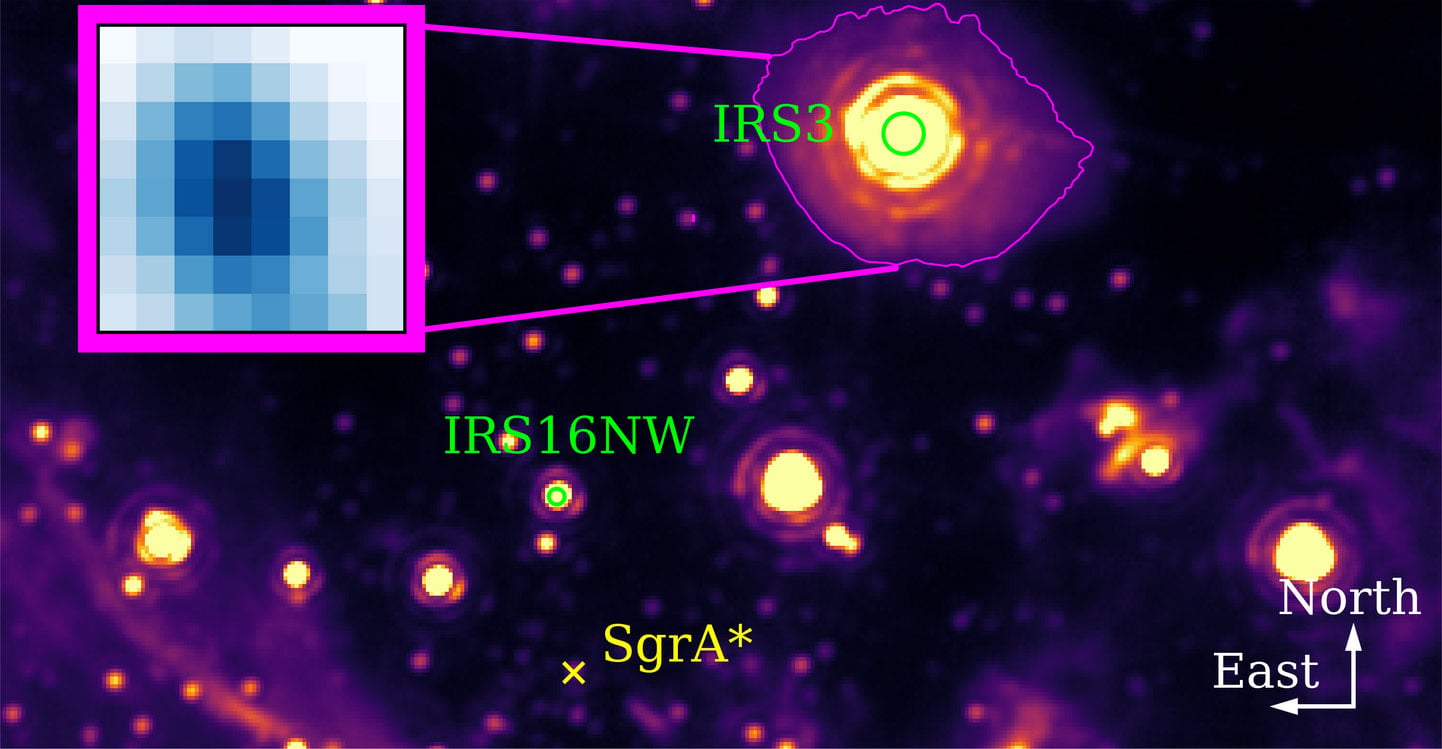
Detailed observations with MIRI also changed the picture of what IRS 3 is currently doing. Contrary to earlier studies, Peißker and his colleagues concluded that the star is undergoing a phase known as a ‘superwind.’ In astrophysics, a ‘superwind’ describes a period of extremely rapid mass loss near the end of a massive star’s life, during which enormous quantities of gas and dust are expelled into the surrounding environment over centuries.
Water survives in a harsh environment
The researchers estimate that IRS 3 is losing an amount of material equivalent to Earth’s mass roughly every 18 days, continually expanding its surrounding envelope. That rapid mass loss helps account for both the envelope’s unusual size and its density.
More unexpectedly, JWST observations revealed water inside the envelope. Earlier assumptions suggested that radiation associated with Sgr A* and its surroundings would make it difficult for molecules to survive so close to the black hole. The detection shows that water can persist within the material surrounding IRS 3 and suggests that the star is contributing molecular material to the environment around Sgr A*, including compounds associated with the fundamental building blocks of life.
Researchers in Professor Dr. Lucas Labadie’s group at the Institute for Astrophysics are now developing a new generation of instruments for the Extremely Large Telescope in Chile’s Atacama Desert, which is expected to begin operations in the coming years. With the METIS instrument, astronomers hope to investigate the structure and composition of IRS 3’s vast envelope in greater detail.
Reference: “Dust production in the harsh environment of Sgr A* – MIRI/JWST observation of the O-rich asymptotic giant branch star IRS 3” by F. Peißker, M. García Marín, A. Eckart, G. Wright, O. C. Jones, D. Dicken, A. Alonso Herrero, D. Rouan, D. Law, T. Böker, T. Henning, M. Baes, A. Labiano, L. Pantoni, L. Hermosa Muñoz, P. O. Lagage, P. van der Werf, G. Östlin, J. A. D. L. Blommaert, M. Güdel and P. Guillard, 11 August 2026, Astronomy & Astrophysics.
DOI: 10.1051/0004-6361/202660243
Never miss a breakthrough: Join the SciTechDaily newsletter.
Follow us on Google and Google News.