
The University of British Columbia researchers have discovered a key vulnerability of major coronavirus variants.
The University of British Columbia researchers uncovered a key vulnerability in all main variants of the SARS-CoV-2 virus, including the newly discovered BA.1 and BA.2 Omicron subvariants.
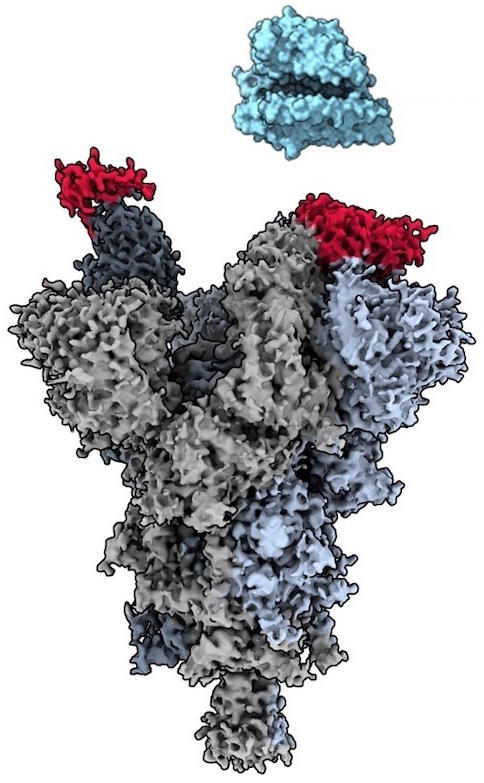
Neutralizing antibodies can target the vulnerability, potentially opening the door for treatments that would be universally effective across variants.
The research, which was published in the journal Nature Communications, uses cryo-electron microscopy (cryo-EM) to identify the atomic structure of the vulnerable region, or epitope, on the virus’ spike protein. The study also reports a VH Ab6 antibody fragment that can bind to this location and neutralize every major variant.
“This is a highly adaptable virus that has evolved to evade most existing antibody treatments, as well as much of the immunity conferred by vaccines and natural infection,” says Dr. Sriram Subramaniam (he/him), a professor at UBC’s faculty of medicine and the study’s senior author. “This study reveals a weak spot that is largely unchanged across variants and can be neutralized by an antibody fragment. It sets the stage for the design of pan-variant treatments that could potentially help a lot of vulnerable people.”
Identifying COVID-19 Master Keys
Our bodies manufacture antibodies naturally to combat infection, but they may also be created in a lab and given to patients as a treatment. Despite the fact that a number of antibody treatments have been created for COVID-19, their efficacy has decreased in the face of highly mutated variants like Omicron.
“Antibodies attach to a virus in a very specific manner, like a key going into a lock. But when the virus mutates, the key no longer fits,” says Dr. Subramaniam. “We’ve been looking for master keys — antibodies that continue to neutralize the virus even after extensive mutations.”
This new paper identifies the antibody fragment VH Ab6 as the “master key,” which has been found to be effective against the Alpha, Beta, Gamma, Delta, Kappa, Epsilon, and Omicron variants. By binding to the epitope on the spike protein and preventing SARS-CoV-2 from infecting human cells, the fragment neutralizes the virus.
The discovery is the latest from a longstanding and productive collaboration between Dr. Subramaniam’s team at UBC and colleagues at the University of Pittsburgh, led by Drs. Mitko Dimitrov and Wei Li. The team in Pittsburgh has been screening large antibody libraries and testing their effectiveness against COVID-19, while the UBC team has been using cryo-EM to study the molecular structure and characteristics of the spike protein.
Focusing on COVID-19’s Weak Points
The UBC team is world-renowned for its expertise in using cryo-EM to visualize protein-protein and protein-antibody interactions at an atomic resolution. In another paper published earlier this year in Science, they were the first to report the structure of the contact zone between the Omicron spike protein and the human cell receptor ACE2, providing a molecular explanation for Omicron’s enhanced viral fitness.
By mapping the molecular structure of each spike protein, the team has been searching for areas of vulnerability that could inform new treatments.
“The epitope we describe in this paper is mostly removed from the hot spots for mutations, which is why its capabilities are preserved across variants,” says Dr. Subramaniam. “Now that we’ve described the structure of this site in detail, it unlocks a whole new realm of treatment possibilities.”
Dr. Subramaniam says this key vulnerability can now be exploited by drug makers, and because the site is relatively mutation-free, the resulting treatments could be effective against existing—and even future—variants.
Reference: “SARS-CoV-2 variants of concern: spike protein mutational analysis and epitope for broad neutralization” by Dhiraj Mannar, James W. Saville, Zehua Sun, Xing Zhu, Michelle M. Marti, Shanti S. Srivastava, Alison M. Berezuk, Steven Zhou, Katharine S. Tuttle, Michele D. Sobolewski, Andrew Kim, Benjamin R. Treat, Priscila Mayrelle Da Silva Castanha, Jana L. Jacobs, Simon M. Barratt-Boyes, John W. Mellors, Dimiter S. Dimitrov, Wei Li and Sriram Subramaniam, 18 August 2022, Nature Communications.
DOI: 10.1038/s41467-022-32262-8
Never miss a breakthrough: Join the SciTechDaily newsletter.
Follow us on Google and Google News.