
Compact, Massive Triple Star System Detected by University of Copenhagen Researchers
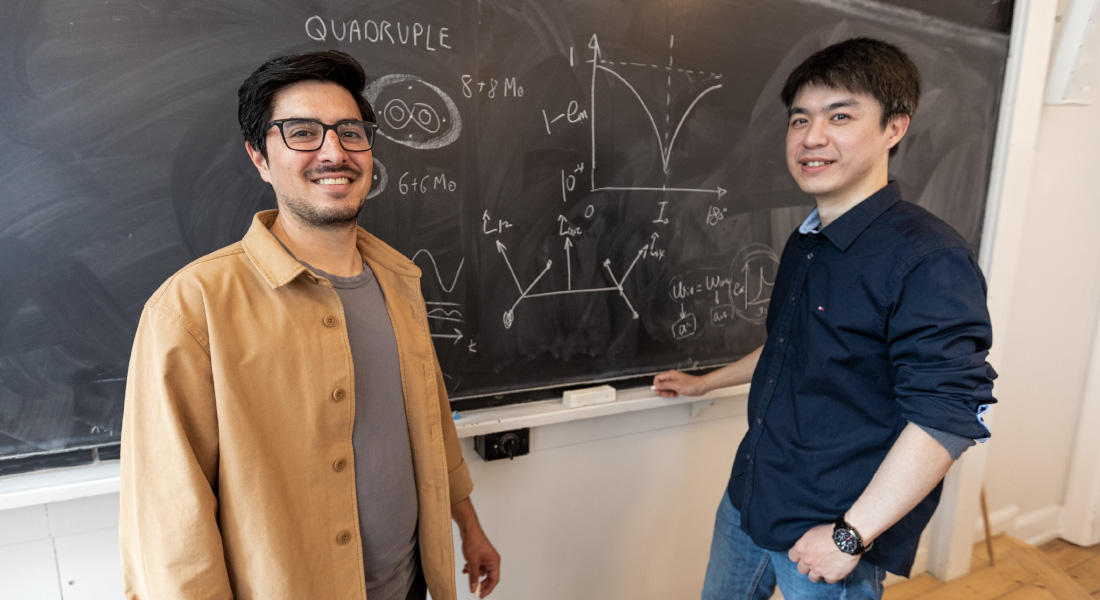
Earlier this year, researchers revealed the discovery of an extraordinarily compact “one-of-a-kind” system of three stars. A partnership between two young researchers at the Niels Bohr Institute at the University of Copenhagen is currently focusing on how this unusual combination of a binary set of stars and a revolving larger star can form.
Tertiary Star Formation on a Massive Scale
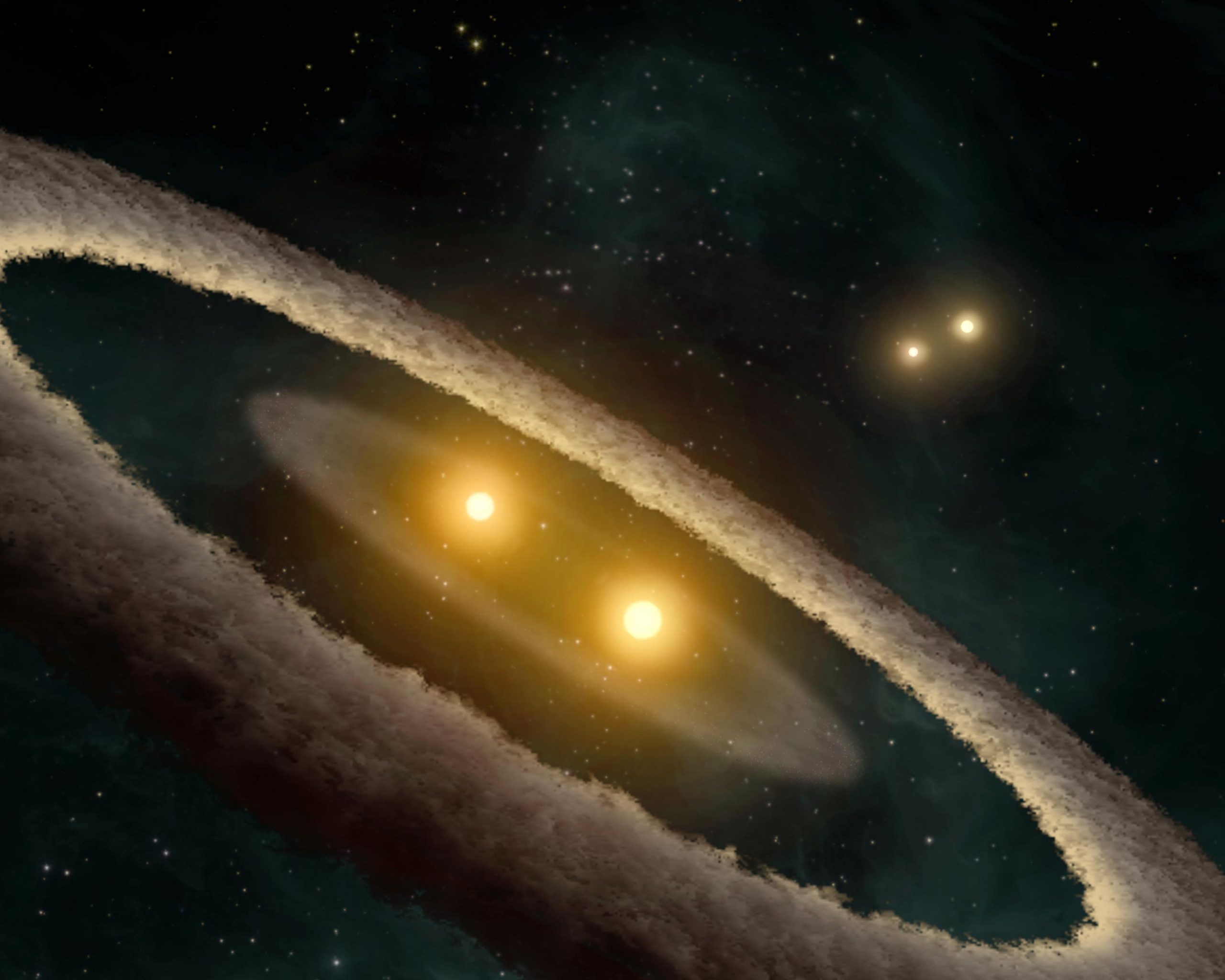
The star system is made up of a binary set of stars, two stars that orbit each other, and one more massive star that orbits the binary.
“As far as we know, it is the first of its kind ever detected”, Alejandro Vigna-Gomez says. “We know of many tertiary star systems (three star systems), but they are typically significantly less massive. The massive stars in this triple are very close together – it is a compact system. The orbital period of the binary (~1 d) is the same as that of the rotation of Earth (1 day). The combined mass of the two of them is twelve times the mass of our Sun – so rather big stars. The tertiary star is approximately 16 times the mass of our Sun, so even bigger! The inner orbit is circular in shape with close to six revolutions of the tertiary star around the binary per year. Pretty fast, when you consider the size of them – unsurprisingly, the system is very luminous, so at first they were detected as a stellar binary”.
The Dedication of Amateurs Led to the Discovery of the Star System
The initial discovery of the unusual nature of this highly peculiar system was equally remarkable in that it was discovered by amateur astronomers.
A group of amateur astronomers who were combing through a public data set from NASA’s TESS observatory (Transiting Exoplanet Survey Satellite) discovered something unusual.
The level of professionalism can be quite high among amateurs, and they made the professional astronomers aware of anomalies in the detection. It was discovered that what had previously been thought to be two stars were really three. These kinds of communities are known as citizen scientists.
The Combination of Expertise in Dynamics and Stellar Evolution Proved To Be Fruitful
Postdoc Alejandro Vigna-Gomez explains that when investigating the formation of the star system, several options were considered.
- If, for instance, the bigger star formed first, it would likely have ejected material that would have disrupted the formation of a binary that close.
- Another possibility is that the binary and the third star formed separately from each other and eventually encountered and locked in their orbits because of gravity.
- – or a third possibility, where two binaries formed and one merged into one, bigger star.
This is where the combined efforts of Bin Liu, an expert on dynamics, and Alejandro Vigna-Gomez’s knowledge of star formation came in handy. They coded the options and ran more than 100,000 iterations on the computer, in order to assess the most likely outcome of this scenario.
The result turned out to be in favor of the two binary systems forming initially and one of them merging with one star. Their results show that the two binary scenario could in fact explain the origin of the triple system.
The Way Forward Requires the Expertise of an Astronomer Specializing in Observations
“Now we have a model of the most likely scenario on this unique system. But a model is not enough. And there are two ways in which we can prove or disentangle our theory on this formation”, postdoc Alejandro explains. ”One is studying the system in detail and the other is to make statistical analysis on a population of stars. If we go into the system in detail, we shall have to rely on the expertise of an astronomer. We already have some preliminary observations, but we still need to go through the data, and make sure we are interpreting it well”.
Bin Liu continues: “We also encourage people in the scientific community to look at the data deeply,” Postdoc Bin Liu says. “Maybe there are more compact systems buried in the data. What we really want to know is whether this kind of system is common in our universe”.
Alejandro Vigna-Gomez and Bin Liu have now mapped out quite a lot of work for themselves. “We need to find an adequate telescope with available observing time somewhere in the world and talk to someone who is really an expert from the observational point of view. The data from telescopes needs to be understood correctly. What you see in a telescope is not entirely what you get, so to speak. It must be interpreted”.
So more collaboration is underway, very much in the spirit of Niels Bohr, Alejandro says:
“A Chinese and a Mexican with each their different fields, dynamics, and star formation, meet at the Niels Bohr Institute and are now on the way to yet more scientific collaboration”.
Reference: “Mergers prompted by dynamics in compact, multiple-star systems: a stellar-reduction case for the massive triple TIC 470710327” by Alejandro Vigna-Gómez, Bin Liu, David R Aguilera-Dena, Evgeni Grishin, Enrico Ramirez-Ruiz and Melinda Soares-Furtado, 29 June 2022, Monthly Notices of the Royal Astronomical Society Letters.
DOI: 10.1093/mnrasl/slac067
Never miss a breakthrough: Join the SciTechDaily newsletter.
Follow us on Google and Google News.
7 Comments
“As far as we know, it is the first of its kind ever detected””””””
… Okay, this is bit strange, like a movie thing! Well, like SF movies, …
I’m no astrophysicist, but aren’t there FOUR stars in this picture?
Every time I see this story, the same pic/graphic, though I do agree a triple star system with 4 stars, would be “one of a kind”.
Can’t they just turn the new telescope in that direction and look… Humans.. three is three and 4 is 4…
I think the picture shows the assumed formation of two binaries becoming a single large star and a binary system.
I agree Alex.
I for one welcome our Trisolaran overlords
If You Read The Article You Would Understand What It’s Being Argued Here. There Were Two Binary Systems Orbiting Each Other At The Beginning But Over Time The Outer Binary System Became One Giant Star Which Orbited Around The Other Binary System Making Them Of Course A Three Stars System. This Is A Very Slow Process That Makes Millenniums To Occur.