
Close Menu
    Facebook X (Twitter) Instagram
    SciTechDaily
    • Biology
    • Chemistry
    • Earth
    • Health
    • Physics
    • Science
    • Space
    • Technology
    Facebook X (Twitter) Pinterest YouTube RSS
    SciTechDaily
    Home»Health»Computational Model of a Human Lung Cell Predicts Cellular Drug Targets Against COVID-19
    Health

    Computational Model of a Human Lung Cell Predicts Cellular Drug Targets Against COVID-19

    By University of WarwickDecember 8, 2020No Comments3 Mins Read
    Facebook Twitter Pinterest Telegram LinkedIn WhatsApp Email Reddit
    Share
    Facebook Twitter LinkedIn Pinterest Telegram Email Reddit
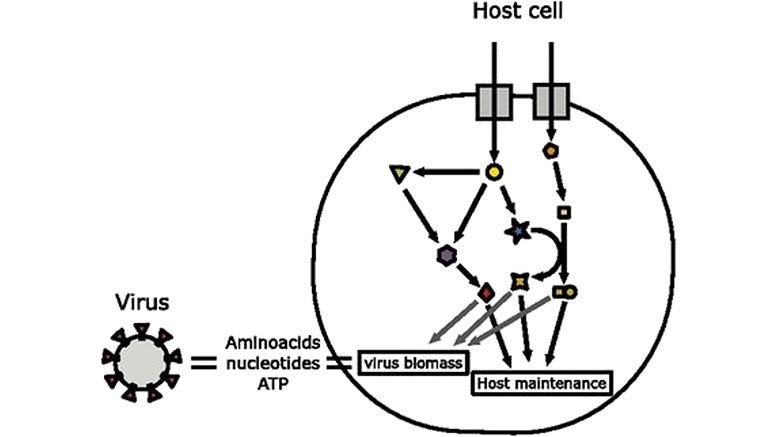
    Integrated Host Virus Metabolic Modeling Approach
    Schematic representation of the integrated host-virus metabolic modeling approach used in the article. The biomass composition of SARS-CoV-2 is estimated based on genomic and structural information and then embedded in the metabolic network model of the host cell. This model is then used to predict the metabolic fluxes supporting virus production and effects of perturbations. Credit: University of Warwick
    • The COVID-19 virus, like all viruses, relies on its host for reproduction
    • How SARS-CoV-2 captures stoichiometric amino and nucleic acids in a human lung cell has been discovered by using a computational model by scientists from the University of Warwick
    • By understanding host-based metabolic perturbations inhibiting SARS-CoV-2, a rapid, experimentally testable generation of drug predictions can be made

    A computational model of a human lung cell has been used to understand how SARS-CoV-2 draws on human host cell metabolism to reproduce by researchers at the University of Warwick. This study helps understand how the virus uses the host to survive, and enable drug predictions for treating the virus to be made.

    Viruses rely on their host to survive, a crucial step of lifecycle is the synthesis of the virus particles within the host cell, therefore understanding this process is key to finding ways to prevent the virus from surviving.

    Using a computer model of a human lung cell metabolism, scientists from the School of Life Sciences at the University of Warwick have captured the stoichiometric amino and nucleic acid requirements of SARS-CoV-2, the virus that causes COVID-19. Publishing their results in the paper, ‘Inhibiting the reproduction of SARS-CoV-2 through perturbations in human lung cell metabolic network’, in the journal Life Science Alliance.

    Their model has identified host-based metabolic perturbations inhibiting SARS-CoV-2 reproduction, highlighting reactions in the central metabolism, as well as amino acid and nucleotide biosynthesis pathways. In fact, researchers found that only a few of these metabolic perturbations are able to selectively inhibit virus reproduction.

    Researchers have also noted that some of the catalyzing enzymes of such reactions have demonstrated interactions with existing drugs, which can be used for experimental testing of the presented predictions using gene knockouts and RNA-interference techniques.

    Professor Orkun Soyer, from the School of Life Sciences at the University of Warwick comments:

    “We have created a stoichiometric biomass function for the COVID-19-causing SARS-CoV-2 virus and incorporated this into a human lung cell genome scale metabolic model.

    “We then predicted reaction perturbations that can inhibit SARS-CoV-2 reproduction in general or selectively, without inhibiting the host metabolic maintenance. The predicted reactions primarily fall onto glycolysis and oxidative phosphorylation pathways, and their connections to amino acid biosynthesis pathways.”

    Dr. Hadrien Delattre, from the School of Life Sciences at the University of Warwick adds:

    “Together, these results highlight the possibility of targeting host metabolism for inhibition of SARS-CoV-2 reproduction in human cells in general and in human lung cells specifically.

    He added, “More research needs to be carried out to explore SARS-CoV-2 infected cells and their metabolism, however, the model developed here by the researchers can be used as a starting point for testing out specific drug predictions.”

    Reference: “Inhibiting the reproduction of SARS-CoV-2 through perturbations in human lung cell metabolic network” by Hadrien Delattre, Kalesh Sasidharan and Orkun S Soyer, 24 November 2020, Life Science Alliance.
    DOI: 10.26508/lsa.202000869

    Never miss a breakthrough: Join the SciTechDaily newsletter.
    Follow us on Google and Google News.

    Biomedical Engineering Biotechnology Cell Biology COVID-19 Infectious Diseases University of Warwick
    Share. Facebook Twitter Pinterest LinkedIn Email Reddit

    Related Articles

    “Primed” for Infection: Cells Damaged by Chronic Lung Disease Can Result in Severe COVID

    New Sensor Detects COVID-19 and Variants on People’s Breath – Even When They Are Asymptomatic

    New COVID-19 Test Distinguishes SARS-CoV-2 From Other Coronaviruses With 100% Accuracy

    MIT and Harvard Engineers Create New Face Mask That Can Detect COVID-19 Infection

    Newly Discovered Virus-Cell Interaction May Explain COVID-19’s High Infection Rate

    NIRVANA: Fast, Portable Test Can Diagnose COVID-19 and Track Variants

    Team of Biochemists and Virologists Discover Potential Targets for COVID-19 Therapy

    COVID-19 Treatment May Lie in Pangolin Genetics – May Possess Evolutionary Advantage Against Coronavirus

    Infection Researchers Identify How Coronaviruses From Animals Need to Change to Spread to Humans

    Leave A Reply Cancel Reply

    • Facebook
    • Twitter
    • Pinterest
    • YouTube

    Don't Miss a Discovery

    Subscribe for the Latest in Science & Tech!

    Trending News

    Tyrannosaurus Tooth Found Embedded in Dinosaur Skull Reveals Brutal Prehistoric Attack

    This Supervolcano Is Refilling With Magma After 7,300 Years

    New Study Reveals Hidden Trade-Off in Popular Weight Loss Treatments

    Scientists “Bottle the Sun” With Revolutionary Liquid Battery

    This Ancient Ape Fossil Could Change Where Humans Came From

    This Simple Eating Habit May Help You Lose More Weight

    “Hulk Lizards” Are Wiping Out Millions of Years of Evolution

    Vitamin B2’s Dark Side: The Nutrient That May Help Cancer Cells Survive

    Follow SciTechDaily
    • Facebook
    • Twitter
    • YouTube
    • Pinterest
    • Newsletter
    • RSS
    SciTech News
    • Biology News
    • Chemistry News
    • Earth News
    • Health News
    • Physics News
    • Science News
    • Space News
    • Technology News
    Recent Posts
    • Scientists Say Washing Dishes With a Sponge Has a Concerning Side Effect
    • Scientists Break 50-Year-Old Bottleneck To Supercharge Cancer Drug Production
    • Scientists Identify Biological Pathway That Could Reverse Memory Loss
    • Popular Weight-Loss Drug Wegovy Linked to Sudden Vision Loss
    • 3,500-Year-Old Loom Discovery Reveals Secrets of Bronze Age Weaving
    Copyright © 1998 - 2026 SciTechDaily. All Rights Reserved.
    • Science News
    • About
    • Contact
    • Editorial Board
    • Privacy Policy
    • Terms of Use

    Type above and press Enter to search. Press Esc to cancel.