
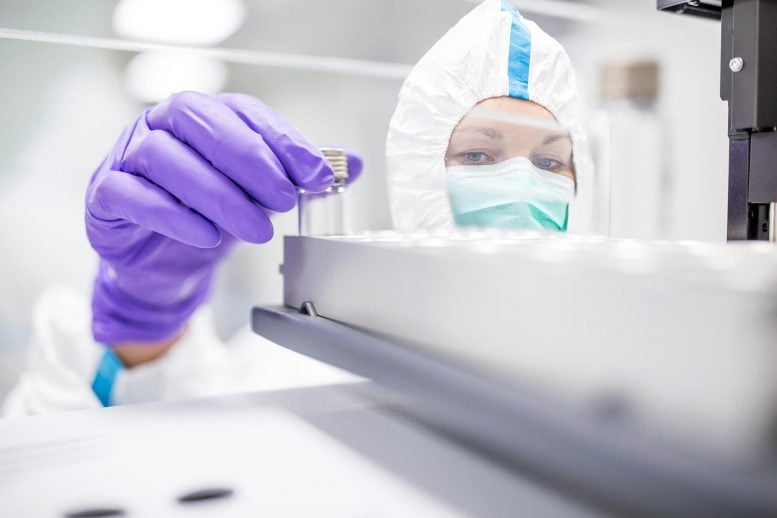
Cell culture model: several compounds stop SARS-CoV-2 virus.
A team of biochemists and virologists at Goethe University and the Frankfurt University Hospital were able to observe how human cells change upon infection with SARS-CoV-2, the virus causing COVID-19 in people. The scientists tested a series of compounds in laboratory models and found some which slowed down or stopped virus reproduction. These results now enable the search for an active substance to be narrowed down to a small number of already approved drugs.
Based on these findings, a US company reports that it is preparing clinical trials. A Canadian company is also starting a clinical study with a different substance.
Since the start of February, the Medical Virology of the Frankfurt University Hospital has been in possession of a SARS-CoV-2 infection cell culture system. The Frankfurt scientists in Professor Sandra Ciesek’s team succeeded in cultivating the virus in colon cells from swabs taken from two infected individuals returning from Wuhan (Hoehl et al. NEJM 2020).
Using a technique developed at the Institute for Biochemistry II at Goethe University Frankfurt, researchers from both institutions were together able to show how a SARS-CoV-2 infection changes the human host cells. The scientists used a particular form of mass spectrometry called the mePROD method, which they had developed only a few months previously. This method makes it possible to determine the amount and synthesis rate of thousands of proteins within a cell.
The findings paint a picture of the progression of a SARS-CoV-2 infection: whilst many viruses shut down the host’s protein production to the benefit of viral proteins, SARS-CoV-2 only slightly influences the protein production of the host cell, with the viral proteins appearing to be produced in competition to host cell proteins. Instead, a SARS-CoV-2 infection leads to an increased protein synthesis machinery in the cell. The researchers suspected this was a weak spot of the virus and were indeed able to significantly reduce virus reproduction using something known as translation inhibitors, which shut down protein production.
Twenty-four hours after infection, the virus causes distinct changes to the composition of the host proteome: while cholesterol metabolism is reduced, activities in carbohydrate metabolism and in modification of RNA as protein precursors increase. In line with this, the scientists were successful in stopping virus reproduction in cultivated cells by applying inhibitors of these processes. Similar success was achieved by using a substance that inhibits the production of building blocks for the viral genome.
The findings have already created a stir on the other side of the Atlantic: in keeping with the common practice since the beginning of the corona crisis, the Frankfurt researchers made these findings immediately available on a preprint server and on the website of the Institute for Biochemistry II. Professor Ivan Dikic, Director of the Institute, comments: “Both the culture of ‘open science’, in which we share our scientific findings as quickly as possible, and the interdisciplinary collaboration between biochemists and virologists contributed to this success. This project started not even three months ago, and has already revealed new therapeutic approaches to COVID-19.”
Professor Sandra Ciesek, Director of the Institute for Medical Virology at the University Hospital Frankfurt, explains: “In a unique situation like this we also have to take new paths in research. An already existing cooperation between the Cinatl and Münch laboratories made it possible to quickly focus the research on SARS-CoV-2. The findings so far are a wonderful affirmation of this approach of cross-disciplinary collaborations.”
Among the substances that stopped viral reproduction in the cell culture system was 2-Deoxy-D-Glucose (2-DG), which interferes directly with the carbohydrate metabolism necessary for viral reproduction. The US company Moleculin Biotech possesses a substance called WP1122, a prodrug similar to 2-DG. Recently, Moleculin Biotech announced that they are preparing a clinical trial with this substance based on the results from Frankfurt.
Based on another one of the substances tested in Frankfurt, Ribavirin, the Canadian company Bausch Health Americas is starting a clinical study with 50 participants.
Dr. Christian Münch, Head of the Protein Quality Control Group at the Institute for Biochemistry II and lead author, comments: “Thanks to the mePROD-technology we developed, we were for the first time able to trace the cellular changes upon infection over time and with high detail in our laboratory. We were obviously aware of the potential scope of our findings. However, they are based on a cell culture system and require further testing. The fact that our findings may now immediately trigger further in vivo studies with the purpose of drug development is definitely a great stroke of luck.” Beyond this, there are also other potentially interesting candidates among the inhibitors tested, says Münch, some of which have already been approved for other indications.
Professor Jindrich Cinatl from the Institute of Medical Virology and lead author explains: “The successful use of substances that are components of already approved drugs to combat SARS-CoV-2 is a great opportunity in the fight against the virus. These substances are already well characterized, and we know how they are tolerated by patients. This is why there is currently a global search for these types of substances. In the race against time, our work can now make an important contribution as to which directions promise the fastest success.”
Reference: “SARS-CoV-2 infected host cell proteomics reveal potential therapy targets” by Denisa Bojkova, Kevin Klann, Benjamin Koch, Marek Widera, David Krause, Sandra Ciesek, Jindrich Cinatl, Christian Münch, 14 May 2020, Nature.
DOI: 10.1038/s41586-020-2332-7
Never miss a breakthrough: Join the SciTechDaily newsletter.
Follow us on Google and Google News.