
Caltech researchers simulated solar flares, discovering that their structures resemble intertwined ropes. When these ‘ropes’ overload, they break and emit energy bursts, shedding light on the behavior of real solar flares.
Simulating solar flares on a scale the size of a banana, researchers at the California Institute of Technology (Caltech) have parsed out the process by which these massive explosions blast potentially harmful energetic particles and X-rays into the cosmos.
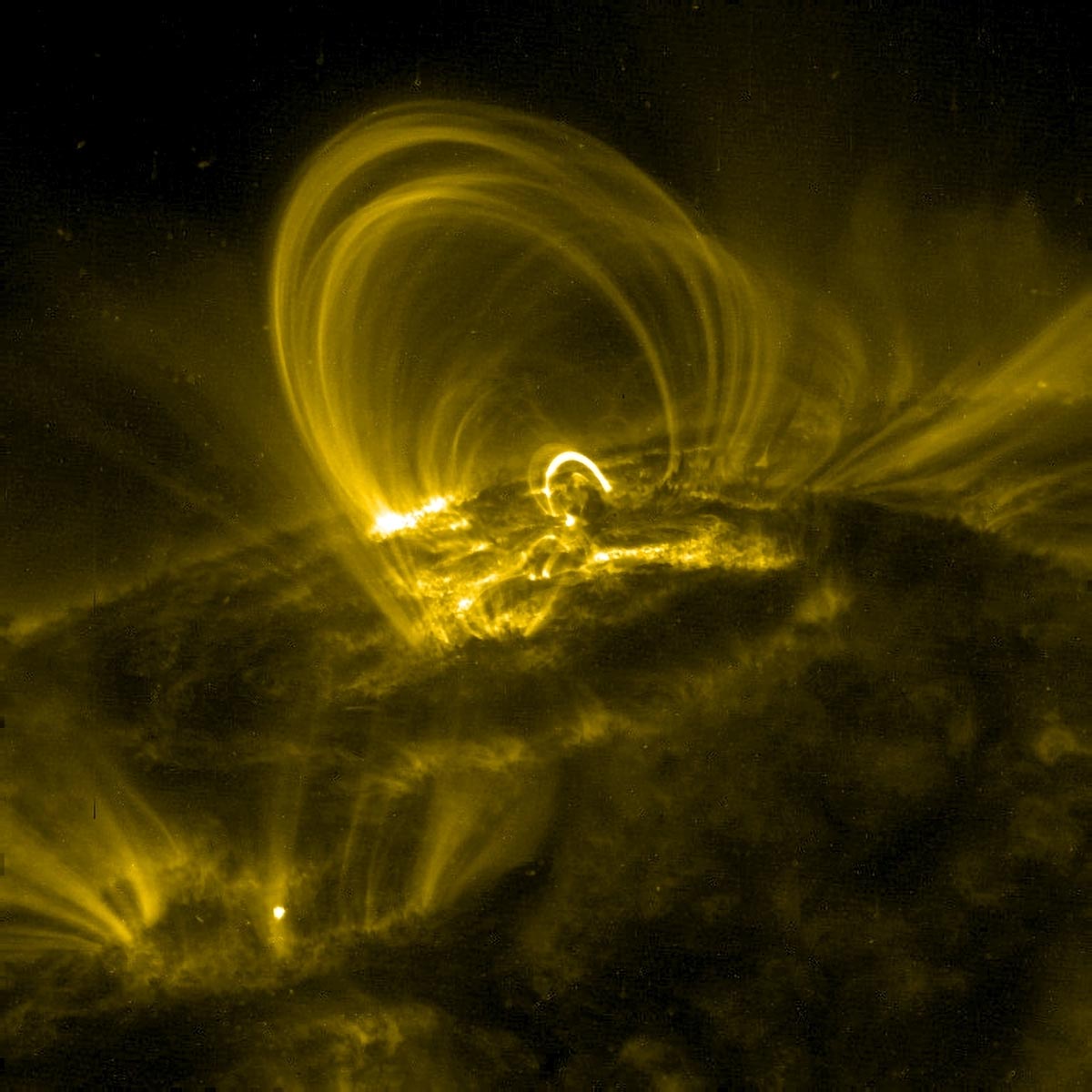
Corona loops are arches of plasma that protrude from the surface of the sun, aligned along magnetic field lines. The magnetic field lines act like highways for charged particles, guiding the motion of the electrons and ions that comprise plasma. The loops, which may project 100,000 kilometers above the sun’s surface, can persist for minutes to hours. The loops usually grow and evolve slowly but sometimes can abruptly blast a tremendous amount of energy—billions of times stronger than the most powerful nuclear explosion on Earth—into space. This sudden blast of energy is called a solar flare.
Potential Threats From Solar Flares
Some of the energy in the flare takes the form of charged particles and “hard X-rays,” which are high-energy electromagnetic waves like those used to image bones in a doctor’s office. The Earth’s own magnetic field and atmosphere act as a shield that protects life on the surface from getting cooked by these torrents of energy, but they have been known to disrupt communications and power grids. They also pose an ongoing threat to spacecraft and astronauts in space.
Research Approach and Simulation
Although the fact that solar flares generate energetic particles and X-ray bursts has long been known, scientists are only starting to piece together the mechanism by which they do so.
Researchers have two options for deciphering how and why the loops form and change. The first is to observe the sun and hope to capture the phenomenon in sufficiently fine detail to yield relevant information. The second is to simulate the loops in a lab. Caltech’s Paul Bellan, professor of applied physics, chose the latter.
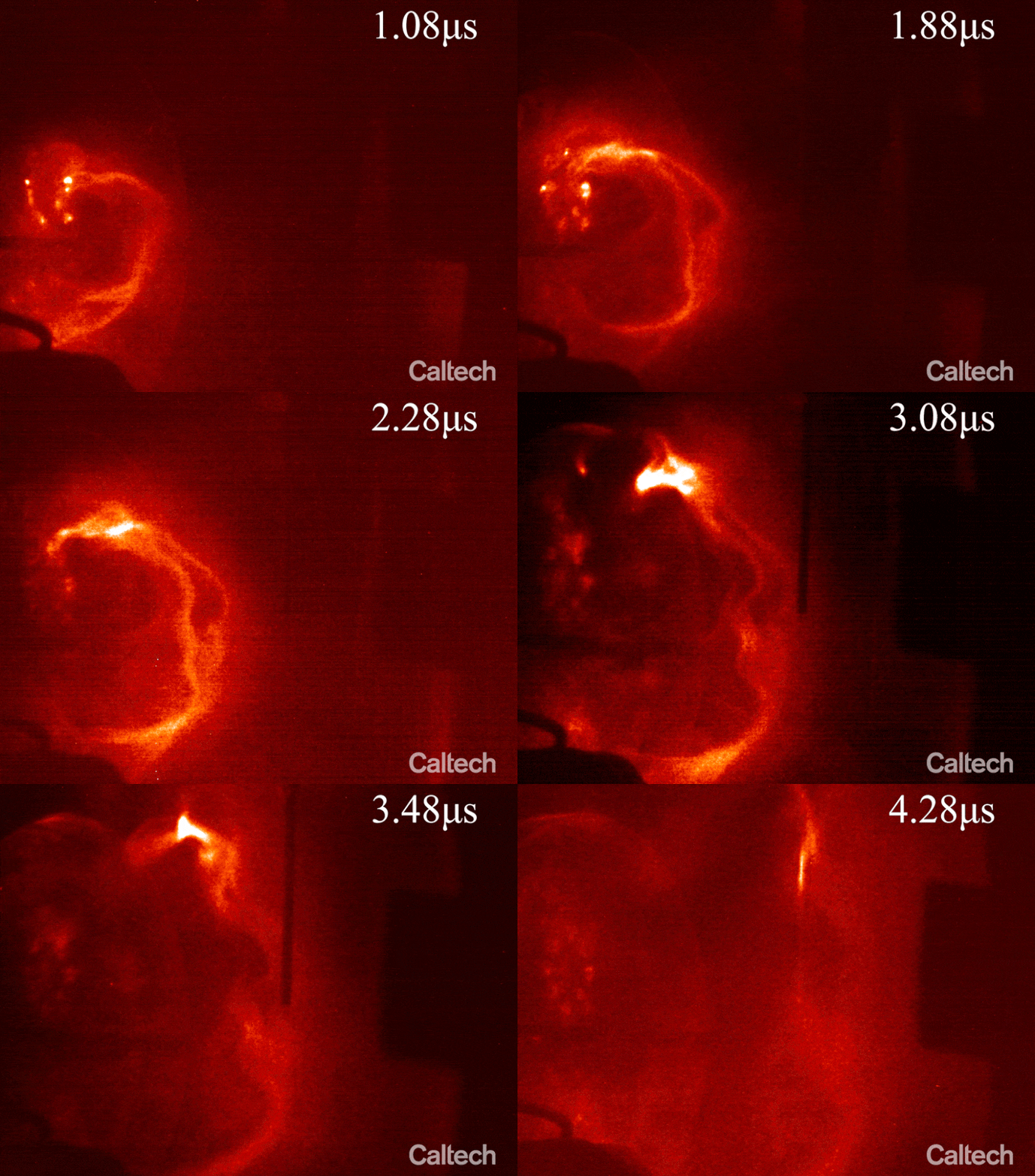
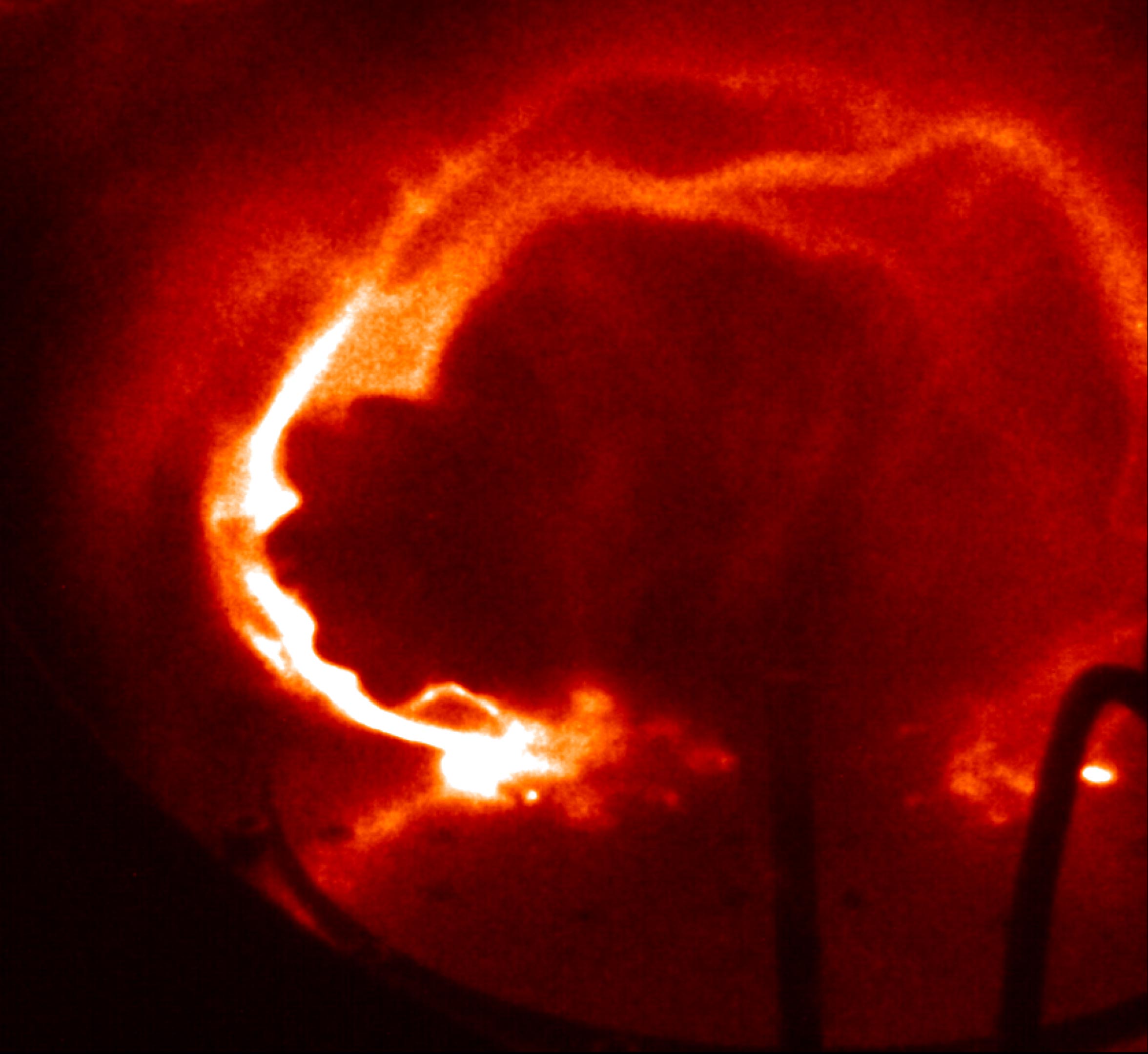
In a lab on the first floor of the Thomas J. Watson, Sr., Laboratories of Applied Physics on Caltech’s campus, Bellan built a vacuum chamber with twin electrodes inside. To simulate the phenomenon, he charged a capacitor with enough energy to run the City of Pasadena for a few microseconds, then discharged it through the electrodes to create a miniature solar corona loop.
Each loop lasts about 10 microseconds, and has a length of about 20 centimeters (cm) and a diameter of about 1 cm. But structurally, Bellan’s loops are identical to the real thing, offering he and his colleagues the opportunity to simulate and study them at will.
“Each experiment consumes about as much energy as it takes to run a 100-watt lightbulb for about a minute, and it takes just a couple minutes to charge the capacitor up,” says Bellan, the senior author of a new paper on solar flares that published recently in the journal Nature Astronomy. Bellan captures each loop with a camera capable of taking 10 million frames per second, and he then studies the resulting images.
New Discoveries and Insights
Among the recent discoveries are that solar corona loops do not appear to be a single structure, but rather are composed of fractally braided strands akin to a large rope.
“If you dissect a piece of rope, you see that it’s made up of braids of individual strands,” says Yang Zhang, graduate student and lead author of the Nature Astronomy paper. “Pull those individual strands apart, and you’ll see that they’re braids of even smaller strands, and so on. Plasma loops appear to work the same way.”
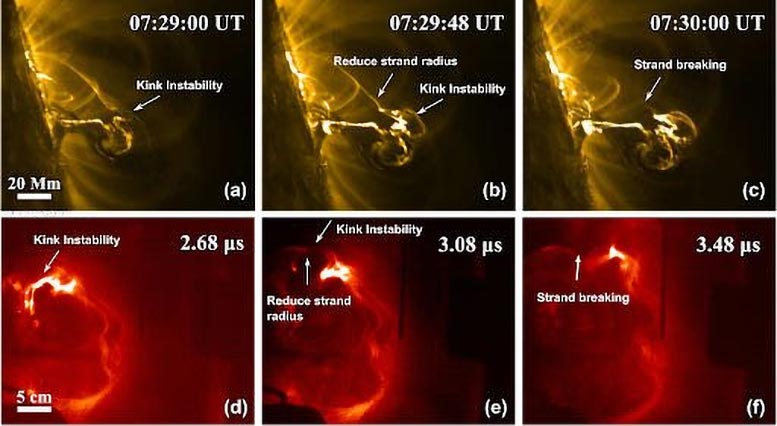
That structure, it turns out, is important to the generation of energetic particles and X-ray bursts associated with solar flares. Plasma is a strong electrical conductor—think of neon signs, which are filled with plasma and light up when electricity passes through. However, when too much current tries to pass through a solar corona loop, the structure is compromised. The loop develops a kink—a corkscrew-shaped instability—and individual strands start to break. Each new broken strand then dumps strain onto the remaining ones.
“Like an elastic band stretched too tight, the loop gets longer and skinnier until the strands just snap,” says Seth Pree, postdoctoral scholar research associate in applied physics and materials science, and co-author of the Nature Astronomy paper.
Correlations and Future Research
Studying the process microsecond by microsecond, the team noted a negative voltage spike associated with an X-ray burst at the exact instant a strand broke. This voltage spike is akin to the pressure drop that builds up at the point of constriction in a water pipe. The electric field from this voltage spike accelerates charged particles to extreme energy, then X-rays are emitted when the energetic particles decelerate.
In addition, Zhang combed through pictures of solar flares and was able to document a kink instability similar to the one created in the lab that was associated with a subsequent X-ray burst.
Next, the team plans to explore how separate plasma loops can merge and reorganize into different configurations. They are interested to learn if there are also energy burst events during this type of interaction.
Reference: “Generation of laboratory nanoflares from multiple braided plasma loops” by Yang Zhang, Seth Pree and Paul M. Bellan, 6 April 2023, Nature Astronomy.
DOI: 10.1038/s41550-023-01941-x
This research was funded by the National Science Foundation and the Advanced Research Projects Agency-Energy (ARPA-E).
Never miss a breakthrough: Join the SciTechDaily newsletter.
Follow us on Google and Google News.