
Close Menu
    Facebook X (Twitter) Instagram
    SciTechDaily
    • Biology
    • Chemistry
    • Earth
    • Health
    • Physics
    • Science
    • Space
    • Technology
    Facebook X (Twitter) Pinterest YouTube RSS
    SciTechDaily
    Home»Space»Lunar Radio Telescopes Could Finally Reveal the Secrets of Dark Matter
    Space

    Lunar Radio Telescopes Could Finally Reveal the Secrets of Dark Matter

    By University of TsukubaOctober 18, 20252 Comments3 Mins Read
    Facebook Twitter Pinterest Telegram LinkedIn WhatsApp Email Reddit
    Share
    Facebook Twitter LinkedIn Pinterest Telegram Email Reddit
    Dark Matter Moon
    A faint radio glow from the Universe’s “Dark Ages” may hold the key to unlocking dark matter’s secrets. Credit: Stock

    Japanese scientists simulated faint 21-centimeter radio waves from the Universe’s “Dark Ages,” offering a potential way to detect dark matter.

    About 13.8 billion years ago, the Universe emerged in a sudden burst of expansion known as the Big Bang. Roughly 400,000 years after this event, it entered a long, lightless stretch called the “Dark Ages.”

    This era continued for about 100 million years, until the first stars and galaxies ignited and began to illuminate the cosmos. During this silent period, hydrogen atoms are believed to have released faint radio signals at a wavelength of 21 centimeters. These ancient waves may contain valuable clues about the Universe’s earliest stages.

    Scientists from the University of Tsukuba and the University of Tokyo have used advanced computer simulations to explore how strong this 21-centimeter signal might have been under various dark matter scenarios. Dark matter, the unseen substance making up roughly 80% of all matter in the cosmos, continues to puzzle researchers.
    Probing the Nature of Dark Matter from the Moon
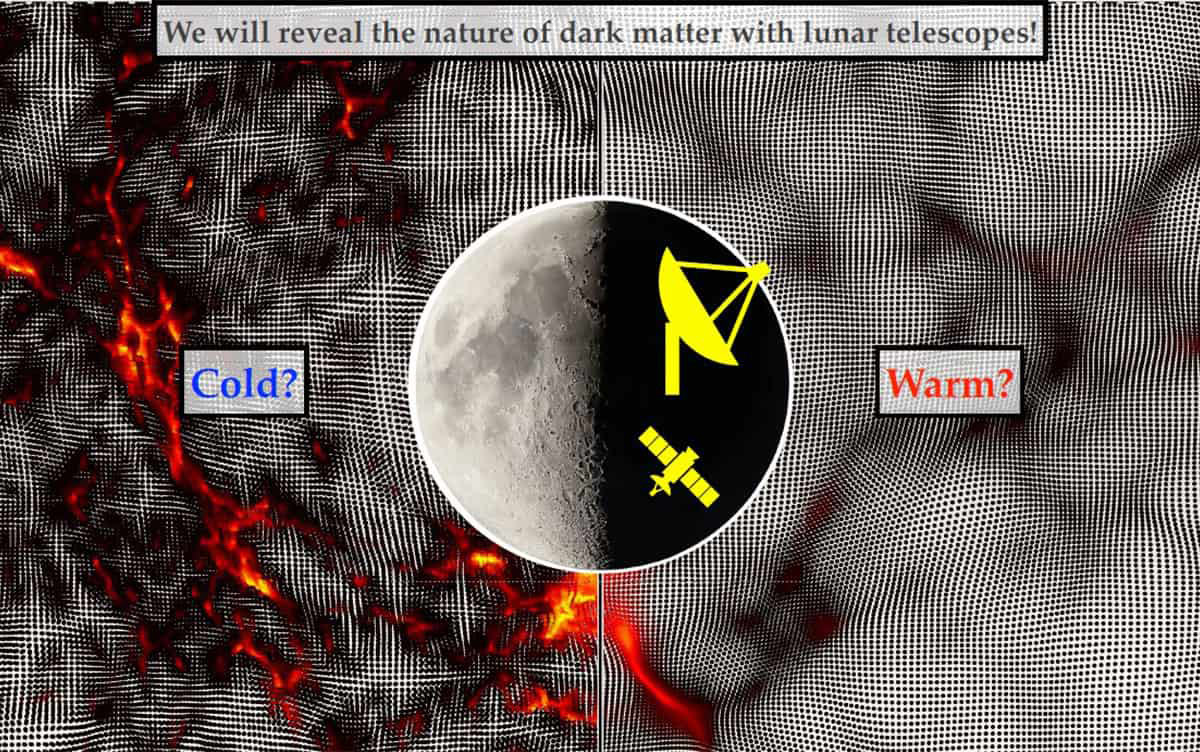
    Simulated distributions of cold and warm dark matter are shown using particles color-coded by temperature, accompanied by an illustration of lunar telescopes. Credit: Hyunbae Park, University of Tsukuba

    By recreating the distribution of gas and dark matter in the young Universe with powerful supercomputers, the team was able to calculate the intensity of these radio emissions during the Dark Ages with remarkable accuracy.

    A Signal Hidden in the Darkness

    The results imply that hydrogen gas in the dark ages produced a characteristic signal of about 1 millikelvin (one-thousandth of a degree) in the brightness temperature of sky-averaged radio emission. Crucially, dark matter is expected to produce variations of similar magnitude in this signal. Observing the global signal across a broad frequency band (~45 MHz) could therefore reveal the mass and velocity of dark matter particles.

    Several lunar missions, including Japan’s Tsukuyomi Project, are now aiming to build radio telescopes on the Moon. If such telescopes can detect this faint signal, they will help unlock the mystery of dark matter.

    Explore Further: Ghostly Radio Glow From the Cosmic Dark Ages May Expose Dark Matter

    Reference: “The signature of subgalactic dark matter clumping in the global 21-cm signal of hydrogen” by Hyunbae Park, Rennan Barkana, Naoki Yoshida, Sudipta Sikder, Rajesh Mondal and Anastasia Fialkov, 16 September 2025, Nature Astronomy.
    DOI: 10.1038/s41550-025-02637-0

    H.P. was supported in part by grant NSF PHY-2309135 to the Kavli Institute for Theoretical Physics (KITP). N.Y. acknowledges financial support from JSPS International Leading Research 23K20035. R.B. and N.Y. acknowledge JSPS Invitational Fellowship S24099.

    Never miss a breakthrough: Join the SciTechDaily newsletter.
    Follow us on Google and Google News.

    Astronomy Astrophysics Dark Matter Moon University of Tsukuba
    Share. Facebook Twitter Pinterest LinkedIn Email Reddit

    Related Articles

    X-Ray Emission From Mysterious Dark Matter

    Extended Dark Matter Halo Detected Around Ancient Dwarf Galaxy – “First Signature of Galactic Cannibalism”

    The Universe Is Getting Hot, Hot, Hot – Temperature Has Increased 10-Fold Over the Last 10 Billion Years

    Milky Way’s Dark Side Revealed by Measurements of Pulsar Acceleration

    What if Dark Matter Doesn’t Exist? Unique Prediction of “Modified Gravity” Challenges Dark Matter Hypothesis

    A Hint of New Physics Observed in Polarized Radiation From the Early Universe

    Milky Way Is Being Twisted and Deformed With Extreme Violence by the Gravitational Force of the LMC’s Dark Matter Halo

    Hubble Space Telescope Explains Oddball Galaxy’s Missing Dark Matter

    Extreme-Horizon: Understanding the “Dark” Universe and Primordial Galaxy Formation

    2 Comments

    1. Boba on October 19, 2025 11:08 am

      The secret of the dark matter is that it doesn’t exist.

      Reply
    2. PhysicsPundit on October 19, 2025 4:30 pm

      21cm hydrogen observations may tell us whether a “dark ages” existed, and when the epoch of reionization began, but not much about dark matter. The prediction here is for large variations in the expected dark ages signal, which may or may not be due to subgalactic DM clumping.

      Reply
    Leave A Reply Cancel Reply

    • Facebook
    • Twitter
    • Pinterest
    • YouTube

    Don't Miss a Discovery

    Subscribe for the Latest in Science & Tech!

    Trending News

    1.4-Million-Year-Old Footprints Reveal a Giant Human Relative

    Astronomers May Have Found the First Moon Beyond Our Solar System

    Underwater Cameras Expose the Secret Lives of Whale Sharks

    Why Dreaming Leaves the Brain Running Low on Energy

    CERN Experiments Detect Signs of the Universe’s Primordial Matter

    Study Finds a Surprising Link Between Gut Microbes and Aging

    Frequent Cannabis Users Wake Up With More “Stress Hormone”

    Scientists Reveal Hidden DNA Traces in the Shroud of Turin

    Follow SciTechDaily
    • Facebook
    • Twitter
    • YouTube
    • Pinterest
    • Newsletter
    • RSS
    SciTech News
    • Biology News
    • Chemistry News
    • Earth News
    • Health News
    • Physics News
    • Science News
    • Space News
    • Technology News
    Recent Posts
    • A Daily Multivitamin May Help Older Adults Stay Active
    • Blood Test May Reveal Alzheimer’s Risk Years Before Symptoms
    • Scientists Thought SuperAgers Had Lucky Genes. They Were Wrong
    • Humans and Mice May Process Smells in Very Similar Ways
    • These Beautiful Flowers Can Paralyze You, but Their Chemistry Could Save Lives
    Copyright © 1998 - 2026 SciTechDaily. All Rights Reserved.
    • Science News
    • About
    • Contact
    • Editorial Board
    • Privacy Policy
    • Terms of Use

    Type above and press Enter to search. Press Esc to cancel.