
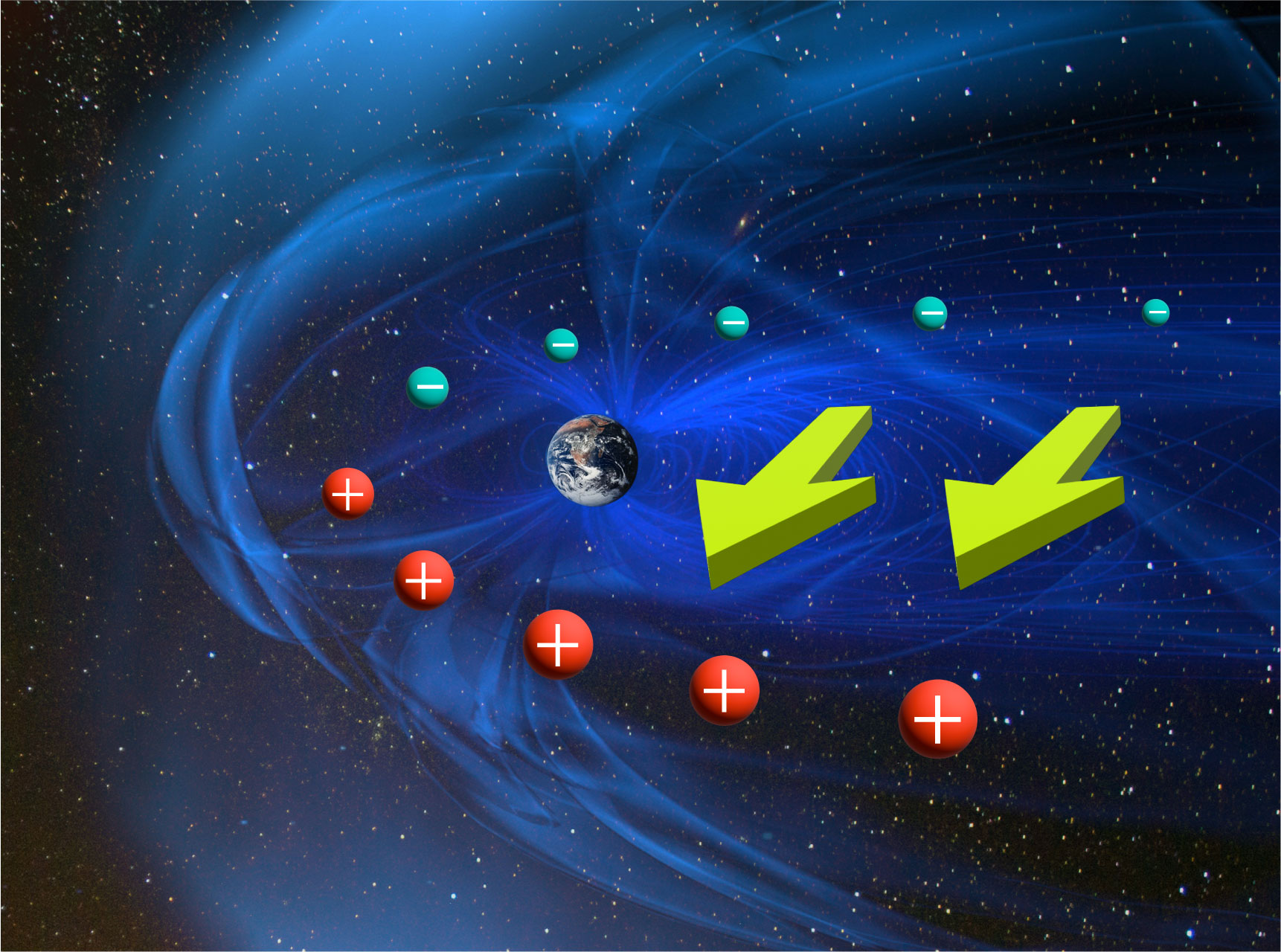
Scientists have discovered that Earth’s magnetosphere is charged opposite to what was once believed.
The area of space influenced by Earth’s magnetic field is called the magnetosphere. Within this protective bubble, scientists have observed an electric force that moves from the morning side of the planet toward the evening side. This vast electric field plays a crucial role in generating disturbances in near-Earth space, including geomagnetic storms.
Because electric forces move from positive to negative charges, researchers once believed that the morning side of the magnetosphere carried a positive charge while the evening side was negative. However, new satellite data has revealed the reverse: the morning side is actually negatively charged, and the evening side is positively charged.
This unexpected finding led a research group from Kyoto University, Nagoya University, and Kyushu University to take a closer look at the mechanisms that shape the magnetosphere.
To investigate, the scientists ran large-scale magnetohydrodynamic (MHD) simulations to recreate conditions in near-Earth space. They modeled a steady, high-speed stream of plasma from the Sun, known as the solar wind. The results supported recent observations, showing negative charging on the morning side and positive charging on the evening side, although this pattern was not consistent across all regions.
Polar vs. Equatorial Contrasts
In the polar regions, the polarity remains consistent with traditional understanding. In contrast, in the equatorial region, it is reversed over a broad area.
“In conventional theory, the charge polarity in the equatorial plane and above the polar regions should be the same. Why, then, do we see opposite polarities between these regions? This can actually be explained by the motion of plasma,” says corresponding author Yusuke Ebihara of Kyoto University.
As the magnetic energy originating from the sun enters the magnetosphere, it circulates clockwise on the dusk side and flows toward the polar regions.
On the other hand, Earth’s magnetic field points from the Southern Hemisphere to the Northern Hemisphere, meaning that it is directed upward near the equatorial plane and downward above the polar regions. Consequently, the relative orientation between plasma motion and magnetic field is reversed between these regions.
“The electric force and charge distribution are both results, not causes, of plasma motion,” says Ebihara.
Implications for Space and Planetary Science
Convection, which describes the plasma flow in the magnetosphere, is a major driver of various space environment phenomena, and recent studies have also highlighted its indirect role in modulating the radiation belts: regions populated by high-energy particles moving at nearly the speed of light.
These findings contribute to a better understanding of the fundamental nature of large-scale plasma flows in space. Since these phenomena play a crucial role in space environment variability, this study also offers insights into planetary environments around magnetized planets such as Jupiter and Saturn.
Reference: “MHD Simulation Study on Quasi-Steady Dawn-Dusk Convection Electric Field in Earth’s Magnetosphere” by Yusuke Ebihara, Masafumi Hirahara and Takashi Tanaka, 10 July 2025, Journal of Geophysical Research: Space Physics.
DOI: 10.1029/2025JA033731
Funding: Japan Society for the Promotion of Science
Never miss a breakthrough: Join the SciTechDaily newsletter.
Follow us on Google and Google News.