
Close Menu
    Facebook X (Twitter) Instagram
    SciTechDaily
    • Biology
    • Chemistry
    • Earth
    • Health
    • Physics
    • Science
    • Space
    • Technology
    Facebook X (Twitter) Pinterest YouTube RSS
    SciTechDaily
    Home»Space»The Solar Wind Is Hiding Strange Particles That Could Rewrite Space Weather
    Space

    The Solar Wind Is Hiding Strange Particles That Could Rewrite Space Weather

    By Southwest Research InstituteSeptember 19, 2025No Comments3 Mins Read
    Facebook Twitter Pinterest Telegram LinkedIn WhatsApp Email Reddit
    Share
    Facebook Twitter LinkedIn Pinterest Telegram Email Reddit
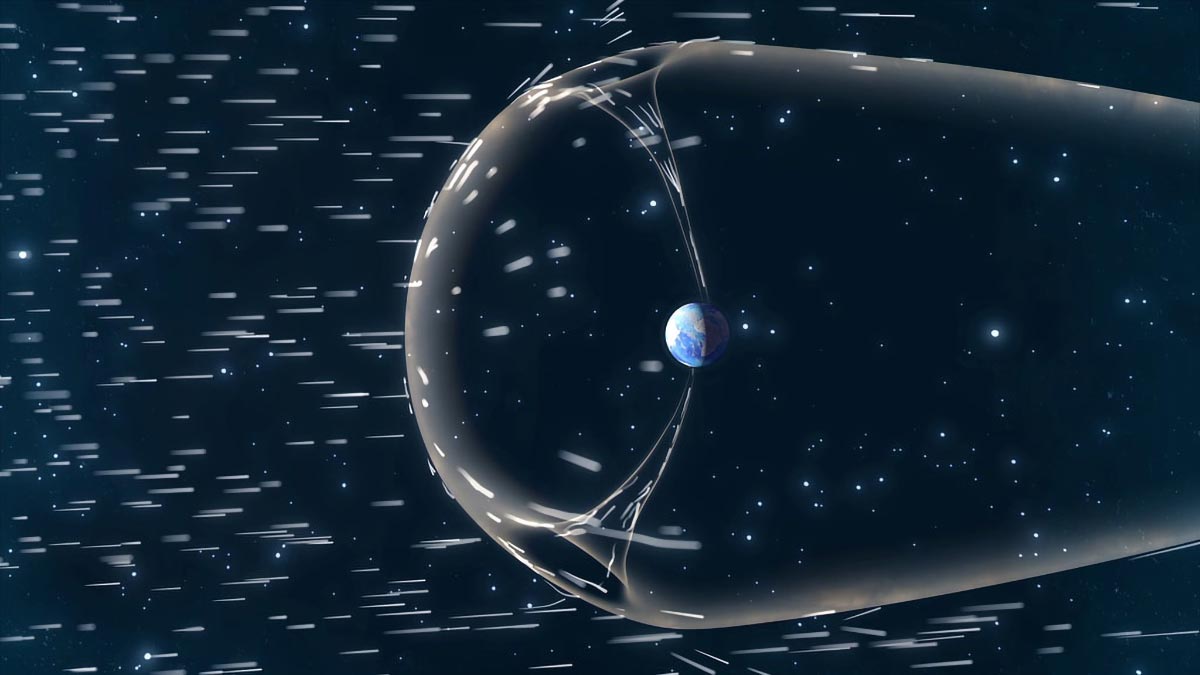
    Solar Wind and Earth Magnetosphere
    This illustration shows Earth’s magnetosphere interacting with the solar wind. The magnetosphere shields the Earth from harmful solar and cosmic radiation. Credit: NASA

    Data may challenge and reshape current models of solar wind evolution.

    A recent study led by Dr. Michael Starkey of the Southwest Research Institute has delivered the first observational evidence from the Magnetospheric Multiscale (MMS) Mission of pickup ions (PUIs) and their related wave activity in the solar wind near Earth. NASA launched the MMS mission in 2015, deploying four spacecraft to study Earth’s magnetosphere, the magnetic field that protects the planet from harmful solar and cosmic radiation.

    Formation and behavior of PUIs

    PUIs are created when neutral particles traveling through the heliosphere become ionized by the solar wind. Once ionized, they are carried along with the solar wind and spiral around the local magnetic field, forming a plasma population with properties that differ from the standard solar wind particles.

    In this study, PUIs displayed a characteristic velocity distribution, without the presence of other significant energetic ion or electron populations. Evidence of wave activity was identified using MMS magnetic field measurements, combined with theoretical predictions of expected wave growth modes based on models of the observed PUIs.

    “The results of this study indicate that PUIs can in fact generate waves in the solar wind near Earth and motivate the need for further statistical studies of these processes,” Starkey said. “It may be that PUIs play a larger role in the heating and thermalization of the solar wind near Earth than previously thought, which would have large implications for models of the solar wind throughout the heliosphere.”

    Modeling plasma populations

    By modeling the individual ion components (solar wind and PUIs), the authors identified which populations could be responsible for the observed wave activity. They concluded that the observed waves were likely generated by helium and/or hydrogen PUIs, but due to instrument limitations, they were unable to pinpoint the precise ion species responsible.

    At farther distances from the Sun, the relative density of PUIs in the solar wind increases, which increases their contribution toward the heating and thermalization of the solar wind through wave-particle interactions. At the outer edges of the solar system, PUIs contribute significantly to the total dynamic pressure in the solar wind, which has large implications for physical processes taking place at the termination shock and in the heliosheath.

    “Near Earth, the intensity of PUIs is relatively low, and so it is typically assumed that their contribution to wave-particle interactions in the solar wind is negligible,” Starkey added. “If this assumption is false, current theory and modeling of the solar wind and its evolution throughout the heliosphere would need to be updated.”

    Reference: “First MMS Observations of Waves Possibly Generated by PUIs Near Earth” by Michael J. Starkey, Kyunghwan Dokgo, Justyna M. Sokół, Joey Mukherjee, Charles W. Smith, Stephen A. Fuselier and Roman Gomez, 25 May 2025, Journal of Geophysical Research: Space Physics.
    DOI: 10.1029/2024JA033660

    Never miss a breakthrough: Join the SciTechDaily newsletter.
    Follow us on Google and Google News.

    Magnetosphere Plasma Physics Solar Wind Southwest Research Institute Space Weather
    Share. Facebook Twitter Pinterest LinkedIn Email Reddit

    Related Articles

    A Massive Geomagnetic Superstorm Crushed Earth’s Plasma Shield

    Shocking Discovery About Earth’s Magnetosphere Challenges Decades of Theory

    “Alien Aurora” – Scientists Spot Never-Before-Seen Plasma Waves in Jupiter’s Polar Lights

    NASA’s TRACERS Mission Hits Major Milestone With Twin Spacecraft Completion

    Switchbacks in Space: Scientists Uncover How Solar Wind Gets Energy

    Modeling Solar Winds: Simulations Reproduce Complex Fluctuations in Soft X-Ray Signal Detected by Satellites

    Scientists Discover New Physics Missing From Existing Models of Magnetic Reconnection

    New Model Advances the Understanding of How Solar Wind Works

    Magnetic Disturbances Sent Massive Solar Wind Earthward

    Leave A Reply Cancel Reply

    • Facebook
    • Twitter
    • Pinterest
    • YouTube

    Don't Miss a Discovery

    Subscribe for the Latest in Science & Tech!

    Trending News

    Black Hole Collisions May Follow a Surprisingly Simple Rule

    The Eye Has a Hidden Cleanup System and Scientists Just Discovered It

    The Truth About Vikings Is More Complicated Than Museums Admit

    New Catalyst Turns Stubborn Plant Waste Into Valuable Chemicals

    Quantum Gravity May Be Far Less Quantum Than Physicists Expected

    New Tool Supercharges Immunotherapy Against Prostate Cancer

    The Hidden Cancer Risk of Ketogenic Diets

    One Asteroid Collision May Have Rocked Earth, Mars, and the Moon

    Follow SciTechDaily
    • Facebook
    • Twitter
    • YouTube
    • Pinterest
    • Newsletter
    • RSS
    SciTech News
    • Biology News
    • Chemistry News
    • Earth News
    • Health News
    • Physics News
    • Science News
    • Space News
    • Technology News
    Recent Posts
    • Scientists Built a Programmable Chip That Can Slow Light on Command
    • Astronomers Detect an Atmosphere on a Potentially Earth-Like World
    • The Backyard “Silly Sprinkler” That Cracked One of Physics’ Biggest Puzzles
    • Magnetic Nanoparticles Restore Movement in Mice With Parkinson’s-Like Symptoms
    • Scientists Found What May Be Keeping the Alzheimer’s Brain Awake
    Copyright © 1998 - 2026 SciTechDaily. All Rights Reserved.
    • Science News
    • About
    • Contact
    • Editorial Board
    • Privacy Policy
    • Terms of Use

    Type above and press Enter to search. Press Esc to cancel.