
Close Menu
    Facebook X (Twitter) Instagram
    SciTechDaily
    • Biology
    • Chemistry
    • Earth
    • Health
    • Physics
    • Science
    • Space
    • Technology
    Facebook X (Twitter) Pinterest YouTube RSS
    SciTechDaily
    Home»Space»Modeling Solar Winds: Simulations Reproduce Complex Fluctuations in Soft X-Ray Signal Detected by Satellites
    Space

    Modeling Solar Winds: Simulations Reproduce Complex Fluctuations in Soft X-Ray Signal Detected by Satellites

    By Tokyo Metropolitan UniversityJanuary 27, 2023No Comments3 Mins Read
    Facebook Twitter Pinterest Telegram LinkedIn WhatsApp Email Reddit
    Share
    Facebook Twitter LinkedIn Pinterest Telegram Email Reddit
    Solar Wind Charge Exchange Events
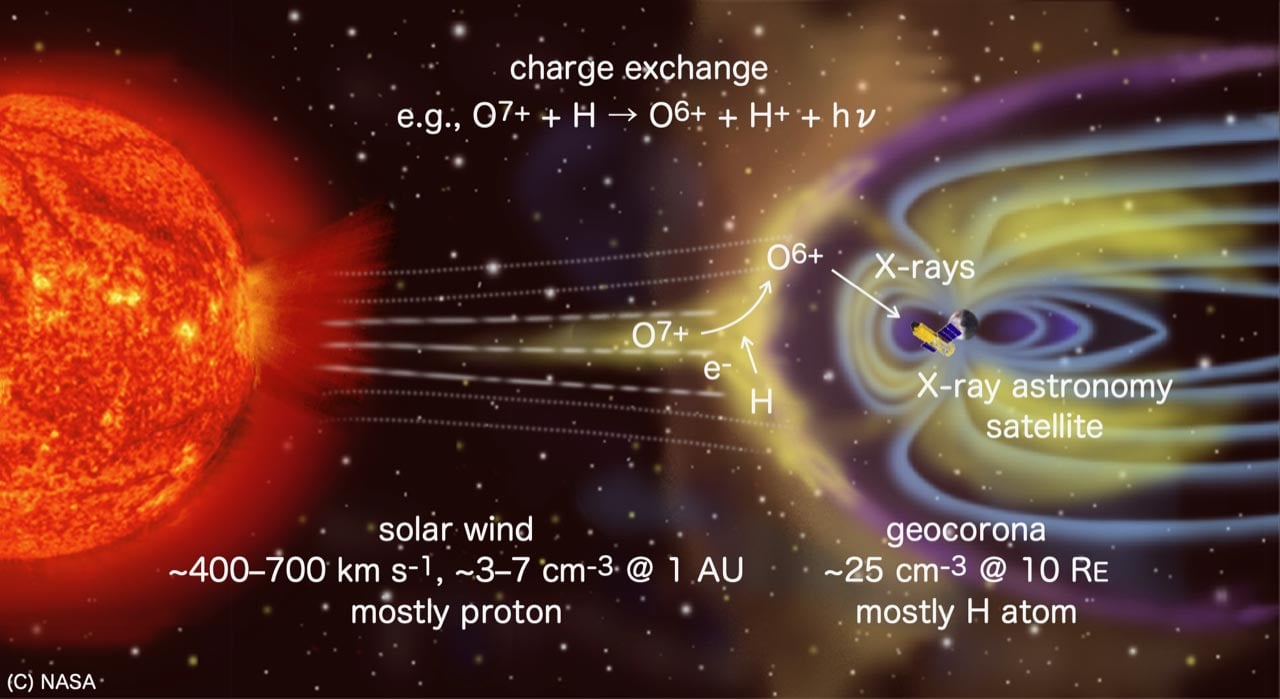
    Charged particles from the sun coming towards earth interact with the geocorona, a wide cloud of hydrogen atoms extending into space from the Earth. Charge is transferred to the hydrogen atoms, and soft X-rays are emitted. Credit: Tokyo Metropolitan University

    Models Capture How Solar Wind Charge Exchange Events Are Observed

    Researchers from Tokyo Metropolitan University have used numerical methods to model the variations observed in soft X-ray signals detected by X-ray satellites. They analyzed data from the Suzaku telescope and compared it with modeling of solar winds interacting with the most upper parts of our atmosphere. They succeeded in capturing how the signal varied with the orbital motion of the satellite, with implications for how predictions can be made for future satellite experiments.

    In the 1990s, the German orbital X-ray telescope ROSAT began detecting large variations in signals in the soft X-ray part of the spectrum that lasted a day or so. These were similar to the copious flux of soft X-rays from the comet Hyakutake discovered around the same time. It was proposed that these were due to solar wind, fluxes of charged particles arriving from the sun, and how they interact with neutral ions in the upper extremities of our atmosphere, or the geocorona. More detailed observations in the 2000s confirmed the telltale spectra of these events, known as solar wind charge exchange events (SWCX), and the mechanism itself was widely accepted.
    Variations in Proton Flux and Photons
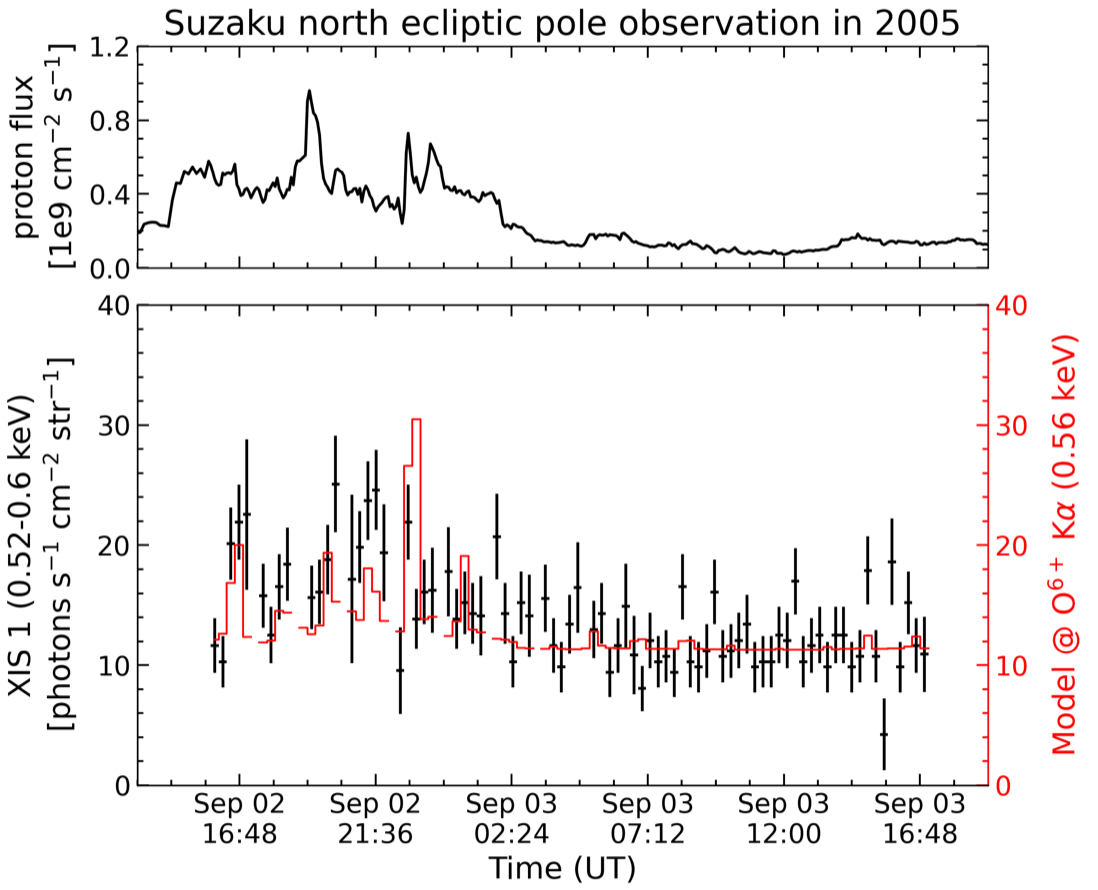
    Variations in proton flux and photons over an exchange event measured by Suzaku. The model (red) is found to closely reproduce the variations seen in the experiment. Credit: Tokyo Metropolitan University

    However, modeling how solar wind gives rise to the measurements taken by orbital telescopes proved much more difficult. It requires successfully capturing the arrival of solar wind events, how the charged particles interact with neutral atoms, and how that affects the magnetosphere, not to mention how these phenomena combine to give rise to the variation in signal observed over time and space by the satellites.

    Now, a team led by Associate Professor Yuichiro Ezoe of Tokyo Metropolitan University have successfully brought these aspects together to realize a model that can successfully reproduce how the signal varies over time. The team’s focus was on data from Suzaku, an X-ray telescope satellite launched in 2005 by the Japan Aerospace Exploration Agency. In contrast to other satellites, Suzaku lies in a lower orbit, allowing it to observe the polar cusps of the magnetosphere, where solar winds are being strongly bent away. A highlight of the team’s work is not only the wide range of astrophysical events they are able to bring together, but how it may be mapped onto real data.

    The model showed excellent correspondence with experimental data, reproducing the signal observed up to a factor of two, an impressive feat in the field. Furthermore, they were able to reproduce the particularly strong variations in the signal when the line of sight of the satellite aligned with the polar cusps. There were some notable exceptions, like when a major geomagnetic storm was observed; nevertheless, successful reproduction of the variations holds significant promise for predicting the outcomes of the next generation of X-ray observations in space.

    Reference: “Modeling of geocoronal solar wind charge exchange events detected with Suzaku” by Daiki Ishi, Kumi Ishikawa, Yoshizumi Miyoshi, Naoki Terada and Yuichiro Ezoe, 12 December 2022, Publications of the Astronomical Society of Japan.
    DOI: 10.1093/pasj/psac095

    This work was supported by Japan Society for the Promotion of Science KAKENHI Grant Numbers 19J20910 and 21H04972.

    Never miss a breakthrough: Join the SciTechDaily newsletter.
    Follow us on Google and Google News.

    Magnetosphere Solar Wind Space Weather Tokyo Metropolitan University
    Share. Facebook Twitter Pinterest LinkedIn Email Reddit

    Related Articles

    A Massive Geomagnetic Superstorm Crushed Earth’s Plasma Shield

    The Solar Wind Is Hiding Strange Particles That Could Rewrite Space Weather

    NASA’s TRACERS Mission Hits Major Milestone With Twin Spacecraft Completion

    Scientists Discover New Physics Missing From Existing Models of Magnetic Reconnection

    Solar Cycle 25: The Sun Wakes Up

    Predicting When the Sky Will Bleed: MIT-Led Team to Develop Software to Help Forecast Space Storms

    NASA’s TWINS Provide Continuous Coverage of the Ring Current

    New Model Advances the Understanding of How Solar Wind Works

    Magnetic Disturbances Sent Massive Solar Wind Earthward

    Leave A Reply Cancel Reply

    • Facebook
    • Twitter
    • Pinterest
    • YouTube

    Don't Miss a Discovery

    Subscribe for the Latest in Science & Tech!

    Trending News

    Even Occasional Binge Drinking May Triple Liver Damage Risk

    Liftoff! NASA’s Artemis II Launch Sends Astronauts Around the Moon for First Time in 50 Years

    Scientists Discover New Way To Eliminate “Zombie Cells” Driving Aging

    This New Quantum Theory Could Change Everything We Know About the Big Bang

    This One Vitamin May Help Protect Your Brain From Dementia Years Later

    Stopping Weight-Loss Drugs Like Ozempic Can Quickly Erase Heart Benefits

    A 500-Million-Year-Old Surprise Is Forcing Scientists to Rethink Spider Evolution

    Coffee and Blood Pressure: What You Need To Know Before Your Next Cup

    Follow SciTechDaily
    • Facebook
    • Twitter
    • YouTube
    • Pinterest
    • Newsletter
    • RSS
    SciTech News
    • Biology News
    • Chemistry News
    • Earth News
    • Health News
    • Physics News
    • Science News
    • Space News
    • Technology News
    Recent Posts
    • Tiny 436-Million-Year-Old Fish Fossil Rewrites the Origins of Vertebrates
    • 1,800 Miles Down: Scientists Uncover Mysterious Movements at the Edge of Earth’s Core
    • Scientists Uncover Earth’s Hidden “Gold Kitchen” Beneath the Ocean Floor
    • You Don’t Need To Be Rich: New Study Reveals a Simple Life Is the Real Secret to Happiness
    • “Crazy Dice” Help Scientists Prove Only One 150-Year-Old Theory About Randomness Works
    Copyright © 1998 - 2026 SciTechDaily. All Rights Reserved.
    • Science News
    • About
    • Contact
    • Editorial Board
    • Privacy Policy
    • Terms of Use

    Type above and press Enter to search. Press Esc to cancel.