
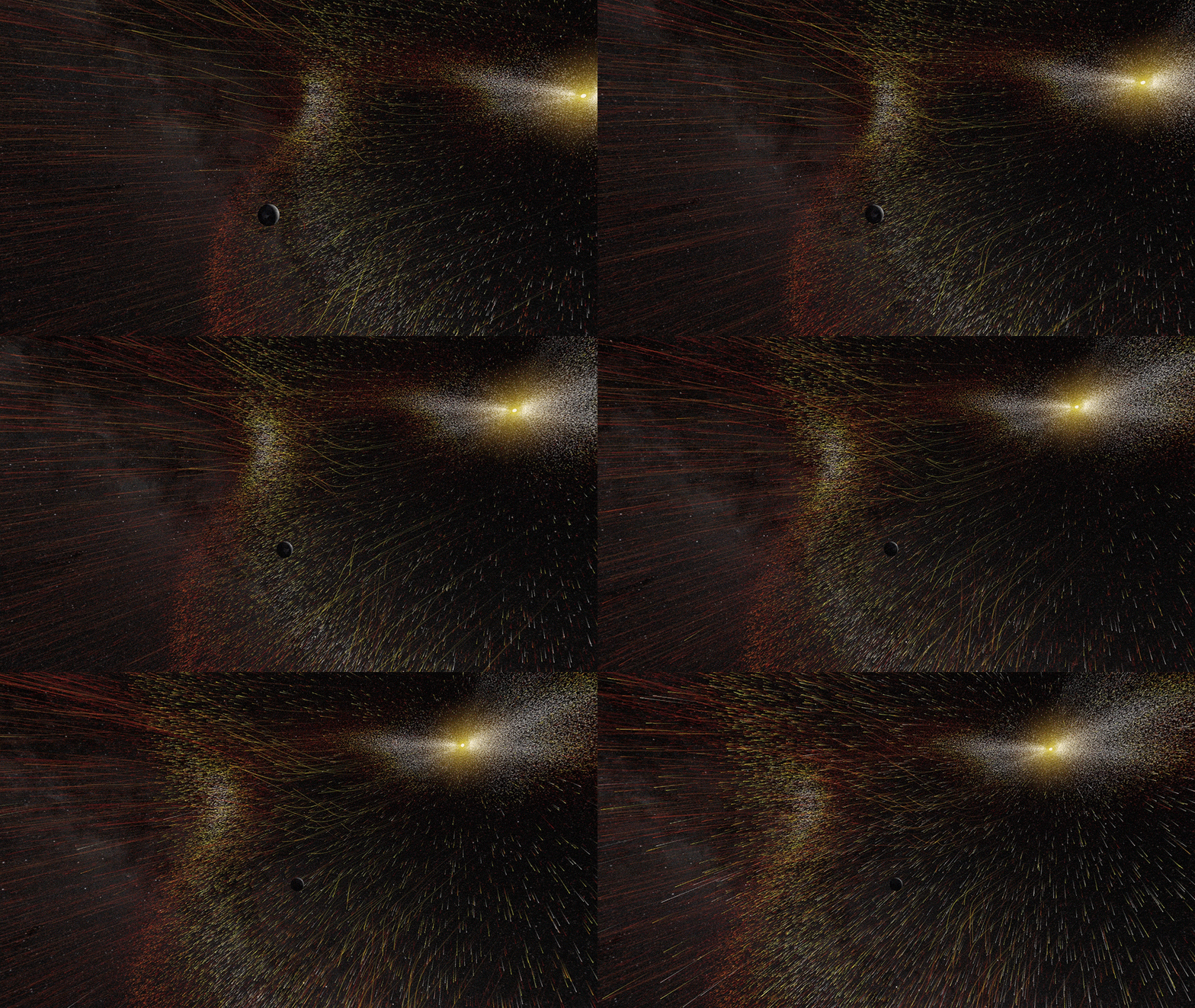
Using newly processed observations, astronomers spot tell-tale signs that the slow solar wind passing Earth originated from a magnetic phenomenon known as magnetic reconnection.
From our vantage point on the ground, the sun seems like a still ball of light, but in reality, it teems with activity. Eruptions called solar flares and coronal mass ejections explode in the sun’s hot atmosphere, the corona, sending light and high-energy particles out into space. The corona is also constantly releasing a stream of charged particles known as the solar wind.
But this isn’t the kind of wind you can fly a kite in.
Even the slowest moving solar wind can reach speeds of around 700,000 mph (1.13 million kph). And while scientists know a great deal about solar wind, the source of the slow wind remains a mystery. Now, a team at NASA’s Goddard Space Flight Center in Greenbelt, Maryland, has explored a detailed case study of the slow solar wind, using newly processed observations close to Earth to determine what in fact seeded that wind 93 million miles away, back on the sun. The team spotted tell-tale signs in the wind sweeping by Earth showing that it originated from a magnetic phenomenon known as magnetic reconnection. A paper on these results was published April 22, 2016, in the journal Geophysical Research Letters.
Knowing the source of the slow solar wind is important for understanding the space environment around Earth, as near-Earth space spends most of its time bathed in this wind. Just as it is important to know the source of cold fronts and warm fronts to predict terrestrial weather, understanding the source of the solar wind can help tease out space weather around Earth — where changes can sometimes interfere with our radio communications or GPS, which can be detrimental to guiding airline and naval traffic.
Slow and Fast Solar Wind
Fast solar wind — not surprisingly — can travel much faster than the slow wind at up to 1.7 million mph (2.7 million kph), but the most definitive difference between fast and slow solar wind is their composition. The solar wind is what’s known as a plasma, a heated gas made up of charged particles — primarily protons and electrons, with trace amounts of heavier elements such as helium and oxygen. The amount of heavy elements and their charge state, or number of electrons, differ between the two types of wind.
“The composition and charge state of the slow solar wind is very different from that of the fast solar wind,” said Nicholeen Viall, a solar scientist at Goddard. “These differences imply that they came from different places on the sun.”
By studying its composition, scientists know that fast solar wind emanates from the interior of coronal holes — areas of the solar atmosphere where the corona is darker and colder. The slow solar wind, on the other hand, is associated with hotter regions around the equator, but just how the slow solar wind is released has not been clear.
But the new results may have provided an answer.
Tracking Down the Source: Magnetic Reconnection
Magnetic reconnection can occur anywhere there are powerful magnetic fields, such as in the sun’s magnetic environment. Imagine a magnetic field line pointing in one direction and another field line nearby moving toward it pointing in the opposite direction. As they come together, the field lines will cancel and re-form, each performing a sort of U-turn and curving to move off in a perpendicular direction. The resulting new magnetic field lines create a large force — like a taut rubber band being released — that flings out plasma. This plasma is the slow solar wind.
The team studied an interval of 90-minute periodic structures in the slow wind, and identified magnetic structures that are the telltale fingerprints of magnetic reconnection. They also found that each 90-minute parcel of slow wind showed an intriguing and repeating variability that could only be remnants of magnetic reconnection back at the sun.
“We found that the density and charge state composition of the slow solar wind rises and falls every 90 minutes, varying from what is normally slow wind to what is considered fast,” Viall said. “But the speed was constant at a slow wind speed. This could only be created by magnetic reconnection at the sun, tapping into both fast and slow wind source regions.”
Researchers first discovered the periodic density structures about 15 years ago using the Wind spacecraft — a satellite launched in 1994 to observe the space environment surrounding Earth. The scientists observed oscillations in the magnetic fields near Earth, known as the magnetosphere.
“It has been thought that the magnetosphere rang like a bell when the solar wind hit it with a sudden increase in pressure,” said Larry Kepko, a magnetospheric scientist at Goddard. “We went in for a closer look and found these periodicities in the solar wind. The magnetosphere was acting more like a drum than a bell.”
But Wind only gave the researchers measurements of the slow solar wind’s density and velocity, and could not identify its source. For that, they needed composition data.
Furthermore, in order to solve this problem, scientists from different disciplines needed to work together to come up with an explanation of the entire system. Kepko studies the magnetosphere, while Viall studies the sun. By observing what’s close to Earth and what’s happening at the sun, the team could determine the source of the slow solar wind.
The scientists turned to NASA’s Advanced Composition Explorer. ACE launched in 1997 to study and measure the composition of several types of space material including the solar wind and cosmic rays. It can observe solar particles and helps researchers determine the elemental composition and speeds of solar wind.
“Without the ACE data, we wouldn’t have been able to do this research,” Kepko said. “There’s no other instrument that gives us the information at the time resolution we needed.”
The team is continuing to look at composition data to find other instances of the periodic density structures to determine if the source for all slow solar wind is magnetic reconnection. Their case study clearly shows that this particular event was the result of magnetic reconnection, but they wish to find other examples to show this is the most common mechanism for powering the slow solar wind.
As the team gathers more information about magnetic reconnection and its effects near the sun, it will add to a growing body of knowledge about the phenomenon in general — because magnetic reconnection events take place throughout the universe.
“If we can understand this phenomenon here, where we can actually measure the magnetic field, we can get a better handle on how these fundamental physics processes take place in other places in the universe,” Viall said.
Reference: “Implications of L1 observations for slow solar wind formation by solar reconnection” by L. Kepko, N. M. Viall, S. K. Antiochos, S. T. Lepri, J. C. Kasper and M. Weberg, 22 April 2016, Geophysical Research Letters.
DOI: 10.1002/2016GL068607
Never miss a breakthrough: Join the SciTechDaily newsletter.
Follow us on Google and Google News.