
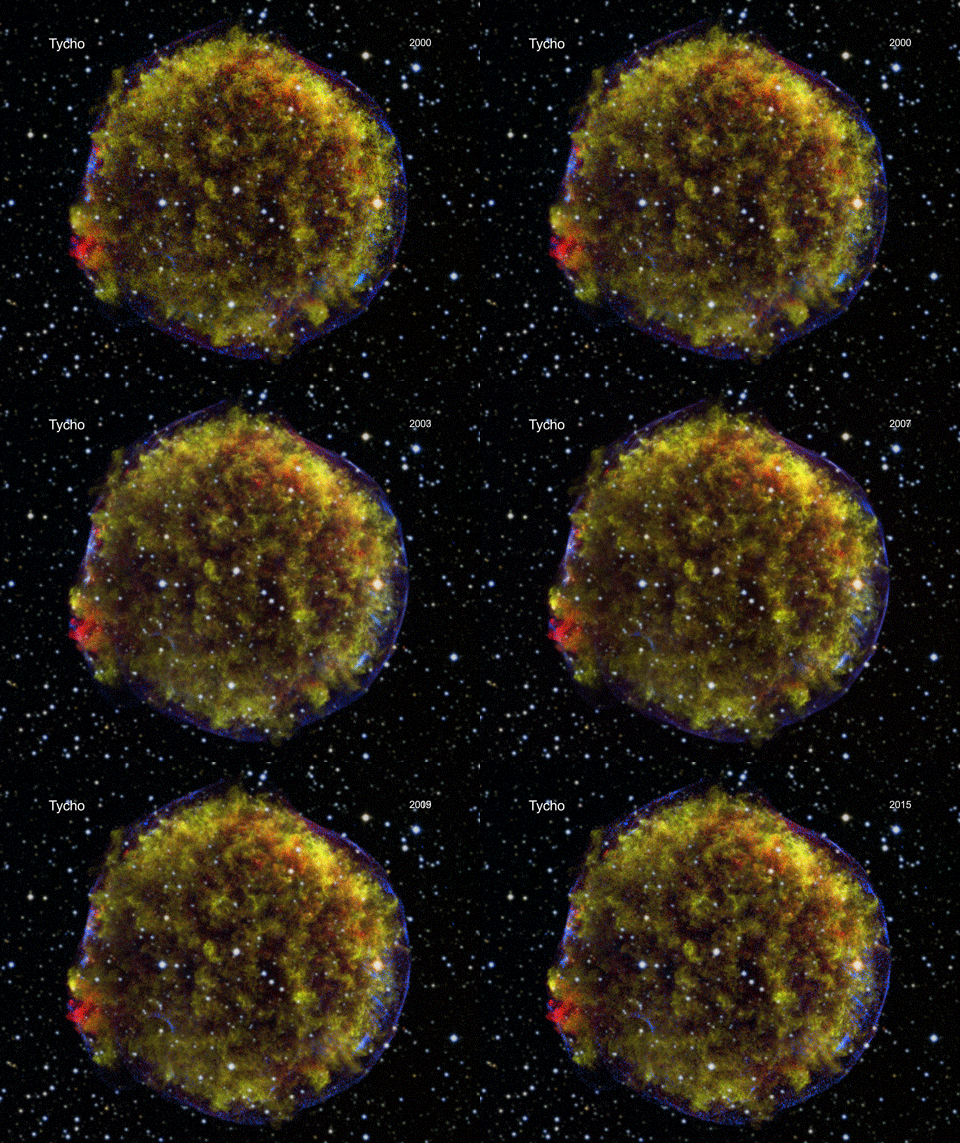
By combining the Chandra data with 30 years worth of observations, scientists have made a movie of the evolution of Tycho’s supernova remnant.
When the star that created this supernova remnant exploded in 1572, it was so bright that it was visible during the day. And though he wasn’t the first or only person to observe this stellar spectacle, the Danish astronomer Tycho Brahe wrote a book about his extensive observations of the event, gaining the honor of it being named after him.
In modern times, astronomers have observed the debris field from this explosion − what is now known as Tycho’s supernova remnant − using data from NASA’s Chandra X-ray Observatory, the NSF’s Karl G. Jansky Very Large Array (VLA), and many other telescopes. Today, they know that the Tycho remnant was created by the explosion of a white dwarf star, making it part of the so-called Type Ia class of supernovas used to track the expansion of the Universe.
Since much of the material being flung out from the shattered star has been heated by shock waves − similar to sonic booms from supersonic planes − passing through it, the remnant glows strongly in X-ray light. Astronomers have now used Chandra observations from 2000 through 2015 to create the longest movie of the Tycho remnant’s X-ray evolution over time, using five different images. This shows the expansion from the explosion is still continuing about 450 years later, as seen from Earth’s vantage point roughly 10,000 light years away.
By combining the X-ray data with some 30 years of observations in radio waves with the VLA, astronomers have also produced a movie, using three different images. Astronomers have used these X-ray and radio data to learn new things about this supernova and its remnant.
The researchers measured the speed of the blast wave at many different locations around the remnant. The large size of the remnant enables this motion to be measured with relatively high precision. Although the remnant is approximately circular, there are clear differences in the speed of the blast wave in different regions. The speed in the right and lower right directions is about twice as large as that in the left and the upper left directions. This difference was also seen in earlier observations.
This range in speed of the blast wave’s outward motion is caused by differences in the density of gas surrounding the supernova remnant. This causes an offset in position of the explosion site from the geometric center, determined by locating the center of the circular remnant. The astronomers found that the size of the offset is about 10% of the remnant’s current radius, towards the upper left of the geometric center. The team also found that the maximum speed of the blast wave is about 12 million miles per hour.
Offsets such as this between the explosion center and the geometric center could exist in other supernova remnants. Understanding the location of the explosion center for Type Ia supernovas is important because it narrows the search region for a surviving companion star. Any surviving companion star would help identify the trigger mechanism for the supernova, showing that the white dwarf pulled material from the companion star until it reached a critical mass and exploded. The lack of a companion star would favor the other main trigger mechanism, where two white dwarfs merge causing the critical mass to be exceeded, leaving no star behind.
The significant offset from the center of the explosion to the remnant’s geometric center is a relatively recent phenomenon. For the first few hundred years of the remnant, the explosion’s shock was so powerful that the density of gas it was running into did not affect its motion. The density discrepancy from the left side to the right has increased as the shock moved outwards, causing the offset in position between the explosion center and the geometric center to grow with time. So, if future X-ray astronomers, say 1,000 years from now, do the same observation, they should find a much larger offset.
Reference: “An X-ray and Radio Study of the Varying Expansion Velocities in Tycho’s Supernova Remnant” by Brian J. Williams, Laura Chomiuk, John W. Hewitt, John M. Blondin, Kazimierz J. Borkowski, Parviz Ghavamian, Robert Petre and Stephen P. Reynolds, 26 May 2016, The Astrophysical Journal Letters.
DOI: 10.3847/2041-8205/823/2/L32
A paper describing these results has been accepted for publication in The Astrophysical Journal Letters. The authors are Brian Williams (NASA’s Goddard Space Flight Center), Laura Chomiuk (Michigan State University), John Hewitt (University of North Florida), John Blondin (North Carolina State University), Kazimierz Borkowski (NCSU), Parviz Ghavamian (Towson University), Robert Petre (GSFC), and Stephen Reynolds (NCSU).
Never miss a breakthrough: Join the SciTechDaily newsletter.
Follow us on Google and Google News.
9 Comments
Tycho did not explode in 1572 as stated in the article. It exploded over 10,000 years ago.
The expansion of the blast wave, 12 million MPH is equal to around 1.8% the speed of light. If we could build space craft that fast, and had something to nullify the crushing g forces of acceleration and deceleration, we could travel to Mars in a matter of hours. However the closest star system to us would take over 200 years.
Where did you come up with that? B Cassiopeiae became a supernova in November, 1572, as verified by four separate Internet sources.
My bad. The supernova appeared in 1572, but, of course it is 10,000 light years away, so the actual explosion occurred about 10,000 years ago.
looking at it it reminds me of something you’d see under a microscope, or perhaps a dust bunny magnified a gazillion times
A couple of questions. Are the stars seen inside the mass behind the cloud or in front of it? Has it overrun any close stars and what would it do to any system if it did?
“When the star that created this supernova remnant exploded in 1572” combined with the statement “as seen from Earth’s vantage point roughly 10,000 light years away” kind of contradict themselves. The super nova was visible 450 years ago but it went supernova approx. 10,450 years ago.
I’m trying to figure out how they combined 30 years of observations from 2000 to 2015.
What amazes me about pictures like this that no one ever mentions is that this very explosion could have wiped out a solar system. This explosion could have wiped out billions of lives, intelligent or otherwise.