
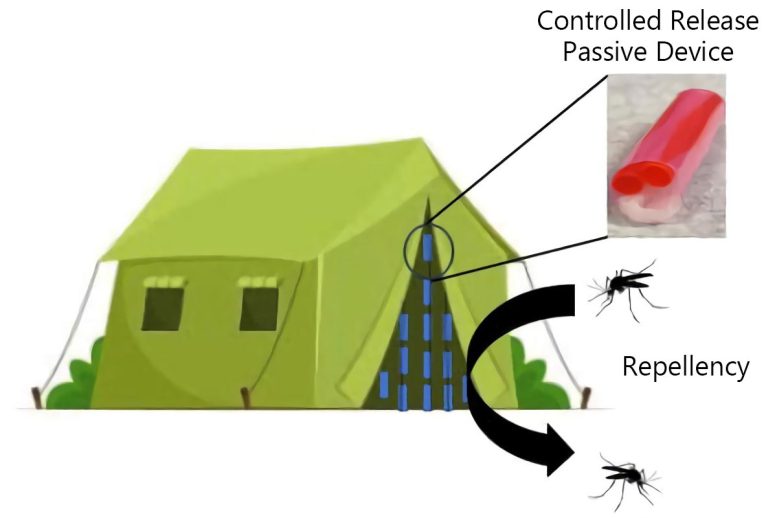
A device developed at the University of Florida for the U.S. military provides protection from mosquitos for an extended period and requires no heat, electricity, or skin contact.
Funded by the Department of Defense Deployed Warfighter Protection program, the controlled-release passive device was designed by Nagarajan Rajagopal, a PhD candidate and Dr. Christopher Batich in UF’s Department of Materials Science and Engineering in the Herbert Wertheim College of Engineering. It recently was tested successfully in a four-week semi-field study at the U.S. Department of Agriculture in Gainesville in a collaboration with Dr. Daniel Kline, Dr. Jerry Hogsette, and Adam Bowman from the USDA’s Center for Medical, Agricultural and Veterinary Entomology.
Results showed the controlled release of the repellent transfluthrin was effective in preventing multiple species of mosquitos from entering the testing site. Transfluthrin is an organic insecticide considered to be safe for humans and animals.
Advantages Over Traditional Repellents
“Our device eliminates the need for applying topical repellents and for insecticides that are sprayed across an open area, which can contaminate surrounding plants or bodies of water and have a negative impact on beneficial pollinators like bees and butterflies,” Rajagopal said. “This is versatile, portable, easily deployed, and doesn’t require electricity or heat to activate the solution.”
Mosquitos are more than an annoying distraction for military personnel, as they can spread serious diseases and viruses like malaria, dengue virus, Zika, and West Nile virus. The DOD continually looks for ways to protect soldiers in the field from mosquito bites.
The controlled-release passive device is made up of a tube-shaped polypropylene plastic that is 2.5 centimeters long and holds two smaller tubes and cotton containing the repellent. The team attached 70 of the devices to the opening of a large military tent using fishing line and nothing to a similar control tent. Caged mosquitos were released at various points along the exterior of the tent, and almost all were killed or repelled within 24 hours, Rajagopal said.
He explained that while the field test showed the team’s prototype created a protective space from mosquitos for four weeks, the final product, which will be built through a 3D-printing process, could extend that period up to three months.
“We call our device passive because you don’t need to do anything to activate it,” he said. “It provides a sustained release of the insecticide over an extended period rather than just a spike at the beginning.”
Opportunities Beyond Military Use
Rajagopal said they are filing for a patent on the device, and the government is interested in further study, so that it can eventually be commercialized for the civilian market. USDA scientists believe there are more opportunities for its use by people who enjoy outdoor activities.
“While initially developed for tent-entrance protection, the personal protection device in various sizes and configurations has potential for other applications, including for hiking and fishing,” said Kline, a research entomologist with the USDA.
Kline added that they will evaluate other active ingredients in addition to transfluthrin to expand its potential.
“It doesn’t stop with mosquitos,” Rajagopal said. “We want to show that it will work with other insects, especially ticks, which pose a threat by causing Lyme disease.”
Reference: “Semi-field evaluation of a novel controlled release device using transfluthrin as spatial repellent to prevent entry of mosquitoes into military tents” by Nagarajan R. Rajagopal, Adam R. Bowman, Floyd J. Aldana, Christopher D. Batich, Jerome A. Hogsette and Daniel L.Kline, 13 January 2023, Current Research in Parasitology & Vector-Borne Diseases.
DOI: 10.1016/j.crpvbd.2023.100113
Never miss a breakthrough: Join the SciTechDaily newsletter.
Follow us on Google and Google News.
1 Comment
Forbidden crab-sticks