
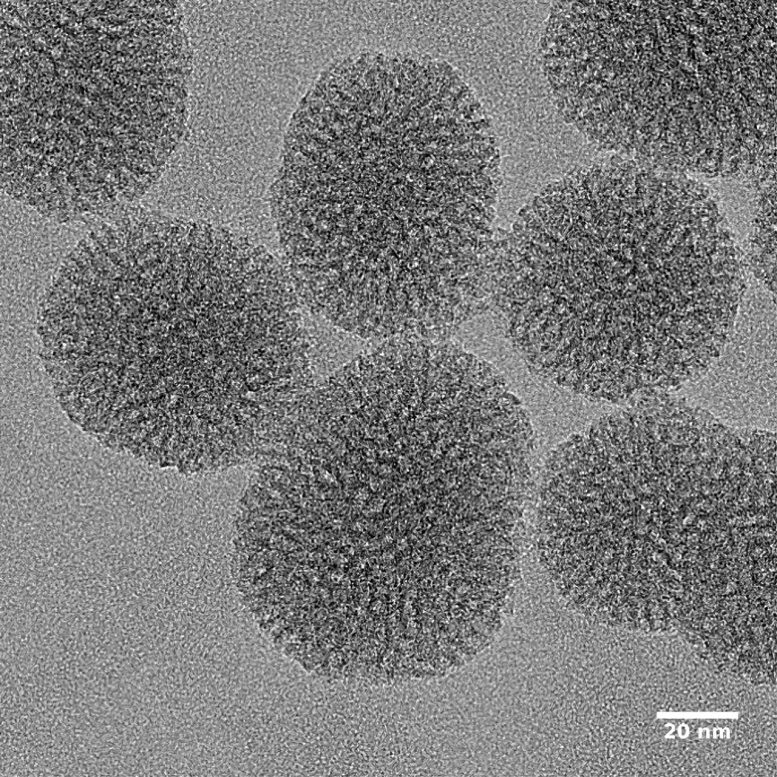
A team from UNIGE and LMU developed a transport nanoparticle to make an anti-inflammatory drug much more effective and less toxic.
How can a drug be delivered exactly where it is needed, while limiting the risk of side effects? The use of nanoparticles to encapsulate a drug to protect it and the body until it reaches its point of action is being increasingly studied. However, this requires identifying the right nanoparticle for each drug according to a series of precise parameters. A team from the University of Geneva (UNIGE) and the Ludwig Maximilians Universität München (LMU) has succeeded in developing a fully biodegradable nanoparticle capable of delivering a new anti-inflammatory drug directly into macrophages – the cells where uncontrolled inflammatory reactions are triggered – ensuring its effectiveness. In addition, the scientists used an in vitro screening methodology, thus limiting the need for animal testing. These results, recently published in the Journal of Controlled Release, open the way to an extremely powerful and targeted anti-inflammatory treatment.
Inflammation is an essential physiological response of the body to defend itself against pathogens such as bacteria. It can however become problematic when it turns into a chronic condition, such as in cancers, autoimmune diseases or certain viral infections. Many treatments already exist, but their action is often not very targeted, high doses are required and deleterious side effects are frequent. Macrophages, large immune cells whose natural function is to absorbs pathogens and trigger inflammation to destroy them, are often involved in inflammatory diseases. When overactivated, they trigger an excessive inflammatory response that turns against the body instead of protecting it.
Necrosulfonamide (NSA) is a new molecule that inhibits the release of several important pro-inflammatory mediators, therefore constituting a promising advance to reduce certain types of inflammation. However, being extremely hydrophobic in nature, it travels poorly in the bloodstream and could target many cell types, triggering potentially toxic effects.
‘‘This is why this molecule is not yet available as a drug,» says Gaby Palmer, a professor in the Department of Medicine and the Geneva Centre for Inflammation Research at the UNIGE Faculty of Medicine, who codirected the study. «Using a nanoparticle as a transport vessel would circumvent these shortcomings by delivering the drug directly into macrophages to combat inflammatory overactivation in the place where it begins.’’
Three Nanoparticles Under the Microscope
The scientists tested different porous nanoparticles, with the main criteria being a reduction in toxicity and in the required dosage, as well as the ability to release the drug only once the nanoparticle has reached the interior of the macrophages. ‘‘We used an in vitro screening technology which we developed a few years ago on human and mouse cells. This saves time and greatly reduces the need to use animal models,’’ explains Carole Bourquin, a professor at the UNIGE’s Faculties of Science (Institute of Pharmaceutical Sciences of Western Switzerland) and Medicine (Department of Anaesthesiology, Pharmacology, Intensive Care and Emergencies, Translational Research Centre in Oncohaematology, Geneva Centre for Inflammation Research), who codirected this work at UNIGE. ‘‘Thus, only the most promising particles will then be tested on mice, which is a prerequisite for clinical trials on humans.”
Three very different nanoparticles featuring high porosity were examined: a cyclodextrin-based nanoparticle, a substance commonly used in cosmetics or industrial food, a porous magnesium phosphate nanoparticle, and finally a porous silica nanoparticle. ‘‘The first was less satisfactory in cell uptake behavior, while the second proved to be counterproductive: it triggered the release of pro-inflammatory mediators, stimulating the inflammatory reaction instead of fighting it,’’ says Bart Boersma, a doctoral student in Carole Bourquin’s laboratory and first author of this study.
‘‘The porous silica nanoparticle, on the other hand, met all the criteria: it was fully biodegradable, of the right size to be swallowed by macrophages, and was able to absorb the drug into its numerous pores without releasing it too early. The anti-inflammatory effect was remarkable.” The team then replicated their tests by coating the nanoparticles with an additional layer of lipid, but with no greater benefit than silica nanoparticles alone.
Tiny Silica Sponges
Other silica nanosponges developed by the German-Swiss team had already proven their effectiveness in transporting anti-tumor drugs. ‘‘Here, they carry a very different drug that inhibits the immune system,’’ says Carole Bourquin. ‘‘Mesoporous silica is increasingly revealing itself as a nanoparticle of choice in the pharmaceutical field, as it is very effective, stable and non-toxic. Nevertheless, each drug requires a tailor-made carrier: the shape, size, composition and destination of the particles must be reassessed each time.” The combination of this potent anti-inflammatory drug and these mesoporous silica nanoparticles shows a promising synergism to be further studied by the team.
Reference: “Inhibition of IL-1ß release from macrophages targeted with necrosulfonamide-loaded porous nanoparticles” by Bart Boersma, Karin Möller, Lisa Wehl, Viola Puddinu, Arnaud Huard, Sébastien Fauteux-Daniel, Carole Bourquin, Gaby Palmer and Thomas Bein, 13 October 2022, Journal of Controlled Release.
DOI: 10.1016/j.jconrel.2022.09.063
Never miss a breakthrough: Join the SciTechDaily newsletter.
Follow us on Google and Google News.
1 Comment
goooooood