
Close Menu
    Facebook X (Twitter) Instagram
    SciTechDaily
    • Biology
    • Chemistry
    • Earth
    • Health
    • Physics
    • Science
    • Space
    • Technology
    Facebook X (Twitter) Pinterest YouTube RSS
    SciTechDaily
    Home»Space»NASA’s Geotail Mission Ends: Data Recorder Failure Halts Operations
    Space

    NASA’s Geotail Mission Ends: Data Recorder Failure Halts Operations

    By Mara Johnson-Groh, NASA’s Goddard Space Flight CenterJanuary 24, 20232 Comments3 Mins Read
    Facebook Twitter Pinterest Telegram LinkedIn WhatsApp Email Reddit
    Share
    Facebook Twitter LinkedIn Pinterest Telegram Email Reddit
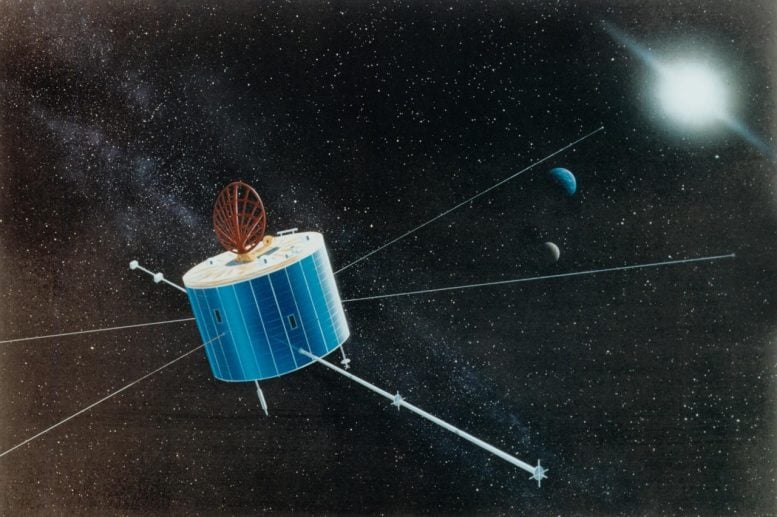
    Geotail Spacecraft
    An artist’s concept of the Geotail spacecraft. The GEOTAIL mission is a collaboration between the Institute of Space and Astronautical Science (ISAS), Japan Aerospace Exploration Agency (JAXA), and NASA. The spacecraft, designed and built by ISAS, was launched on July 24, 1992, with the main objective of studying the dynamics of the Earth’s magnetotail. The spacecraft was equipped with a variety of instruments such as magnetic field monitor, an electric field monitor, plasma monitors, high-energy particle monitors, and a plasma wave instrument. Credit: NASA

    The Geotail spacecraft, a joint NASA–JAXA mission launched in 1992, has concluded operations after 30 years of studying Earth’s magnetosphere.

    After 30 years in orbit, mission operations for the joint NASA–JAXA Geotail spacecraft have ended, after the failure of the spacecraft’s remaining data recorder.

    Since its launch on July 24, 1992, Geotail orbited Earth, gathering an immense dataset on the structure and dynamics of the magnetosphere, Earth’s protective magnetic bubble. Geotail was originally slated for a four-year run, but the mission was extended several times due to its high-quality data return, which contributed to over a thousand scientific publications.

    While one of Geotail’s two data recorders failed in 2012, the second continued to work until experiencing an anomaly on June 28, 2022. After attempts to remotely repair the recorder failed, the mission operations were ended on November 28, 2022.

    Importance of Geotail to Space Science

    “Geotail has been a very productive satellite, and it was the first joint NASA-JAXA mission,” said Don Fairfield, emeritus space scientist at NASA’s Goddard Space Flight Center in Greenbelt, Maryland, and NASA’s first project scientist for Geotail until his retirement in 2008. “The mission made important contributions to our understanding of how the solar wind interacts with Earth’s magnetic field to produce magnetic storms and auroras.”

    With an elongated orbit, Geotail sailed through the invisible boundaries of the magnetosphere, gathering data on the physical process at play there to help understand how the flow of energy and particles from the Sun reach Earth. Geotail made many scientific breakthroughs, including helping scientists understand how quickly material from the Sun passes into the magnetosphere, the physical processes at play at the magnetosphere’s boundary, and identifying oxygen, silicon, sodium, and aluminum in the lunar atmosphere.

    The mission also helped identify the location of a process called magnetic reconnection, which is a major conveyor of material and energy from the Sun into the magnetosphere and one of the instigators of the aurora. This discovery laid the way for the Magnetospheric Multiscale mission, or MMS, which launched in 2015.

    Over the years, Geotail collaborated with many of NASA’s other space missions including MMS, Van Allen Probes, Time History of Events and Macroscale Interactions during Substorms mission, Cluster, and Wind. With an orbit that took it as far as 120,000 miles from Earth at times, Geotail helped provide complementary data from remote parts of the magnetosphere to give scientists a complete picture of how events seen in one area affect other regions. Geotail also paired with observations on the ground to confirm the location and mechanisms of how aurora form.

    Although Geotail is done gathering new data, the scientific discoveries aren’t over. Scientists will continue to study Geotail’s data in the coming years.

    Never miss a breakthrough: Join the SciTechDaily newsletter.
    Follow us on Google and Google News.

    NASA NASA Goddard Space Flight Center
    Share. Facebook Twitter Pinterest LinkedIn Email Reddit

    Related Articles

    NASA’s DAVINCI Mission: A Daring Dive Into Venus’ Inferno

    Life on Mars? NASA’s Curiosity Rover Finds Prebiotic Clues in a 3.7-Billion-Year-Old Rock

    NASA’s Parker Solar Probe: The Fastest Spacecraft Ever Just Skimmed the Sun at 430,000 MPH

    The Andromeda Mystery: Hubble Discovers Strange Galactic Behavior

    NASA’s EZIE Mission Will Track Earth’s Hidden Electric Highways to Predict Space Storms

    3.7 Billion Miles Away: Hubble Uncovers a Hidden Trio That Could Rewrite Kuiper Belt History

    NASA’s PUNCH Is About to Capture Solar Storms Like Never Before

    Massive Solar Storm Unleashes Mysterious New Radiation Belts

    NASA Spots a Star and Planet Racing at 1.2 Million MPH – A Record-Breaking Discovery

    2 Comments

    1. kamir bouchareb st on January 25, 2023 12:05 am

      goooooooooooood

      Reply
    2. kamir bouchareb st on January 25, 2023 12:08 am

      goooooooooooooood

      Reply
    Leave A Reply Cancel Reply

    • Facebook
    • Twitter
    • Pinterest
    • YouTube

    Don't Miss a Discovery

    Subscribe for the Latest in Science & Tech!

    Trending News

    New Study Reveals Why Ozempic Works Better for Some People Than Others

    Climate Change Is Altering a Key Greenhouse Gas in a Way Scientists Didn’t Expect

    New Study Suggests Gravitational Waves May Have Created Dark Matter

    Scientists Discover Why the Brain Gets Stuck in Schizophrenia

    Scientists Engineer “Tumor-Eating” Bacteria That Devour Cancer From Within

    Even “Failed” Diets May Deliver Long-Term Health Gains, Study Finds

    NIH Scientists Discover Powerful New Opioid That Relieves Pain Without Dangerous Side Effects

    Collapsing Plasma May Hold the Key to Cosmic Magnetism

    Follow SciTechDaily
    • Facebook
    • Twitter
    • YouTube
    • Pinterest
    • Newsletter
    • RSS
    SciTech News
    • Biology News
    • Chemistry News
    • Earth News
    • Health News
    • Physics News
    • Science News
    • Space News
    • Technology News
    Recent Posts
    • The Surprising Reason You Might Want To Sleep Without a Pillow
    • Household Cats Could Hold the Secret to Fighting Breast Cancer
    • Scientists Say This Natural Hormone Reverses Obesity by Targeting the Brain
    • This 15,000-Year-Old Discovery Changes What We Know About Early Human Creativity
    • 35-Million-Year-Old Mystery: Strange Arachnid Discovered Preserved in Amber
    Copyright © 1998 - 2026 SciTechDaily. All Rights Reserved.
    • Science News
    • About
    • Contact
    • Editorial Board
    • Privacy Policy
    • Terms of Use

    Type above and press Enter to search. Press Esc to cancel.