
Close Menu
    Facebook X (Twitter) Instagram
    SciTechDaily
    • Biology
    • Chemistry
    • Earth
    • Health
    • Physics
    • Science
    • Space
    • Technology
    Facebook X (Twitter) Pinterest YouTube RSS
    SciTechDaily
    Home»Space»NASA’s Geotail Spacecraft Experiences an Anomaly – Data Recorder Has Failed
    Space

    NASA’s Geotail Spacecraft Experiences an Anomaly – Data Recorder Has Failed

    By Mara Johnson-Groh, NASA’s Goddard Space Flight CenterOctober 18, 2022No Comments3 Mins Read
    Facebook Twitter Pinterest Telegram LinkedIn WhatsApp Email Reddit
    Share
    Facebook Twitter LinkedIn Pinterest Telegram Email Reddit
    Geotail Spacecraft
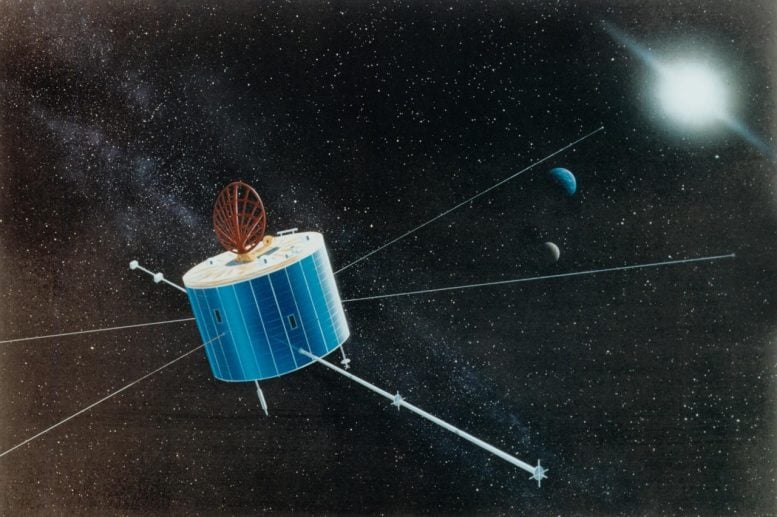
    An artist’s concept of the Geotail spacecraft. The Geotail spacecraft was designed and built by ISAS and was launched on July 24, 1992. After fulfilling Its original objective of studying the dynamics of the Earth’s magnetotail over a wide range of distances, extending from the near-Earth region, roughly eight Earth radii (Re) from the Earth to the distant tail about two hundred Re, its orbit was changed. Since February 1995, Geotail has been in an elliptical nine-by-thirty Re orbit where it has provided data on most aspects of the solar wind interaction with the magnetosphere. The spacecraft contains a magnetic field monitor, an electric field monitor, two plasma monitors, two sets of high-energy particle monitors, and a plasma wave instrument. Credit: NASA

    The Geotail mission, a joint venture between NASA, ISAS, and JAXA, faces challenges following the failure of its last operational data recorder, suspending the collection and downlinking of scientific data. Launched in 1992, Geotail has provided crucial information about the Earth’s magnetosphere and made unexpected lunar discoveries, despite the setbacks.

    NASA’s Science Mission Directorate, Japan’s Institute of Space and Astronautical Science (ISAS), and the Japan Aerospace Exploration Agency (JAXA) are determining how to move forward with the joint Geotail mission after discovering that the spacecraft’s last operational data recorder has failed.

    Originally, Geotail was equipped with two data recorders to collect the mission’s scientific data. In 2012, one data recorder failed after the mission had already spent 20 years of gathering information about the plasma environment around Earth. The remaining data recorder continued collecting data for an additional 10 years until it experienced an anomaly on June 28, 2022.

    The team at JAXA discovered the error with the recorder. They have been performing tests to investigate the cause and extent of the damage. Ongoing attempts to recover the recorder have been unsuccessful thus far. Without a functioning recorder, the science data from the U.S. instruments can no longer be collected or downlinked. NASA, ISAS, and JAXA are currently deciding the best path forward for the mission given the failure.

    Geotail launched on July 24, 1992, from Cape Canaveral Air Force Station in Florida, with the primary goal of studying the structure and dynamics of the tail region of the Earth’s magnetosphere using a comprehensive set of scientific instruments. The magnetosphere is the area of space surrounding Earth that is controlled by Earth’s magnetic field.

    With an elongated orbit, Geotail has spent the last 30 years sailing through the invisible boundaries of the magnetosphere, gathering data on the physical process at play there. Many scientific breakthroughs have been made by Geotail, including helping scientists better understand what causes material from the Sun to pass into the magnetosphere. It has also made discoveries outside its intended scope, such as identifying oxygen, silicon, sodium, and aluminum in the lunar atmosphere.

    Never miss a breakthrough: Join the SciTechDaily newsletter.
    Follow us on Google and Google News.

    NASA NASA Goddard Space Flight Center
    Share. Facebook Twitter Pinterest LinkedIn Email Reddit

    Related Articles

    NASA’s DAVINCI Mission: A Daring Dive Into Venus’ Inferno

    Life on Mars? NASA’s Curiosity Rover Finds Prebiotic Clues in a 3.7-Billion-Year-Old Rock

    NASA’s Parker Solar Probe: The Fastest Spacecraft Ever Just Skimmed the Sun at 430,000 MPH

    The Andromeda Mystery: Hubble Discovers Strange Galactic Behavior

    NASA’s EZIE Mission Will Track Earth’s Hidden Electric Highways to Predict Space Storms

    3.7 Billion Miles Away: Hubble Uncovers a Hidden Trio That Could Rewrite Kuiper Belt History

    NASA’s PUNCH Is About to Capture Solar Storms Like Never Before

    Massive Solar Storm Unleashes Mysterious New Radiation Belts

    NASA Spots a Star and Planet Racing at 1.2 Million MPH – A Record-Breaking Discovery

    Leave A Reply Cancel Reply

    • Facebook
    • Twitter
    • Pinterest
    • YouTube

    Don't Miss a Discovery

    Subscribe for the Latest in Science & Tech!

    Trending News

    Scientists Discover How Coffee Impacts Memory, Mood, and Gut Health

    Why Did the Neanderthals Disappear? Scientists Reveal Humans Had a Hidden Advantage

    Physicists Propose Strange Experiment Where Time Goes Quantum

    Magnesium Magic: New Drug Melts Fat Even on a High-Fat, High-Sugar Diet

    Weight-Loss Drugs Like Ozempic May Come With an Unexpected Cost

    Mezcal “Worm” in a Bottle Mystery: DNA Testing Reveals a Surprise

    New Research Reveals That Your Morning Coffee Activates an Ancient Longevity Switch

    This Is What Makes You Irresistible to Mosquitoes

    Follow SciTechDaily
    • Facebook
    • Twitter
    • YouTube
    • Pinterest
    • Newsletter
    • RSS
    SciTech News
    • Biology News
    • Chemistry News
    • Earth News
    • Health News
    • Physics News
    • Science News
    • Space News
    • Technology News
    Recent Posts
    • Harvard Scientists Reveal Secret Structure Behind How You Smell
    • Scientists Just Discovered the Hidden Trick That Keeps Your Cells Alive
    • This Simple Movement Could Be Secretly Cleaning Your Brain
    • Male Birth Control Breakthrough: Scientists Find Way To Turn Sperm Production Off and Back On
    • A Common Vitamin Could Hold the Key to Treating Fatty Liver Disease
    Copyright © 1998 - 2026 SciTechDaily. All Rights Reserved.
    • Science News
    • About
    • Contact
    • Editorial Board
    • Privacy Policy
    • Terms of Use

    Type above and press Enter to search. Press Esc to cancel.