
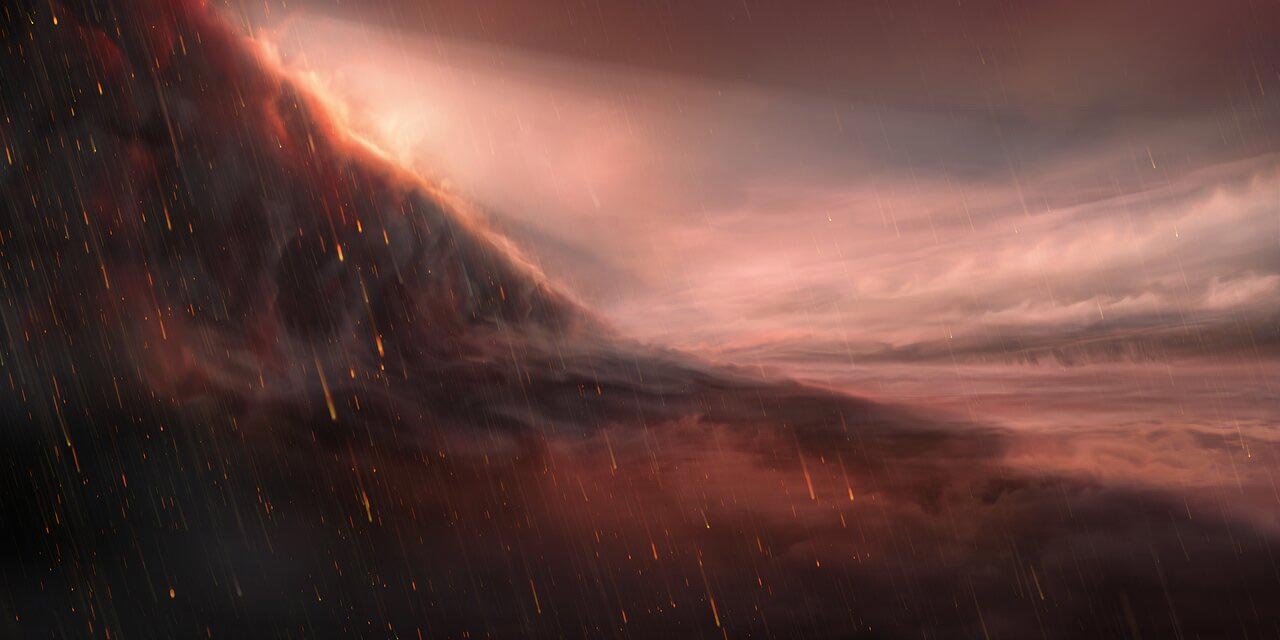
Researchers using ESO’s Very Large Telescope (VLT) have observed an extreme planet where they suspect it rains iron. The ultra-hot giant exoplanet has a dayside where temperatures climb above 2400 degrees Celsius, high enough to vaporize metals. Strong winds carry iron vapor to the cooler nightside where it condenses into iron droplets.
“One could say that this planet gets rainy in the evening, except it rains iron,” says David Ehrenreich, a professor at the University of Geneva in Switzerland. He led a study, published today (March 11, 2020) in the journal Nature, of this exotic exoplanet. Known as WASP-76b, it is located some 640 light-years away in the constellation of Pisces.
This strange phenomenon happens because the ‘iron rain’ planet only ever shows one face, its dayside, to its parent star, its cooler nightside remaining in perpetual darkness. Like the Moon on its orbit around the Earth, WASP-76b is ‘tidally locked’: it takes as long to rotate around its axis as it does to go around the star.

On its dayside, it receives thousands of times more radiation from its parent star than the Earth does from the Sun. It’s so hot that molecules separate into atoms, and metals like iron evaporate into the atmosphere. The extreme temperature difference between the day and nightsides results in vigorous winds that bring the iron vapor from the ultra-hot dayside to the cooler nightside, where temperatures decrease to around 1500 degrees Celsius.
Not only does WASP-76b have different day-night temperatures, it also has distinct day-night chemistry, according to the new study. Using the new ESPRESSO instrument on ESO’s VLT in the Chilean Atacama Desert, the astronomers identified for the first time chemical variations on an ultra-hot gas giant planet. They detected a strong signature of iron vapor at the evening border that separates the planet’s dayside from its nightside. “Surprisingly, however, we do not see the iron vapor in the morning,” says Ehrenreich. The reason, he says, is that “it is raining iron on the nightside of this extreme exoplanet.”
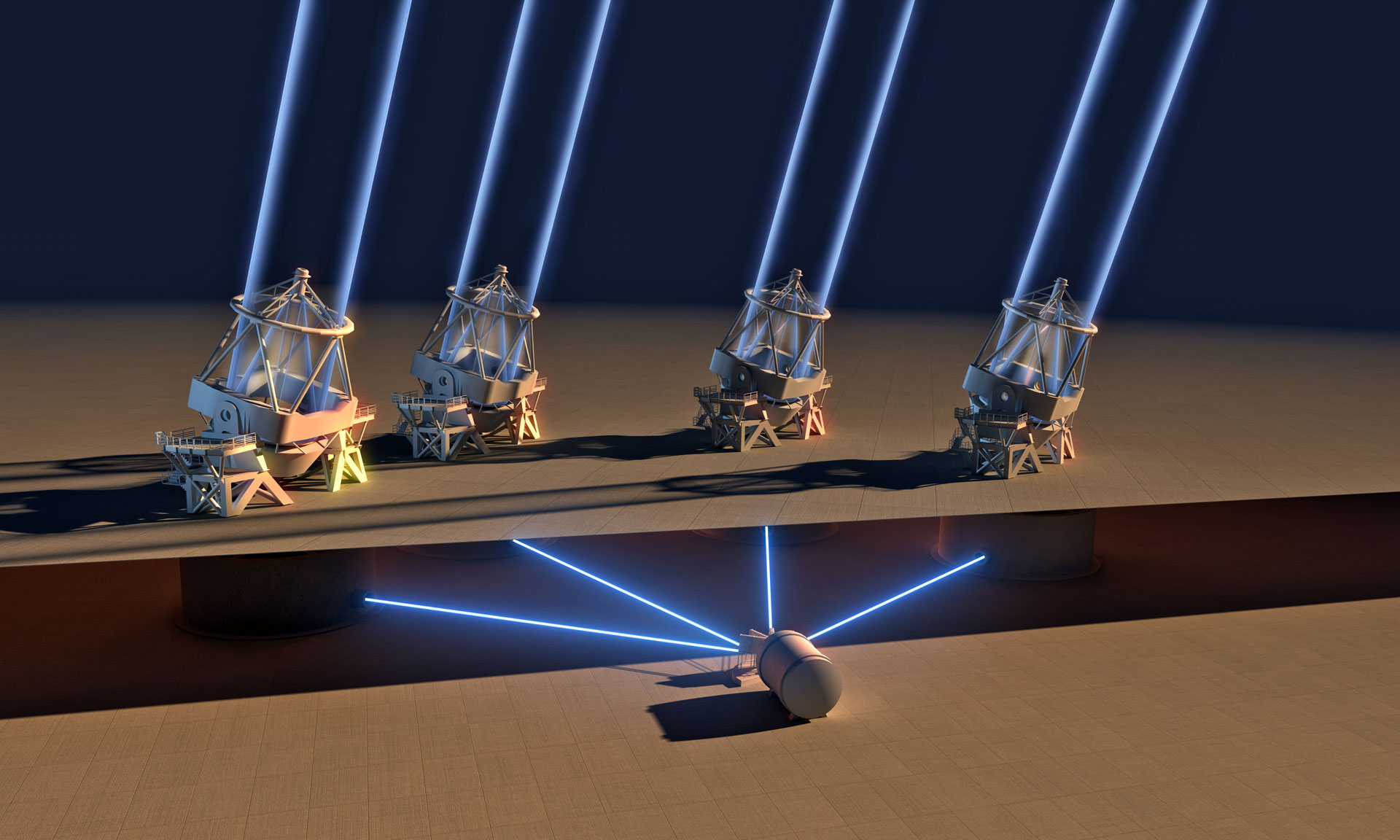
“The observations show that iron vapor is abundant in the atmosphere of the hot dayside of WASP-76b,” adds María Rosa Zapatero Osorio, an astrophysicist at the Centre for Astrobiology in Madrid, Spain, and the chair of the ESPRESSO science team. “A fraction of this iron is injected into the nightside owing to the planet’s rotation and atmospheric winds. There, the iron encounters much cooler environments, condenses, and rains down.”
This result was obtained from the very first science observations done with ESPRESSO, in September 2018, by the scientific consortium who built the instrument: a team from Portugal, Italy, Switzerland, Spain, and ESO.
ESPRESSO — the Echelle SPectrograph for Rocky Exoplanets and Stable Spectroscopic Observations — was originally designed to hunt for Earth-like planets around Sun-like stars. However, it has proven to be much more versatile. “We soon realized that the remarkable collecting power of the VLT and the extreme stability of ESPRESSO made it a prime machine to study exoplanet atmospheres,” says Pedro Figueira, ESPRESSO instrument scientist at ESO in Chile.
“What we have now is a whole new way to trace the climate of the most extreme exoplanets,” concludes Ehrenreich.
Read Giant, Ultra-Hot Planet WASP-76b Where It Rains Iron for more on this research.
Reference: “Nightside condensation of iron in an ultrahot giant exoplanet” by David Ehrenreich et.al., 11 March 2020, Nature.
DOI: 10.1038/s41586-020-2107-1
The team is composed of David Ehrenreich (Observatoire astronomique de l’Université de Genève, Geneva, Switzerland [UNIGE]), Christophe Lovis (UNIGE), Romain Allart (UNIGE), María Rosa Zapatero Osorio (Centro de Astrobiología, Madrid, Spain [CSIC-INTA]), Francesco Pepe (UNIGE), Stefano Cristiani (INAF Osservatorio Astronomico di Trieste, Italy [INAF Trieste]), Rafael Rebolo (Instituto de Astrofísica de Canarias, Tenerife, Spain [IAC]), Nuno C. Santos (Instituto de Astrofísica e Ciências do Espaço, Universidade do Porto, Portugal [IA/UPorto] & Departamento de Física e Astronomia, Faculdade de Ciências, Universidade do Porto, Portugal [FCUP]), Francesco Borsa (INAF Osservatorio Astronomico di Brera, Merate, Italy [INAF Brera]), Olivier Demangeon (IA/UPorto), Xavier Dumusque (UNIGE), Jonay I. González Hernández (IAC), Núria Casasayas-Barris (IAC), Damien Ségransan (UNIGE), Sérgio Sousa (IA/UPorto), Manuel Abreu (Instituto de Astrofísica e Ciências do Espaço, Universidade de Lisboa, Portugal [IA/FCUL] & Departamento de Física da Faculdade de Ciências da Universidade de Lisboa, Portugal [FCUL], Vardan Adibekyan [IA/UPorto], Michael Affolter (Physikalisches Institut & Center for Space and Habitability, Universität Bern, Switzerland [Bern]), Carlos Allende Prieto (IAC), Yann Alibert (Bern), Matteo Aliverti (INAF Brera), David Alves (IA/FCUL & FCUL), Manuel Amate (IA/UPorto), Gerardo Avila (European Southern Observatory, Garching bei München, Germany [ESO]), Veronica Baldini (INAF Trieste), Timothy Bandy (Bern), Willy Benz (Bern), Andrea Bianco (INAF Brera), Émeline Bolmont (UNIGE), François Bouchy (UNIGE), Vincent Bourrier (UNIGE), Christopher Broeg (Bern), Alexandre Cabral (IA/FCUL & FCUL), Giorgio Calderone (INAF Trieste), Enric Pallé (IAC), H. M. Cegla (UNIGE), Roberto Cirami (INAF Trieste), João M. P. Coelho (IA/FCUL & FCUL), Paolo Conconi (INAF Brera), Igor Coretti (INAF Trieste), Claudio Cumani (ESO), Guido Cupani (INAF Trieste), Hans Dekker (ESO), Bernard Delabre (ESO), Sebastian Deiries (ESO), Valentina D’Odorico (INAF Trieste & Scuola Normale Superiore, Pisa, Italy), Paolo Di Marcantonio (INAF Trieste), Pedro Figueira (European Southern Observatory, Santiago de Chile, Chile [ESO Chile] & IA/UPorto), Ana Fragoso (IAC), Ludovic Genolet (UNIGE), Matteo Genoni (INAF Brera), Ricardo Génova Santos (IAC), Nathan Hara (UNIGE), Ian Hughes (UNIGE), Olaf Iwert (ESO), Florian Kerber (ESO), Jens Knudstrup (ESO), Marco Landoni (INAF Brera), Baptiste Lavie (UNIGE), Jean-Louis Lizon (ESO), Monika Lendl (UNIGE & Space Research Institute, Austrian Academy of Sciences, Graz, Austria), Gaspare Lo Curto (ESO Chile), Charles Maire (UNIGE), Antonio Manescau (ESO), C. J. A. P. Martins (IA/UPorto & Centro de Astrofísica da Universidade do Porto, Portugal), Denis Mégevand (UNIGE), Andrea Mehner (ESO Chile), Giusi Micela (INAF Osservatorio Astronomico di Palermo, Italy), Andrea Modigliani (ESO), Paolo Molaro (INAF Trieste & Institute for Fundamental Physics of the Universe, Trieste, Italy), Manuel Monteiro (IA/UPorto), Mario Monteiro (IA/UPorto & FCUP), Manuele Moschetti (INAF Brera), Eric Müller (ESO), Nelson Nunes (IA), Luca Oggioni (INAF Brera), António Oliveira (IA/FCUL & FCUL), Giorgio Pariani (INAF Brera), Luca Pasquini (ESO), Ennio Poretti (INAF Brera & Fundación Galileo Galilei, INAF, Breña Baja, Spain), José Luis Rasilla (IAC), Edoardo Redaelli (INAF Brera), Marco Riva (INAF Brera), Samuel Santana Tschudi (ESO Chile), Paolo Santin (INAF Trieste), Pedro Santos (IA/FCUL & FCUL), Alex Segovia Milla (UNIGE), Julia V. Seidel (UNIGE), Danuta Sosnowska (UNIGE), Alessandro Sozzetti (INAF Osservatorio Astrofisico di Torino, Pino Torinese, Italy), Paolo Spanò (INAF Brera), Alejandro Suárez Mascareño (IAC), Hugo Tabernero (CSIC-INTA & IA/UPorto), Fabio Tenegi (IAC), Stéphane Udry (UNIGE), Alessio Zanutta (INAF Brera), Filippo Zerbi (INAF Brera).
Never miss a breakthrough: Join the SciTechDaily newsletter.
Follow us on Google and Google News.