
Close Menu
    Facebook X (Twitter) Instagram
    SciTechDaily
    • Biology
    • Chemistry
    • Earth
    • Health
    • Physics
    • Science
    • Space
    • Technology
    Facebook X (Twitter) Pinterest YouTube RSS
    SciTechDaily
    Home»Space»Next Generation ESPRESSO Planet Hunter Makes First Observations
    Space

    Next Generation ESPRESSO Planet Hunter Makes First Observations

    By European Southern ObservatoryDecember 6, 2017No Comments4 Mins Read
    Facebook Twitter Pinterest Telegram LinkedIn WhatsApp Email Reddit
    Share
    Facebook Twitter LinkedIn Pinterest Telegram Email Reddit
    First Light for ESPRESSO
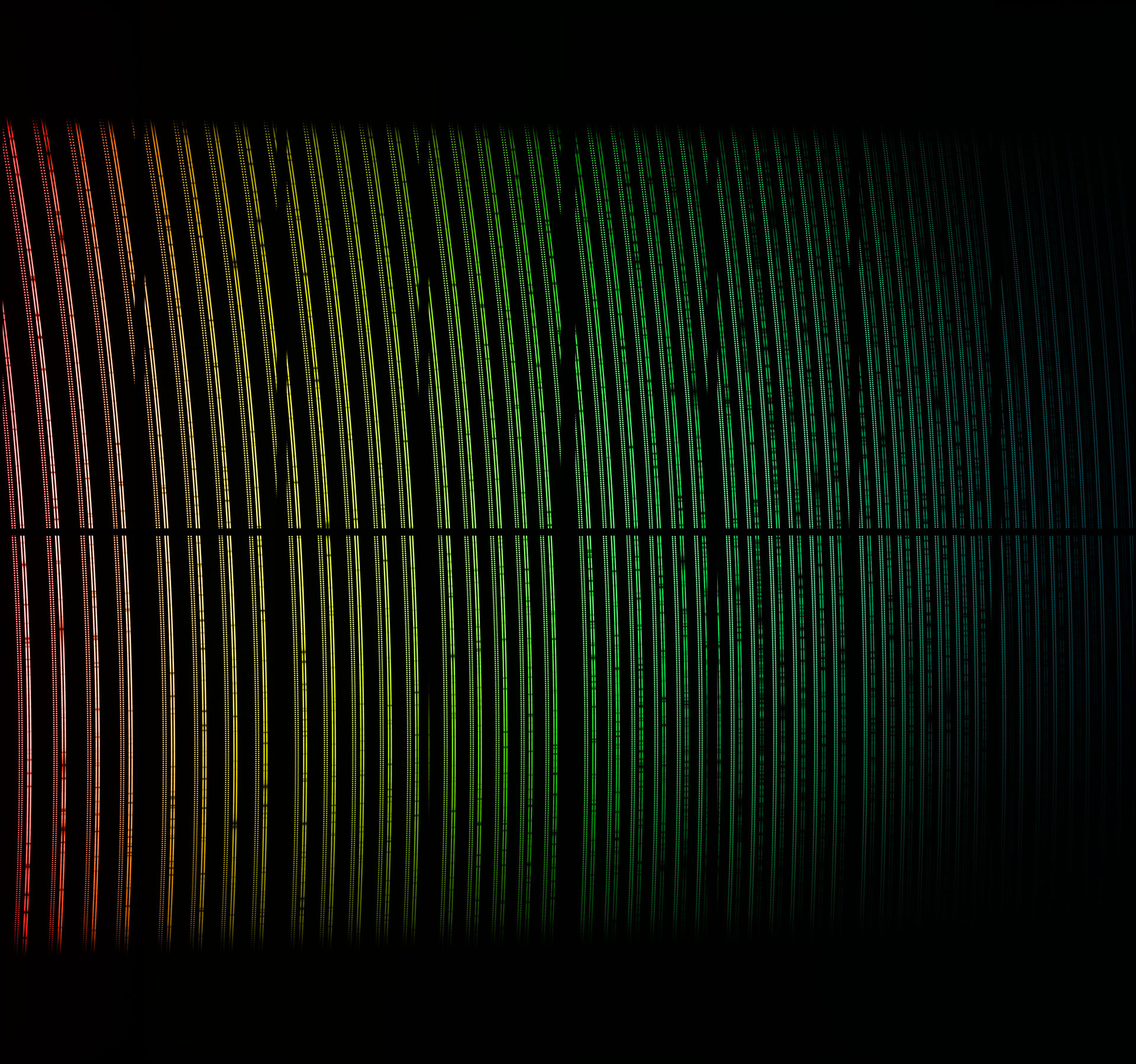
    This colorful image shows spectral data from the First Light of the ESPRESSO instrument on ESO’s Very Large Telescope in Chile. The light from a star has been dispersed into its component colors. This view has been colorized to indicate how the wavelengths change across the image, but these are not exactly the colors that would be seen visually. Close inspection shows many dark spectral lines in the stellar spectra and also the regular double spots from a calibration light source. The dark gaps are features of how the data is taken, and are not real. Credit: ESO/ESPRESSO team

    The Echelle SPectrograph for Rocky Exoplanet and Stable Spectroscopic Observations (ESPRESSO) has successfully made its first observations. Installed on ESO’s Very Large Telescope (VLT) in Chile, ESPRESSO will search for exoplanets with unprecedented precision by looking at the minuscule changes in the light of their host stars. For the first time ever, an instrument will be able to sum up the light from all four VLT telescopes and achieve the light collecting power of a 16-meter telescope.

    ESPRESSO has achieved first light on ESO’s Very Large Telescope at the Paranal Observatory in northern Chile. This new, third-generation echelle spectrograph is the successor to ESO’s hugely successful HARPS instrument at the La Silla Observatory. HARPS can attain a precision of around one meter per second in velocity measurements, whereas ESPRESSO aims to achieve a precision of just a few centimeters per second, due to advances in technology and its placement on a much bigger telescope.

    The lead scientist for ESPRESSO, Francesco Pepe from the University of Geneva in Switzerland, explains its significance: “This success is the result of the work of many people over 10 years. ESPRESSO isn’t just the evolution of our previous instruments like HARPS, but it will be transformational, with its higher resolution and higher precision. And unlike earlier instruments it can exploit the VLT’s full collecting power — it can be used with all four of the VLT Unit Telescopes at the same time to simulate a 16-meter telescope. ESPRESSO will be unsurpassed for at least a decade — now I am just impatient to find our first rocky planet!”

    ESPRESSO can detect tiny changes in the spectra of stars as a planet orbits. This radial velocity method works because a planet’s gravitational pull influences its host star, causing it to “wobble” slightly. The less massive the planet, the smaller the wobble, and so for rocky and possibly life-bearing exoplanets to be detected, an instrument with very high precision is required. With this method, ESPRESSO will be able to detect some of the lightest planets ever found.

    The test observations included observations of stars and known planetary systems. Comparisons with existing HARPS data showed that ESPRESSO can obtain similar quality data with dramatically less exposure time.

    Instrument scientist Gaspare Lo Curto (ESO) is delighted: “Bringing ESPRESSO this far has been a great accomplishment, with contributions from an international consortium as well as many different groups within ESO: engineers, astronomers and administration. They had to not just install the spectrograph itself, but also the very complex optics that bring the light together from the four VLT Unit Telescopes.”

    Although the main goal of ESPRESSO is to push planet hunting to the next level, finding and characterizing less massive planets and their atmospheres, it also has many other applications. ESPRESSO will also be the world’s most powerful tool to test whether the physical constants of nature have changed since the Universe was young. Such tiny changes are predicted by some theories of fundamental physics, but have never been convincingly observed.

    When ESO’s Extremely Large Telescope comes on line, the instrument HIRES, which is currently under conceptual design, will enable the detection and characterization of even smaller and lighter exoplanets, down to Earth-like planets, as well as the study of exoplanet atmospheres with the prospect of the detection of signatures of life on rocky planets.

    Never miss a breakthrough: Join the SciTechDaily newsletter.
    Follow us on Google and Google News.

    Astronomy Cosmology ESPRESSO European Southern Observatory
    Share. Facebook Twitter Pinterest LinkedIn Email Reddit

    Related Articles

    Scientists Capture the Universe’s Hidden Web of Dark Matter

    New Planet Discovered Next Door – Orbiting Proxima Centauri

    ESO and Hubble Reveal Fast-Moving, Wave-Like Features in the Debris Disk Around AU Microscopii

    ESO Image of the Week: A Microlensing Mystery

    GAMA Survey Reveals the Slow Death of the Universe

    VLT Discovers the Brightest Distant Galaxy to Date and Signs of Population III Stars

    VLT/SPHERE Reveal a Star Giving Birth to a Butterfly-Like Planetary Nebula

    ESO Views Star Forming Cloud RCW 34

    The Possible First Signs of Self-interacting Dark Matter

    Leave A Reply Cancel Reply

    • Facebook
    • Twitter
    • Pinterest
    • YouTube

    Don't Miss a Discovery

    Subscribe for the Latest in Science & Tech!

    Trending News

    Scientists Uncover Promising New Strategy To Stop Parkinson’s in Its Tracks

    Experts Reveal the Surprising Cancer Link Behind a Common Vitamin

    This Strange “Golden Orb” Found 2 Miles Deep Stumped Scientists for Years

    Giant “Last Titan” Dinosaur Discovered in Thailand Was Bigger Than 9 Elephants

    This “Longevity Gene” May Protect the Brain From Aging and Dementia

    Common Cleaning Chemical Could Triple Your Risk of a Dangerous Liver Disease

    Scientists Discover Bizarre 100-Million-Year-Old Insect With Giant Claws

    Scientists Discover “Good” Gut Microbes That Could Protect Against Autism and ADHD

    Follow SciTechDaily
    • Facebook
    • Twitter
    • YouTube
    • Pinterest
    • Newsletter
    • RSS
    SciTech News
    • Biology News
    • Chemistry News
    • Earth News
    • Health News
    • Physics News
    • Science News
    • Space News
    • Technology News
    Recent Posts
    • Light-Matter Particles Could Revolutionize AI Computing
    • Scientists Warn Many Insects May Not Survive a Warming World
    • Hektoria Glacier Collapse Reveals How Fast Antarctica Can Fall Apart
    • Hidden Earthquake Threat: Oregon’s Fault May Be Closer to the Surface Than Scientists Thought
    • Scientists Use Smartwatch Data To Track the Hidden Health Effects of Air Pollution
    Copyright © 1998 - 2026 SciTechDaily. All Rights Reserved.
    • Science News
    • About
    • Contact
    • Editorial Board
    • Privacy Policy
    • Terms of Use

    Type above and press Enter to search. Press Esc to cancel.