
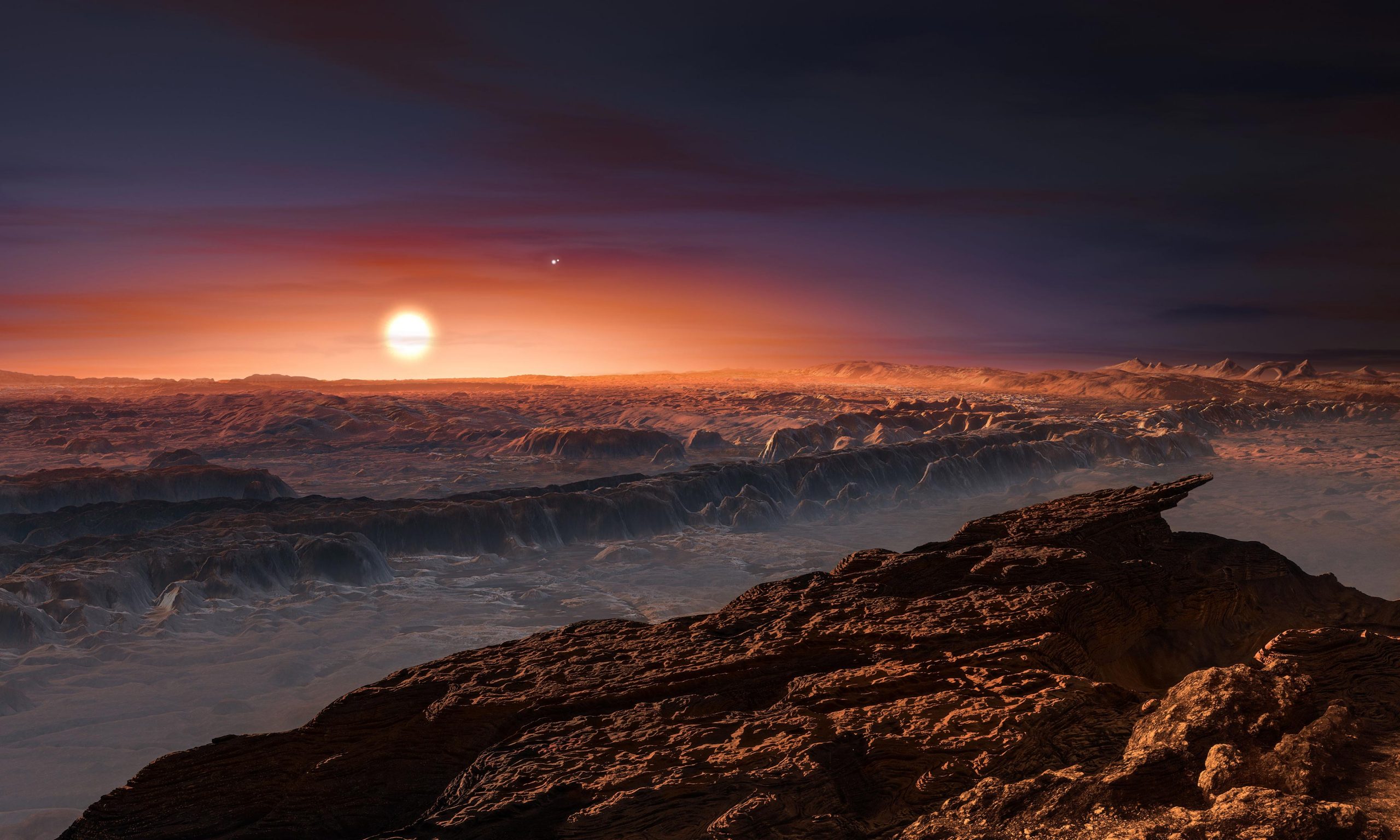
The existence of a planet the size of Earth around the closest star in the Alpha Centauri star system, Proxima Centauri, has been confirmed by an international team of scientists including researchers from the University of Geneva (UNIGE). The results, which you can read all about in the journal Astronomy & Astrophysics, reveal that the planet in question, Proxima b, has a mass of 1.17 earth masses and is located in the habitable zone of its star, which it orbits in 11.2 days. This breakthrough has been possible thanks to radial velocity measurements of unprecedented precision using ESPRESSO, the Swiss-manufactured spectrograph — the most accurate currently in operation — which is installed on the Very Large Telescope in Chile. Proxima b was first detected four years ago by means of an older spectrograph, HARPS — also developed by the Geneva-based team — which measured a low disturbance in the star’s speed, suggesting the presence of a companion.
The ESPRESSO spectrograph has performed radial velocity measurements on the star Proxima Centauri, which is only 4.2 light-years from the Sun, with an accuracy of 30 centimeters (12 inches) a second (cm/s) or about three times more precise than that obtained with HARPS, the same type of instrument but from the previous generation.
“We were already very happy with the performance of HARPS, which has been responsible for discovering hundreds of exoplanets over the last 17 years,” begins Francesco Pepe, a professor in the Astronomy Department in UNIGE’s Faculty of Science and the man in charge of ESPRESSO. “We’re really pleased that ESPRESSO can produce even better measurements, and it’s gratifying and just a reward for the teamwork lasting nearly 10 years.”
Alejandro Suarez Mascareño, the article’s main author, adds: “Confirming the existence of Proxima b was an important task, and it’s one of the most interesting planets known in the solar neighborhood.”
The measurements performed by ESPRESSO have clarified that the minimum mass of Proxima b is 1.17 earth masses (the previous estimate was 1.3) and that it orbits around its star in only 11.2 days.
“ESPRESSO has made it possible to measure the mass of the planet with a precision of over one-tenth of the mass of Earth,” says Michel Mayor, winner of the Nobel Prize for Physics in 2019, honorary professor in the Faculty of Science and the ‘architect’ of all ESPRESSO-type instruments. “It’s completely unheard of.”
And what about life in all this?
Although Proxima b is about 20 times closer to its star than the Earth is to the Sun, it receives comparable energy, so that its surface temperature could mean that water (if there is any) is in liquid form in places and might, therefore, harbor life.
Having said that, although Proxima b is an ideal candidate for biomarker research, there is still a long way to go before we can suggest that life has been able to develop on its surface. In fact, the Proxima star is an active red dwarf that bombards its planet with X-rays, receiving about 400 times more than the Earth.
“Is there an atmosphere that protects the planet from these deadly rays?” asks Christophe Lovis, a researcher in UNIGE’s Astronomy Department and responsible for ESPRESSO’s scientific performance and data processing. “And if this atmosphere exists, does it contain the chemical elements that promote the development of life (oxygen, for example)? How long have these favorable conditions existed? We’re going to tackle all these questions, especially with the help of future instruments like the RISTRETTO spectrometer, which we’re going to build specially to detect the light emitted by Proxima b, and HIRES, which will be installed on the future ELT 39 m giant telescope that the European Southern Observatory (ESO) is building in Chile.”
Surprise: is there a second planet?
In the meantime, the precision of the measurements made by ESPRESSO could result in another surprise. The team has found evidence of a second signal in the data, without being able to establish the definitive cause behind it. “If the signal was planetary in origin, this potential other planet accompanying Proxima b would have a mass less than one third of the mass of the Earth. It would then be the smallest planet ever measured using the radial velocity method,” adds Professor Pepe.
It should be noted that ESPRESSO, which became operational in 2017, is in its infancy and these initial results are already opening up undreamt of opportunities. The road has been traveled at breakneck pace since the first extrasolar planet was discovered by Michel Mayor and Didier Queloz, both from UNIGE’s Astronomy Department. In 1995, the 51Peg b gas giant planet was detected using the ELODIE spectrograph with an accuracy of 10 meters (33 feet) per second (m/s). Today ESPRESSO, with its 30 cm/s (and soon 10 after the latest adjustments) will perhaps make it possible to explore worlds that remind us of the Earth.
Never miss a breakthrough: Join the SciTechDaily newsletter.
Follow us on Google and Google News.
40 Comments
“a planet the size of Earth around the closest star in the solar system, Proxima Centauri”
Did you mean “closest star to our solar system?”
Did you mean “closest other star in our galaxy?”
Neither of those. The sentence is not incorrect, but it is not clear. I will try to improve it.
The “solar system” in that sentence is not our solar system, but the Alpha Centauri star system. The nearest star (to our sun) in that triple star system is Proxima Centauri.
H
It says the closest star in the Alpha Centauri star system. Not the closest star in the solar system. It’s the second closest star to Earth.
No craig. They meant “a planet the size of Earth around the closest star in the solar system, Alpha Centauri” There are multiple stars in alpha centauri and proxima centauri is the closest one.
The Trisolarins are coming for us
The sophons are already here :/
The Alpha and Omega is on his way back.
The detection of oxygen and ozone will be critical for life as some protection from the star’s UV radiation will be necessary. Liquid water can provide both via its photolytic destruction and loss of hydrogen to space.
Or just by 1 m of ocean water, or just soil or crust bacteria.
Everything is already mentioned in Jainism, thousands of year ago.
Nothing in superstition has any bearing on nature, of course.
n.b. – the headline is also misleading, to the edge of being incorrect: an Earth-SIZED planet (even in the “Goldilocks Zone”) is not “an Earth-LIKE Planet.” Most consider oxygen in the atmosphere & liquid water to be the hallmarks of Earth-like.
It’s likely to have liquid water that’s what they mean by being in the “Goldilocks zone” we aren’t able to directly detect liquid water on exoplanets or in most cases atmospheric composition. The vast majority of exoplanets we’ve found are gas giants because they’re easier to detect so this is about as earth-like as it gets right now.
All this was explained by Crystal Gale on The Muppet Show 40 years ago.
Terminology is wrong. Solar system implies planets around our sun. The term they are leaving oking for is stellar system.
Does the planet rotate, how fast? Is there a significant magnetic field? Is there at last one moon able to stabilize the planets axis? Or are we just creating click bate to sell adds?
It’s a discovery, not a click bait – scientists are looking for planets and for life.
More detail to follow in later research, most likely.
Fake news
Real troll
Blah blah blah…
There’s not enough time to increase our technology to the point where we can start sending probes, let alone people in search of another earth before this one is uninhabitable.
And so what? We can do these observations from here – even find life, we think – much faster and cheaper!
Headline was confusing. But interesting topic liked it.
This makes me think that life must be so delicate and fragile with endless pathways of fragility of delicate strands or something even more complex. In awe at shapeless life taking shapes endlessly. Star planet form existence endlessly forever.
The speed with which life evolved on Earth implies it evolves easily, and its 4 billion years of biosphere – despite major mass extinctions – implies it is really robust.
That said, colonizing Mars seems like a good idea.
The main info that readers want to know is whether humans can be transported to another similar to our earth planet asap. Also, whether said planet would be a literal paradise .
The short answer(s) is that we don’t know if interstellar transport is possible (long distances, bad economy) and that scientists are interested in doing observations out there fast and cheap like the one described in the article.
We either found, The xenomorph, or Predator home world.
○●
These comments are out of this world. °•○○•●•○○•°
The second signal of an object 1/3 the size of earth is obviously either a moon or a smaller planetoid. The espresso may be on the cutting edge of technology but with the James web telescope I imagine we may discover systems are teeming with more olanets and moons then we can comprehend extending the possibilities even further of life in other star systems. In my opinion based on the numbers of exoplanets discovered so far it is mathematically impossible that the earth is unique.
No way a planet that whips around it’s dwarf in 11.2 days with 400 times the X-ray bombardment can or could have produced life. Physics and chemistry simply explain this basic truth.
Big claim, zero evidence.
That’s cool. 23t miles away. Pointless…our current speed record in space is roughly 25k mph. It would only take about 100k years to get there if it habitable for humans. Better be one hell of a ship. Even at 10m mph about 260 years. We’re doomed!
The star is the second nearest star. Not the nearest star. The nearest star is the Sun, of course.
Fake news anything in tv or phone is simply to keep us entertained as a civilization/society. Pretty soon they will run out of things to talk about or “discover”and we will go back to killing each other.
Congrats to the Swiss team and everyone involved. Also great write up. Perfect amount of restraint/excitement and all the important facts… Nice!
We’ve known about that planet since 1952 when Philip K. Dick wrote about the war we were having with it. I thought it was common knowledge. 😂.
Just imagine now, that the inhabitants of proxima b are observing earth and are having the very same ideas🤔
Question:
Is the grass actually greener on the other side ? We’ll find out, eventually.
Now imagine another scenario… they’re far more advanced than we, know of us intimately and deeply and want nothing to do with us.🤔
We’re undaunted by the challenge, either way.🙂
Hey I seen that star about a year ago at daytime right beside the Sun to the right of it
To the “blah blah blah…” “Not enough time to advance our tech… Before…”
Excuse me Sir, do you not understand how nuts what we can suddenly do now because of the effects of exponential growth on our rate of advancement in the scientific and technological fields? Especially the past 5 to 10 years?! CRISPER-9 Technology, 5G, repeating fast radio bursts, Galactic Filiments… OMG particles…
S#!t is about to get nuts. I suggest you look into Singulatarian Theory and seriously stop telling the sheople that… Cuz… I don’t want the powers that currently be having what is coming in completely their control.