
Close Menu
    Facebook X (Twitter) Instagram
    SciTechDaily
    • Biology
    • Chemistry
    • Earth
    • Health
    • Physics
    • Science
    • Space
    • Technology
    Facebook X (Twitter) Pinterest YouTube RSS
    SciTechDaily
    Home»Health»New Model Predicts the Peaks of the COVID-19 Pandemic Around the World
    Health

    New Model Predicts the Peaks of the COVID-19 Pandemic Around the World

    By SciTechDailyMay 29, 2020No Comments3 Mins Read
    Facebook Twitter Pinterest Telegram LinkedIn WhatsApp Email Reddit
    Share
    Facebook Twitter LinkedIn Pinterest Telegram Email Reddit
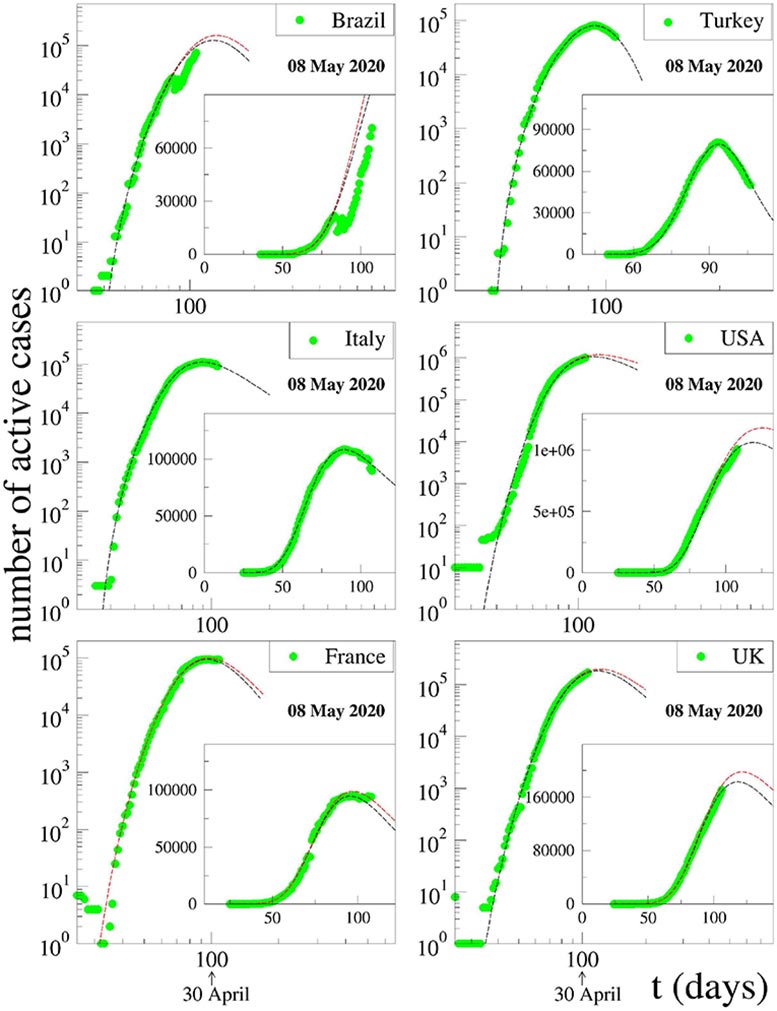
    Global COVID-19 Peaks
    Fits of the data for active cases available on May 8, 2020, for various severely affected countries around the world. Credit: Constantino Tsallis and Ugur Tirnakli, Frontiers

    As of late May, COVID-19 has killed more than 325,000 people around the world. Even though the worst seems to be over for countries like China and South Korea, public health experts warn that cases and fatalities will continue to surge in many parts of the world. Understanding how the disease evolves can help these countries prepare for an expected uptick in cases.

    This week in the journal Frontiers, researchers describe a single function that accurately describes all existing available data on active cases and deaths — and predicts forthcoming peaks. The tool uses q-statistics, a set of functions and probability distributions developed by Constantino Tsallis, a physicist and member of the Santa Fe Institute’s external faculty. Tsallis worked on the new model together with Ugur Tirnakli, a physicist at Ege University, in Turkey.

    “The formula works in all the countries in which we have tested,” says Tsallis.

    Neither physicist ever set out to model a global pandemic. But Tsallis says that when he saw the shape of published graphs representing China’s daily active cases, he recognized shapes he’d seen before — namely, in graphs he’d helped produce almost two decades ago to describe the behavior of the stock market.

    “The shape was exactly the same,” he says. For the financial data, the function described probabilities of stock exchanges; for COVID-19, it described daily the number of active cases — and fatalities — as a function of time.

    Modeling financial data and tracking a global pandemic may seem unrelated, but Tsallis says they have one important thing in common. “They’re both complex systems,” he says, “and in complex systems, this happens all the time.” Disparate systems from a variety of fields — biology, network theory, computer science, mathematics — often reveal patterns that follow the same basic shapes and evolution.

    The financial graph appeared in a 2004 volume co-edited by Tsallis and the late Nobelist Murray Gell-Mann. Tsallis developed q-statistics, also known as “Tsallis statistics,” in the late 1980s as a generalization of Boltzmann-Gibbs statistics to complex systems.

    In the new paper, Tsallis and Tirnakli used data from China, where the active case rate is thought to have peaked, to set the main parameters for the formula. Then, they applied it to other countries including France, Brazil, and the United Kingdom, and found that it matched the evolution of the active cases and fatality rates over time.

    The model, says Tsallis, could be used to create useful tools like an app that updates in real-time with new available data, and can adjust its predictions accordingly. In addition, he thinks that it could be fine-tuned to fit future outbreaks as well.

    “The functional form seems to be universal,” he says, “Not just for this virus, but for the next one that might appear as well.”

    Reference: “Predicting COVID-19 Peaks Around the World” by Constantino Tsallis and Ugur Tirnakli, 29 May 2020, Frontiers in Physics.
    DOI: 10.3389/fphy.2020.00217

    Never miss a breakthrough: Join the SciTechDaily newsletter.
    Follow us on Google and Google News.

    COVID-19 Infectious Diseases Mathematics Public Health Santa Fe Institute
    Share. Facebook Twitter Pinterest LinkedIn Email Reddit

    Related Articles

    Researchers Analyze: How Accurate Were Early Expert Predictions on COVID-19?

    Researchers Say Benefits of AstraZeneca COVID-19 Vaccine Outweigh Its Risks

    Math Shows How Widespread Facemask Use Is Vital to Suppress the COVID Pandemic As Lockdowns Lift

    Model Shows Temporary Herd Immunity Emerged During the Early COVID Epidemic – But Got Destroyed

    Free Online App Calculates Risk of COVID-19 Transmission in Indoor Spaces

    Time to Rethink COVID Predictions? Pandemic Infection Rates Are Deterministic but Cannot Be Modeled

    Simple Algebra Enables Faster, Large-Volume COVID-19 Testing

    New Research Shows COVID-19 Herd Immunity Could Be Achieved With Fewer People Being Infected

    Additional 12 Million to 89 Million Unreported COVID-19 Cases in China According to New Mathematical Model

    Leave A Reply Cancel Reply

    • Facebook
    • Twitter
    • Pinterest
    • YouTube

    Don't Miss a Discovery

    Subscribe for the Latest in Science & Tech!

    Trending News

    Even Occasional Binge Drinking May Triple Liver Damage Risk

    Liftoff! NASA’s Artemis II Launch Sends Astronauts Around the Moon for First Time in 50 Years

    Scientists Discover New Way To Eliminate “Zombie Cells” Driving Aging

    This New Quantum Theory Could Change Everything We Know About the Big Bang

    This One Vitamin May Help Protect Your Brain From Dementia Years Later

    Stopping Weight-Loss Drugs Like Ozempic Can Quickly Erase Heart Benefits

    A 500-Million-Year-Old Surprise Is Forcing Scientists to Rethink Spider Evolution

    Coffee and Blood Pressure: What You Need To Know Before Your Next Cup

    Follow SciTechDaily
    • Facebook
    • Twitter
    • YouTube
    • Pinterest
    • Newsletter
    • RSS
    SciTech News
    • Biology News
    • Chemistry News
    • Earth News
    • Health News
    • Physics News
    • Science News
    • Space News
    • Technology News
    Recent Posts
    • $220 Billion Problem: Scientists Uncover the Secret Weapon Bacteria Use To Take Over Crops
    • Collapsing Plasma May Hold the Key to Cosmic Magnetism
    • DNA Meets Electronics: Scientists Create Ultra-Low Power Memory Breakthrough
    • A Strange Quantum Effect Could Power Future Electronics Without Batteries
    • This Breakthrough Solar Panel Generates Power From Both Sunlight and Raindrops
    Copyright © 1998 - 2026 SciTechDaily. All Rights Reserved.
    • Science News
    • About
    • Contact
    • Editorial Board
    • Privacy Policy
    • Terms of Use

    Type above and press Enter to search. Press Esc to cancel.