
Close Menu
    Facebook X (Twitter) Instagram
    SciTechDaily
    • Biology
    • Chemistry
    • Earth
    • Health
    • Physics
    • Science
    • Space
    • Technology
    Facebook X (Twitter) Pinterest YouTube RSS
    SciTechDaily
    Home»Health»Researchers Link Sleep Quality to Mental Illness Using Wrist Activity Trackers
    Health

    Researchers Link Sleep Quality to Mental Illness Using Wrist Activity Trackers

    By PLOSOctober 12, 2021No Comments3 Mins Read
    Facebook Twitter Pinterest Telegram LinkedIn WhatsApp Email Reddit
    Share
    Facebook Twitter LinkedIn Pinterest Telegram Email Reddit
    Sleep Activity Tracker
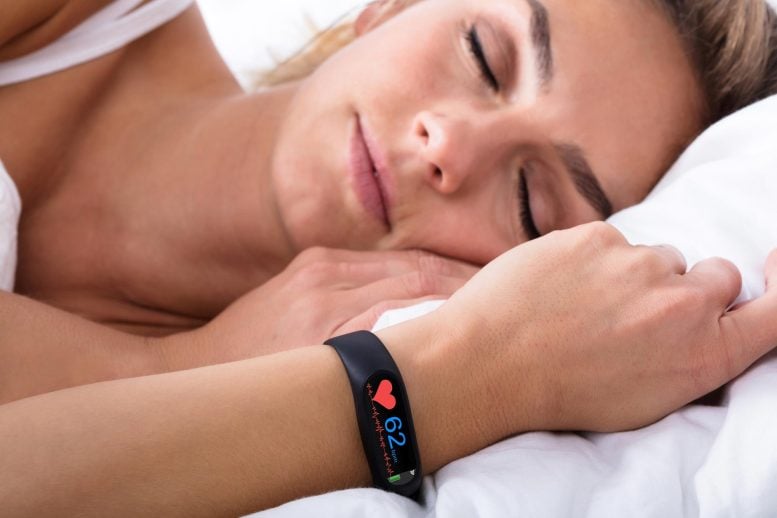
    The researchers discovered notable trends when analyzing the associations between sleep measures and inpatient psychiatric diagnoses.

    Wearable data confirms disrupted sleep as a hallmark of mental illness.

    Multiple measures of sleep patterns and sleep efficiency are associated with lifetime diagnoses of mental illness, according to a new study that used wrist accelerometer data to track sleep. The study is publishing today (October 12th, 2021) in the open-access journal PLOS Medicine by Shreejoy Tripathy of the University of Toronto and the Centre for Addiction and Mental Health (CAMH), Canada, and colleagues.

    Sleep problems are known to be both symptoms of and modifiable risk factors for many psychiatric disorders. In the new study, researchers collected data on 89,205 individuals participating in the UK Biobank study who wore accelerometers on their wrists for 7 days between 2013 and 2015. The accelerometers were used to generate objective data on sleep timing, duration, efficiency, and variability. Data on psychiatric diagnoses – including schizophrenia spectrum disorders, bipolar disorder, major depressive disorder, and anxiety disorders – as well as other health and sociodemographic information was available for all participants, who ranged in age from 43 to 79 and were 56% female.

    The researchers found striking trends when they examined the associations between the sleep measures and inpatient psychiatric diagnoses. Each diagnosis was associated with a mean of 8.5 of the 10 accelerometer-derived sleep measures. Measures of sleep quality, such as sleep efficiency, were generally more affected by psychiatric diagnosis than measures of sleep duration. Effect sizes were small; the largest magnitude effect was observed for the association between sleep efficiency and major depressive disorder. Associations were replicated across ancestries and sexes.

    “Our findings provide a rich clinical portrait of the ways in which sleep can be disrupted across individuals with lifetime mental illness,” the authors say. “This work showcases the capacity of accelerometry to provide detailed, objective sleep measurements at scale, even across cohorts of tens of thousands of individuals.”

    The authors add, “This work showcases the power of wearable devices to provide fine-grained information about how sleep is disrupted in mental illness.”

    Reference: “Association of accelerometer-derived sleep measures with lifetime psychiatric diagnoses: A cross-sectional study of 89,205 participants from the UK Biobank” by Michael Wainberg, Samuel E. Jones, Lindsay Melhuish Beaupre, Sean L. Hill, Daniel Felsky, Manuel A. Rivas, Andrew S. P. Lim, Hanna M. Ollila and Shreejoy J. Tripathy, 12 October 2021, PLOS Medicine.
    DOI: 10.1371/journal.pmed.1003782

    Funding: The authors acknowledge Milos Milic for data curation assistance. MW and SJT acknowledge support from the Kavli Foundation, Krembil Foundation, CAMH Discovery Fund, the McLaughlin Foundation, NSERC (RGPIN-2020-05834 and DGECR-2020-00048) and CIHR (NGN-171423). DF is supported by the Michael and Sonja Koerner Foundation New Scientist Program, Krembil Foundation, CAMH Discovery Fund, and the McLaughlin Foundation. The funders had no role in study design, data collection and analysis, decision to publish, or preparation of the manuscript. This research was conducted under the auspices of UK Biobank application 61530, “Multimodal subtyping of mental illness across the adult lifespan through integration of multi-scale whole-person phenotypes.”

    Never miss a breakthrough: Join the SciTechDaily newsletter.
    Follow us on Google and Google News.

    Mental Health PLOS Psychiatry Sleep Science
    Share. Facebook Twitter Pinterest LinkedIn Email Reddit

    Related Articles

    Scrolling in the Dark: How Screens Steal Sleep and Trigger Teen Depression

    Sleepless Childhood: New Pathway to Psychosis Uncovered

    Melatonin Sleep Aid May Reduce Self-Harm in Young People With Anxiety and Depression

    Deep Sleep Takes Out the Trash: Waste Clearance Is Crucial for Brain Health

    Irregular Sleep Schedules Can Worsen Mood and Increase Risk of Depression

    Study Links Brain Cells to Depression – Brings Hope for Targeted Treatment Options

    Skyrocketing Suicides Were Predicted During First Wave of the COVID-19 Pandemic – Here’s What Johns Hopkins Researchers Actually Found

    Dream Reports During the COVID-19 Pandemic Reflect Mental Suffering and Fear of Contagion

    Psychological Distress: Acute Depression, Stress & Anxiety Higher During Peak of COVID-19 Pandemic

    Leave A Reply Cancel Reply

    • Facebook
    • Twitter
    • Pinterest
    • YouTube

    Don't Miss a Discovery

    Subscribe for the Latest in Science & Tech!

    Trending News

    First-of-Its-Kind Discovery: Homer’s Iliad Found Embedded in a 1,600-Year-Old Egyptian Mummy

    Beyond Inflammation: Scientists Uncover New Cause of Persistent Rheumatoid Arthritis

    A Simple Molecule Could Unlock Safer, Easier Weight Loss

    Scientists Just Built a Quantum Battery That Charges Almost Instantly

    Researchers Unveil Groundbreaking Sustainable Solution to Vitamin B12 Deficiency

    Millions of People Have Osteopenia Without Realizing It – Here’s What You Need To Know

    Researchers Discover Boosting a Single Protein Helps the Brain Fight Alzheimer’s

    World-First Study Reveals Human Hearts Can Regenerate After a Heart Attack

    Follow SciTechDaily
    • Facebook
    • Twitter
    • YouTube
    • Pinterest
    • Newsletter
    • RSS
    SciTech News
    • Biology News
    • Chemistry News
    • Earth News
    • Health News
    • Physics News
    • Science News
    • Space News
    • Technology News
    Recent Posts
    • After Decades, MIT Researchers Capture the First 3D Atomic View of a Mysterious Material
    • Your Favorite Fishing Spot Is Turning Brown – and the Fish Are Changing
    • 380-Million-Year-Old Fish Fossil Reveals Secrets of Life’s First Steps Onto Land
    • Mezcal “Worm” in a Bottle Mystery: DNA Testing Reveals a Surprise
    • Scientists Turn Red Lettuce Green, Unlocking Hidden Nutrients
    Copyright © 1998 - 2026 SciTechDaily. All Rights Reserved.
    • Science News
    • About
    • Contact
    • Editorial Board
    • Privacy Policy
    • Terms of Use

    Type above and press Enter to search. Press Esc to cancel.